Why In News?
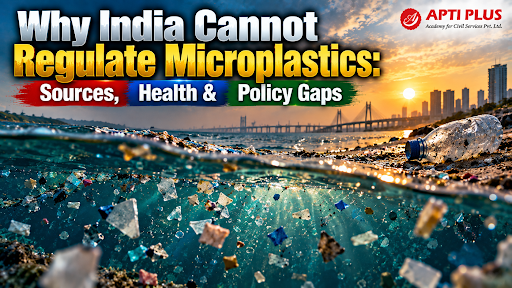
Extensive scientific sampling across India has confirmed that microplastics contaminate food, water, and air nationwide — yet India lacks a unified regulatory framework to address this pervasive pollution.
What are Microplastics?
Microplastics are tiny plastic particles—less than 5 millimetres in size—that originate from the breakdown of larger plastics or are manufactured intentionally for industrial and consumer use.
-
Size Range: Typically 1 nanometre – 5 millimetres wide. Anything smaller than 1 µm is termed nanoplastic.
-
Composition: Made of carbon and hydrogen polymer chains (e.g., polyethylene, polypropylene, polystyrene). Often contain additives like phthalates, PBDEs, and TBBPA, which can leach into the environment.
-
Types:
-
Primary microplastics – manufactured small (microbeads in cosmetics, nurdles in industry, synthetic fibres).
-
Secondary microplastics – formed by weathering and fragmentation of larger plastic items (bags, bottles, tyres, textiles).
-
Non‑biodegradable; remain for centuries, accumulating in soil, water, and living organisms.
Where are Microplastics Found?
Medium |
Findings |
Details |
|
Rivers |
Central Pollution Control Board (CPCB) and Council of Scientific and Industrial Research (CSIR) studies detected 40 – 120 particles/L in the Ganga and Yamuna basins. |
Continuous discharge from sewage, textile effluents, and urban runoff. |
|
Lakes |
Recorded abundantly in Dal Lake, Bhoj Wetland, and Vembanad Lake. |
Inland freshwater bodies act as microplastic reservoirs due to low outflow. |
|
Wetlands |
Sundarbans mudflats show > 200 particles/kg in intertidal sediments. |
Tidal accumulation and mangrove root entrapment enhance retention. |
|
Drinking Water |
Found in municipal piped supplies and bottled water, averaging 10 – 50 particles/500 ml. |
Indicates treatment inefficiency and packaging leachates. |
|
Food (Seafood) |
Heavy bioaccumulation in commercial fishes, crabs, and prawns. |
Marine trophic transfer from plankton to higher organisms. |
|
Salt |
Toxics Link 2024: Microplastics in 100 % of tested sea, rock, and refined salts. |
Evaporative crystallization traps floating plastic fragments. |
|
Sugar |
Laboratory tests found 11.85 – 68.25 pieces/kg across all major brands. |
Contamination during processing and packaging stages. |
|
Air |
Ambient monitoring in Delhi and Mumbai detected inhalable microplastics within PM₂.₅ and PM₁₀. |
Tyre abrasion, textile fibres, and construction dust are major contributors. |
|
Sediments |
Riverbeds and coastal shelves act as long‑term sinks for dense synthetic polymers. |
Persistent deposition forms geological microplastic layers. |
Microplastics are now omnipresent across hydrosphere, atmosphere, and biosphere, revealing a critical regulatory vacuum. Their detection in food, water, and air highlights the need for national monitoring standards and source‑based control mechanisms under the Environment Protection Act and FSSAI guidelines.
What are the Major Sources?
Category |
Scientific Description |
Contribution / Impact |
|
Plastic Waste |
Open burning and unmanaged dumping of 3.4 million tonnes of post‑consumer packaging waste annually. |
Releases secondary microplastics through fragmentation and thermal degradation. |
|
Tyre Wear |
Abrasion of vehicle tyres during road use; particles washed off by stormwater. |
Contributes ≈ 28 % of global aquatic microplastics. |
|
Synthetic Textiles |
Domestic laundry cycles discharge ≈ 700,000 microfibres per 6‑kg wash load. |
Major source of fibrous microplastics in wastewater and rivers. |
|
Plastic Packaging |
Abrasion during manufacturing, capping, and heat‑sealing of containers. |
Directly sheds microscopic fragments into food and beverages. |
|
Industrial Processes |
Accidental spills of virgin resin pellets (nurdles) during synthesis and transport. |
Causes localized contamination near ports and polymer plants. |
|
Degradation of Plastic Products |
Weathering of agricultural mulch films, tarpaulins, and nylon fishing nets. |
Generates secondary fragments in soil and marine environments. |
|
Personal Care Products |
Rinse‑off cosmetics, exfoliants, and detergents containing micro‑polyethylene beads. |
Introduces primary microplastics directly into sewage systems. |
Why are Microplastics Difficult to Regulate?
Multiple Sources: Arise diffusely from transport, textiles, agriculture, and packaging rather than single identifiable industrial effluent pipes.
Different Particle Sizes: Encompass a vast continuum from 5 mm visible particles down to sub-micron nanoplastics (<1 µm).
Different Chemical Composition: Consist of diverse polymer classes (PE, PP, PET, PVC) blended with varied hazardous plasticizers and stabilizers.
Difficult Detection: Demands expensive, highly specialized laboratory infrastructure such as micro-FTIR and Raman Spectroscopy.
Lack of Standardised Testing: Absence of harmonized international sampling protocols prevents legal benchmarking and cross-agency enforcement.
Multiple Regulatory Agencies: Regulatory mandates are fragmented between MoEFCC, CPCB, FSSAI, and the Ministry of Road Transport.
Legacy Pollution: Massive volumes of historical plastic waste already deposited in dumpsites continuously shed microplastics for decades.
What are the Environmental Concerns?
Aquatic Pollution: Suspended particles are ingested by zooplankton and small fishes, causing physical blockages in digestive tracts.
Food-Chain Entry: Biomagnifies through aquatic food chains, passing accumulated synthetic polymers and additives to apex predators.
Marine Ecosystem Damage: Induces cellular inflammation, pseudo-satiation, and reproductive decline in commercial coral and fish species.
Soil Contamination: Agricultural soil accumulation impairs water porosity, suppresses earthworm biomass, and reduces crop root elongation.
Biodiversity Risks: Alters microbial community structures in benthic sediments, disrupting natural nitrogen and carbon mineralization.
Persistent Pollution: Synthetic carbon-carbon polymer bonds take centuries to degrade, creating enduring artificial stratigraphic layers.
What are the Human Health Concerns?
Food Exposure: Direct human ingestion via daily consumption of contaminated salt, processed sugar, seafood, and packaged foods.
Water Exposure: Ingestion through untreated water sources, municipal tap networks, and single-use plastic water bottles.
Inhalation: Inhaling airborne textile fibres and street tyre dust deposits microparticles into deep lung alveoli.
Potential Toxic Effects: Laboratory studies show microplastics can cross cellular membranes, triggering oxidative stress and localized tissue lesions.
Chemical Exposure: Release toxic additives, including endocrine-disrupting phthalates, bisphenol A (BPA), and carcinogenic heavy metals.
Need for Further Research: ICMR and WHO emphasize the critical absence of long-term epidemiological data regarding chronic systemic organ toxicity.
Why are Existing Plastic Rules Not Enough?
Focus on Plastic Waste: The Plastic Waste Management (PWM) Rules 2016 and Extended Producer Responsibility (EPR) 2022 govern macroscopic collection and recycling, ignoring invisible microplastic wear‑and‑tear from daily use.
Limited Control over Tyre Wear: Automotive norms like BS‑VI emission standards regulate tailpipe gases, but completely overlook tyre abrasion, which contributes ≈ 28 % of aquatic microplastics (UNEP 2025).
Limited Control over Synthetic Fibres: No statutory obligation for garment manufacturers or washing‑machine brands to install microfibre filters, despite each wash releasing ≈ 700,000 fibres (IIT Delhi 2025).
Pollution Before Waste Stage: Microplastics detach during product use — tyres rolling, clothes washing, packaging abrasion — before reaching waste bins, escaping PWM oversight.
Source‑Specific Regulation Gap: India lacks legal definitions and threshold limits for diffuse, non‑point microplastic generation, making enforcement impossible under current laws.
No Microplastic Definition in Law: Neither MoEFCC nor CPCB defines microplastics by size, polymer type, or toxicity, preventing classification as a pollutant under the Environment Protection Act 1986.
Absence of Testing Protocols: BIS and CPCB have not finalized standardized sampling and quantification methods, leaving contamination levels unbenchmarked.
Cosmetic Microbeads Loophole: India has no nationwide ban on microbeads in cosmetics and detergents, unlike the EU and US, allowing continuous release into wastewater.
Fragmented Institutional Mandates: Oversight split among MoEFCC, CPCB, FSSAI, MoRTH, and MoHFW, causing jurisdictional overlap and weak coordination.
No Integration with Food Safety Regulations: FSSAI lacks microplastic standards for salt, sugar, seafood, and bottled water, despite confirmed contamination in all major brands.
Lack of Cross‑Sectoral Coordination: Absence of a national microplastics task force linking environment, health, and industry ministries delays unified policy action.
Inadequate Public Awareness: No mandatory labelling or disclosure norms for synthetic products that shed microplastics, limiting consumer‑level accountability.
What Steps Has India Taken?
FSSAI Testing Initiative: Launched national research projects (2025–26) to analyze microplastic concentrations in retail food commodities such as salt, sugar, seafood, and bottled water.
Scientific Research Funding: CSIR institutes, IITs, and MoES funded to map microplastic distribution across coastal, riverine, and urban zones under the National Clean Ganga Mission.
National Green Tribunal (NGT) Intervention: Directed CPCB and MoEFCC to study microplastic levels in rivers and establish baseline data for national monitoring.
Marine Litter Monitoring: National Centre for Coastal Research (NCCR) established marine litter monitoring stations across coastal states to track microplastic flux and composition.
Warning‑Label Debate: Policy discussions underway to mandate cautionary packaging disclosures on microplastic migration in hot food containers and PET bottles.
Removal Technology Pilots: IIT Madras, CSIR‑NEERI, and BITS Pilani testing membrane filtration, bio‑coagulation, and microbial enzyme degradation for microplastic removal from wastewater.
Public Awareness Campaigns: Swachh Vayu Sarvekshan 2026 and Plastic Free India Mission include microplastic awareness modules for schools and municipalities.
International Collaboration: India joined UNEP’s Global Partnership on Plastic Pollution and Marine Litter (GPML) to share data and best practices.
Integration with Blue Economy Policy: Microplastic mitigation included in India’s Blue Economy Vision 2026, linking marine pollution control with sustainable fisheries.
Way Forward
Notifying National Testing Standards: Formulate standardized analytical protocols for detecting microplastics across water, soil, and food matrices.
-
Example: Bureau of Indian Standards (BIS) Water Norms, developing baseline spectroscopic protocols for testing drinking water.
Mandating Built-In Washing Machine Microfibre Filters: Legislate technical mandates requiring consumer washing machines to integrate micro-lint capture units.
-
Example: France’s Anti-Waste Circular Economy Law (AGEC), requiring all new domestic washing machines to contain microfibre filters by 2025.
Regulating Tyre Abrasion and Tread Formulations: Introduce mandatory tyre durability standards and stormwater retention filters along highways.
-
Example: Euro 7 Vehicular Emission Norms, including world-first statutory limits on brake and tyre tread particle emissions.
Upgrading Sewage Infrastructure and Sludge Safety: Install tertiary membrane filtration in municipal STPs and prohibit raw sludge application on cropland.
-
Example: National Mission for Clean Ganga (NMCG) Advanced STPs, piloting membrane ultrafiltration to prevent urban micro-pollutant discharge.
Broadening Extended Producer Responsibility (EPR): Expand the EPR framework to hold synthetic textile and automotive tyre producers financially liable for pollution.
-
Example: Plastic Waste Management (Amendment) Rules, 2022, laying down statutory EPR targets that can be widened to synthetic textiles.
Conclusion
Shifting from post-consumption plastic waste management to source-specific lifecycle regulation is essential to prevent irreversible microplastic accumulation in Indian ecosystems.
Source: DOWNTOEARTH
|
PRACTICE QUESTION Q. Explain the differences between primary and secondary microplastics, and evaluate the systemic challenges in monitoring them across Indian river systems. (10 Marks, 150 Words) |