Why In News?
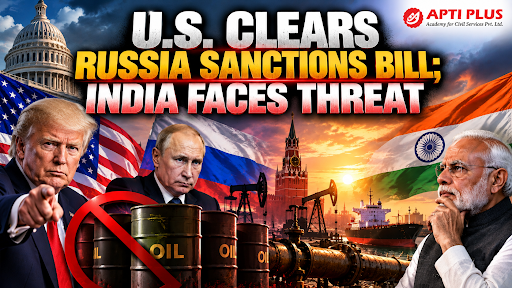
The US House of Representatives passed the Lindsey O. Graham Sanctioning Russia and Iran Act 2026, authorizing US President Donald Trump to impose secondary tariffs of up to 100% on nations purchasing Russian crude oil and natural gas
What is the Lindsey O. Graham Sanctioning Russia and Iran Act?
Sanctions on Russia: Targets Russian leaders, financial institutions, energy entities, and the Shadow Fleet of oil tankers facilitating Russian crude deliveries worldwide.
Sanctions on Iran: Integrates a 5-Year Extension of Iran sanction authorities into a unified secondary sanctions framework targeting energy exports and clearing mechanisms.
Secondary Tariffs: Authorizes secondary tariffs of up to 100% on goods imported from the top five foreign purchasers of Russian crude oil and natural gas, specifically targeting China, India, Brazil, Turkiye, and South Africa.
Presidential Powers: Grants the US President discretionary authority to enforce, adjust, or waive duties based on national security determinations rather than automatic triggers.

Why is India Importing Russian Oil?
Discounted Russian Crude: Following European sanctions in late 2022, Russian Urals crude traded at discount relative to Brent, yielding $13 Billion in cumulative import bill savings for Indian refiners across FY2022–23 and FY2023–24.
Energy Security: Secures an essential, cost-effective energy supply to shield 1.4 Billion citizens from global price shocks and market volatility.
-
Russia accounted for more than 51% of India’s oil imports in July 2026.

Large Domestic Oil Demand: India consumes 5.5 Million Barrels Per Day against stagnant domestic crude production of 0.65 Million Barrels Per Day, resulting in a record crude import dependency of 88.6%.
Diversification of Supply Sources: Broadens India's crude import slate across 40 Countries, routing approximately 70% of imports through corridors outside the Strait of Hormuz.
How Could the 100% Tariff Affect India?
Indian Exports to the U.S.: Exposes $86.5 Billion in annual Indian merchandise exports targeting the US market—including $42.8 Billion recorded between April and August 2026—to punitive duties.
Export Competitiveness: Prohibitive secondary duties would severely erode price competitiveness across labor-intensive sectors such as textiles, gems and jewelry, leather, footwear, smartphones, and pharmaceuticals.
Trade Diversion: Accelerates structural trade reorientation toward the European Union under the newly concluded EU-India Free Trade Agreement, which is projected to expand Indian exports to Europe by 41%.
Pressure on Exporters: Compresses industrial profit margins, triggers factory slowdowns, and disproportionately penalizes the unskilled domestic labor market.
India-U.S. Trade Negotiations: Washington uses secondary tariff threats as coercive leverage during bilateral trade talks to demand market access concessions in digital services, data centers, and agricultural import duties.
Supply-chain Disruptions: Induces systemic shocks across global supply chains, raising compliance burdens and freight insurance costs for international traders.
Why is Russian Oil Important for India?
Large Import Dependence: India relies on foreign imports for 88% to 89% of its crude requirements, making access to competitively priced energy vital for economic survival.
Refinery Requirements: A technical Refinery Lock-In makes substituting Urals crude with lighter Arabian or Atlantic grades inefficient, causing operational throughput drop-offs and margin compression.
Price Advantage: Discounted Urals crude directly lowers the national trade deficit and protects refining margins across state-owned and private refiners.
Stable Supply: Serves as a non-Hormuz supply hedge against West Asian geopolitical escalation and maritime chokepoint blockades.
Energy Security: Maintains uninterrupted domestic fuel availability for agricultural transport, freight logistics, and industrial manufacturing.
Current Account Pressure: Prevents severe macro-currency shocks, as every $10 Per Barrel increase in international crude prices widens India's Current Account Deficit (CAD) by $9 Billion or 0.4% of GDP.
Market Realities: Replacing Russian crude completely could be difficult because of limited alternative supplies and higher costs, according to industry assessments reported after the latest U.S. legislative move.
-
Replacing 2 Million Barrels Per Day of Russian crude is unviable when spot physical cargoes trade at $130–$140 Per Barrel and global oil supply contracts by 5.7 Million Barrels Per Day.
Possible Economic Effects of 100% Tariff on India
Higher Import Costs: Sourcing replacement crude from global spot markets at elevated prices expands India's annual crude import bill significantly above its baseline.
Inflationary Pressure: Pass-through procurement costs increase domestic transport and logistics expenses, raising the Consumer Price Index (CPI) by 3 to 4 Percentage Points.
Petroleum Product Prices: Escalates retail prices for petrol, diesel, and LPG, eroding household purchasing power across 300+ Million domestic connections.
Trade Deficit: Expands the national merchandise trade deficit through accelerated foreign exchange outflows for crude procurement.
Current Account Balance: Induces severe Current Account Deficit (CAD) expansion and triggers a 12% to 18% depreciation pressure on the Indian Rupee (INR).
Export Losses: Imposition of punitive 100% tariffs would collapse Indian textile exports to the US by 76%, machinery exports by 61%, and electronics exports by 36%.
Manufacturing Costs: Higher input energy prices compress industrial gross margins, reducing overall manufacturing output and value addition.
Fiscal Pressure: Elevates government fuel subsidy burdens and oil marketing company under-recoveries if retail price hikes are state-absorbed.
Geopolitical Implications for India
India-U.S. Strategic Partnership: Introduces friction into bilateral trade and security dialogues between New Delhi and Washington, testing the boundaries of the strategic alliance.
India-Russia Relations: Sustains strategic, defense, and nuclear cooperation—including the Kudankulam Nuclear Power Plant and BrahMos Missile Programme—while expanding non-dollar Rupee-Ruble settlement mechanisms via Special Vostro Accounts.
Strategic Autonomy: Reaffirms India's foundational foreign policy principle of Strategic Autonomy, refusing to allow foreign legislative trade measures to dictate sovereign energy choices.
Energy Diplomacy: Positions India as a pragmatic geoeconomic actor balancing relations across Western markets, OPEC+ producers, and Russian suppliers.
Multipolar World Order: Strengthens momentum toward de-dollarization and non-aligned economic cooperation within BRICS and Global South institutional frameworks.
Global Energy Markets: Indian absorption of Russian crude prevents global supply deficits and wards off international oil price spikes above $120–$140 Per Barrel.
Sovereign Positioning: India has indicated that its energy choices are guided by national priorities and has warned that the U.S. tariff measures could affect bilateral relations.
Way Forward For India
Diversify Oil Suppliers: Expand procurement from non-Hormuz producers across West Africa (Nigeria, Ghana), Latin America (Brazil, Venezuela, Guyana), and the United States to reduce chokepoint reliance.
Expand Strategic Petroleum Reserves: Fast-track Phase II Strategic Petroleum Reserves (SPR) expansions at Padur (2.5 Million Metric Tonnes) and Chandikhol (4 Million Metric Tonnes) to extend strategic crude buffers beyond the current 9.5-Day cover.

Increase Domestic Exploration: Accelerate deepwater and Category-II Basin exploration under the Samudra Manthan Scheme with an outlay of ₹84,084 Crore through state entities like Oil and Natural Gas Corporation (ONGC) and Oil India Limited (OIL).
Promote Electric Mobility: Accelerate Electric Vehicle (EV) adoption across commercial freight and private transport fleets under the PM E-DRIVE Scheme to reduce daily hydrocarbon consumption.
Expand Clean Energy: Scale green hydrogen, utility-scale Battery Energy Storage Systems (BESS), and the ₹37,500 Crore National Coal Gasification Mission to convert 100 Million Metric Tonnes of coal into syngas by 2030.
Improve Energy Efficiency: Implement Artificial Intelligence (AI)-driven smart grid management, demand response mechanisms, and efficiency standards under the Draft National Electricity Policy 2026.
Expand Renewable Energy: Execute the National Green Hydrogen Mission with a financial outlay of ₹19,744 Crore under the Strategic Interventions for Green Hydrogen Transition (SIGHT) Programme to produce 5 Million Metric Tonnes Per Annum and substitute grey hydrogen in refineries.
Strengthen Trade Negotiations: Engage Washington to secure national interest waivers under Section 113 of the Sanctioning Russia and Iran Act of 2026 while finalizing comprehensive Free Trade Agreements (FTA) with the European Union (EU) and the United Kingdom (UK).
Develop Alternative Export Markets: Reorient labor-intensive export flows toward Europe, the Middle East, and Latin America to hedge against US market shocks and secondary tariff threats.
Preserve Strategic Autonomy: Uphold a sovereign, interest-based foreign policy that balances complex geopolitical realities with national economic security for 1.4 Billion citizens.
Conclusion
India must resist external tariff coercion by expanding strategic petroleum reserves, institutionalizing local currency trade architecture, and accelerating clean energy transitions under the National Green Hydrogen Mission to safeguard long-term energy sovereignty.
Source: INDIANEXPRESS
|
PRACTICE QUESTION Q. Examine how the US Sanctioning Russia and Iran Act of 2026 exposes India's geoeconomic trilemma between strategic autonomy, energy affordability, and export market access. 250 words |