Why In News?
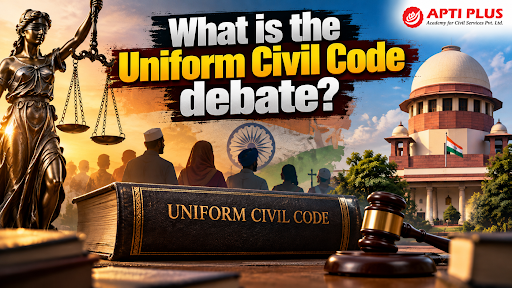
The Union Home Minister announced that a UCC will be implemented across all National Democratic Alliance (NDA)-ruled states by 2029.
What is the Uniform Civil Code?
The Uniform Civil Code is a single, common set of secular civil laws governing personal and private family matters for all citizens across India, replacing community-specific rules based on religious scriptures and customary traditions.
Uniform Civil Laws: While India possesses uniform codified laws for criminal offenses, contracts, evidence, and commercial transactions, personal civil matters remain fragmented along religious lines.
Personal Laws: These are community-specific legal systems derived from religious texts or customs that regulate familial status and private rights.
Marriage and Divorce: A UCC standardizes the minimum age of marriage (18 years for females, 21 years for males), mandates registration, prohibits polygamy/bigamy, and establishes uniform fault-based and mutual-consent divorce grounds.
Inheritance and Succession: It establishes equal inheritance and coparcenary property shares for sons, daughters, and widows, removing gender disparities inherent in traditional inheritance systems.
Adoption and Related Civil Matters: It extends secular, gender-neutral adoption rights to all citizens (overcoming Sharia limitations on formal adoption), codifies maintenance rights, and regulates informal cohabitation arrangements.
Constitutional Basis of UCC
|
How Does India Currently Regulate Personal Laws?
Hindu Personal Laws: Codified through four statutes in 1955–56—the Hindu Marriage Act (1955), Hindu Succession Act (1956), Hindu Minority and Guardianship Act (1956), and Hindu Adoptions and Maintenance Act (1956)—which also apply to Buddhists, Jains, and Sikhs.
Muslim Personal Law: Primarily governed by uncodified Shariat principles under the Muslim Personal Law (Shariat) Application Act, 1937 and the Dissolution of Muslim Marriages Act, 1939.
Christian Personal Laws: Regulated by statutory enactments including the Indian Christian Marriage Act, 1872 and the Indian Divorce Act, 1869.
Parsi Personal Laws: Governed by the Parsi Marriage and Divorce Act, 1936.
Customary Laws: Protected customary family practices apply across indigenous Scheduled Tribes under constitutional safeguards such as Article 371 and the Sixth Schedule.
Special Civil Laws: The Special Marriage Act, 1954 provides an opt-in secular civil framework for inter-faith or elective civil unions, with property succession routed through the secular Indian Succession Act, 1925.
UCC Status in India
|

Dimension |
Core Issue |
Constitutional Provision |
Arguments For |
Arguments Against |
|
Equality before Law |
Replace varied religious personal laws with identical standards |
Article 14 (Equality) |
Ensures equal treatment of all citizens; removes legal pluralism |
Risks ignoring community‑specific needs; may impose majority norms |
|
Gender Justice |
Address discrimination in divorce, alimony, guardianship, inheritance |
Articles 15 & 16 (Non‑discrimination) |
Promotes women’s rights; curbs patriarchal practices |
Resistance from conservative groups; fear of disrupting family traditions |
|
Religious Freedom |
Whether civil family laws fall under protected religious practices |
Article 25 (Freedom of Religion) |
State can regulate secular aspects of religion; prioritises civil rights |
Seen as infringement on religious autonomy; may trigger communal tensions |
|
Cultural Diversity |
Balancing uniformity with India’s plural traditions |
Preamble (Unity in Diversity) |
Creates common civil identity; strengthens national integration |
Could erode cultural pluralism; homogenisation of diverse practices |
|
Individual Rights & Autonomy |
State intervention vs. privacy in family matters |
Article 21 (Right to Privacy & Liberty) |
Protects individuals from discriminatory customs; ensures dignity |
Compulsory registration may feel intrusive; limits personal choice |
|
Uniformity vs. Diversity |
Identical textual rules vs. outcome‑focused harmonisation |
Directive Principles (Article 44) |
Uniformity simplifies law; reduces litigation |
Harmonisation preferable to rigid uniformity; respects diversity |
What are the Key Legal Issues?
Article 44 versus Fundamental Rights: Navigating the legal relationship between non-enforceable DPSPs and enforceable Part III rights.
Personal Law and Religious Freedom: Applying the Essential Religious Practices (ERP) doctrine to separate reformable secular civil acts from protected religious tenets.
Legislative Competence: Entry 5 of the Concurrent List (List III, Seventh Schedule) grants dual competence over marriage, divorce, adoption, and succession to both Parliament and State Assemblies.
Presidential Assent & Repugnancy under Article 254: Under Article 254(2), a state UCC receiving Presidential Assent prevails over conflicting central laws within that state.
Judicial Review: Testing mandatory live-in registration rules and state surveillance provisions against Article 21 privacy and autonomy guarantees (Indra Sarma v. V.K.V. Sarma).
Interstate Conflicts & State-Level Uniformity: Assessing whether distinct state codes undermine territorial civil uniformity.
What are the Major Challenges?
Diverse Religious Practices: Resolving deep scriptural and customary differences across communities.
Tribal and Customary Laws: Balancing tribal exemptions against non-discrimination claims by non-tribal minority groups.
Constitutional Balancing: Protecting religious freedom while enforcing constitutional morality and non-discrimination.
Social Consensus: Preventing feelings of majoritarian coercion among minority groups.
Legal Harmonisation: Addressing structural gaps—such as the Hindu Undivided Family (HUF) tax-entity structure under the Income Tax Act, 1961, which state UCCs leave intact.
Administrative Implementation: Managing existing case pendency in Family Courts (established under the Family Courts Act, 1984) and operating digital registration portals.
Way Forward
Broad Stakeholder Consultation: Conducting transparent, pre-legislative meetings with women's groups, minority bodies, and sociologists before publishing draft codes.
Gender-neutral Civil Rights: Standardizing core civil rights—including a uniform marriage age (18/21 years), no-fault divorce, and equal inheritance.
Protection of Constitutional Rights: Ensuring civil codes respect decisional privacy and individual liberty under Article 21.
Respect for Legitimate Cultural Practices: Preserving ceremonial marriage forms while requiring non-negotiable equality in legal outcomes.
Evidence-based Legal Reform: Establishing a National Family Law Reform Dashboard to track maintenance enforcement, conviction rates, and gender parity indices.
Protection of Tribal Customs: Respecting indigenous customary frameworks protected under Article 371 and the Sixth Schedule.
Gradual Legal Harmonisation: Following the 21st Law Commission's 2018 Recommendation to prioritize achieving "equality within communities" by reforming discriminatory provisions within personal laws before imposing an overarching uniform code.
Conclusion
The Uniform Civil Code must evolve not as an instrument of coercive cultural homogenisation, but as a reconciliatory framework that harmonizes gender justice under Article 14 with pluralistic autonomy under Articles 25–30.
Source: THEHINDU
PRACTICE QUESTIONQ. Critically analyze the tension between Constitutional Morality under Article 14 and religious freedom under Article 25 in the context of personal law reforms in India. 250 words |