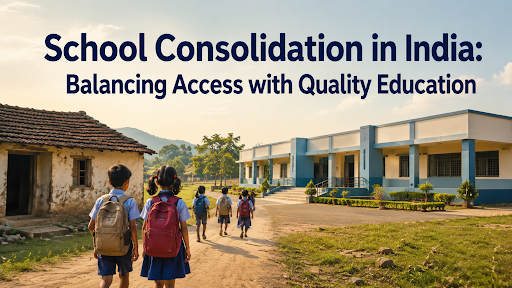
Why In News?
A NITI Aayog report reveals that nearly 94,000 government schools were closed in the last decade, averaging 25 closures per day, sparking a nationwide debate on school rationalisation versus the right to education.
What is School Consolidation?
School consolidation (or school rationalisation) is the process of merging two or more low-enrolment government schools into a larger institution or School Complex, enabling the sharing of teachers, laboratories, libraries, sports facilities and digital infrastructure.
The concept is rooted in the School Complex/Cluster framework proposed by the National Education Policy (NEP), 2020 to improve educational quality through resource optimisation.
However, it raises concerns regarding the neighbourhood school principle under the Right of Children to Free and Compulsory Education (RTE) Act, 2009, which guarantees elementary schooling within prescribed distances to ensure equitable access.

Why are Government Schools Being Consolidated?
Declining enrolment: Falling fertility, migration to private schools and demographic changes have left many government schools with extremely low enrolment.
-
The UDISE+ 2023–24 report reveals that 56.7% of schools in India operate with fewer than 100 students, with approximately 4.6% (over 67,000 schools) functioning with fewer than 10 students.
Addressing teacher shortages: India has 1.17 lakh single-teacher government schools, with Madhya Pradesh (16,630), Andhra Pradesh (12,386) and Rajasthan (10,878) accounting for the highest numbers.
-
Consolidation enables subject-specific teacher deployment and reduces multi-grade teaching.
Improving learning outcomes: The ASER 2024 findings highlight foundational learning deficits in rural India: Only 23.4% of Class 3 government school students can read a Class 2 text, and major regional divides remain.
-
Larger school complexes enable peer learning, specialised teaching and better academic support, improving classroom outcomes.
Efficient use of public resources: Maintaining separate buildings, staff and utilities for very small schools leads to high per-student expenditure.
-
The NEP 2020 recommends School Complexes to optimise public investment while improving educational quality.\
Strengthening multidisciplinary education: School complexes facilitate shared access to art, sports, vocational training, counselling, and digital infrastructure.
-
This aligns with the National Curriculum Framework (NCF) 2023 by enabling holistic and experiential learning across clusters.

Key Features of the Consolidation Model
Cluster-Based Schooling: Groups neighbouring schools into a School Complex/Cluster hub within a 5–10 km radius, optimizing governance and resources.
Shared Academic Resources: Labs, libraries, ICT, sports, vocational facilities, and special educators are shared across schools, reducing duplicate expenditure.
Transportation Support: States must provide safe and free transport or mobility tools to preserve school access for younger children and girls.
Technology-Enabled Learning: Hub schools feature smart classrooms, ICT labs and digital infrastructure, enabling hybrid learning and cluster-wide teacher sharing.
Teacher Rationalisation: Deploys subject-specific teachers, counsellors, and special educators based on actual enrolment rather than school-wise sanctions.
Improved School Governance: Introduces School Complex Management Committees, improving academic planning, monitoring and community participation.
Challenges of School Consolidation
Reduced accessibility: Closing neighbourhood schools violates the Right to Education (RTE) Act, 2009, which mandates a primary school within 1 km and an upper primary school within 3 km of residences.
Longer travel distance: In Jammu & Kashmir, many children reportedly travel 4–6 km after school mergers, increasing absenteeism and fatigue.
-
The Rajya Sabha Department-related Parliamentary Standing Committee recommended that school consolidation should not violate neighbourhood school norms and must be supported by transport facilities and impact assessments.
Higher dropout risk: Longer commutes disproportionately affect children in remote habitations, increasing the probability of irregular attendance and dropouts.
Gender dimension: Safety concerns, lack of transport and social norms make girls more vulnerable to dropping out after consolidation.
Impact on tribal and hilly regions: Uniform consolidation norms ignore geographical realities where rivers, forests and hilly terrain make even 2–3 km difficult for young children.
Equity concerns: NSS 2019 indicates relatively lower access to free education among SC, ST and Muslim households, implying that consolidation without safeguards can widen educational inequality.
Teacher rationalisation without quality improvement: School mergers often redistribute teachers but do not automatically improve learning outcomes unless accompanied by teacher training and pedagogical reforms.
Administrative focus over learning: Consolidation is frequently driven by enrolment efficiency rather than measurable improvements in learning outcomes, contrary to the outcome-based approach under NEP 2020.
Way Forward
Evidence-based consolidation: NITI Aayog's 2026 School Education Report recommends evidence-based rationalisation, supported by district-level planning rather than blanket consolidation.
Mandatory impact assessment: The Rajya Sabha Department-Related Standing Committees (DRSCs) recommended mandatory impact assessments, student tracking and transport assistance before approving any school closure.
Strengthen community participation: Implement the School Management Committee (SMC) Guidelines, 2026 to ensure local communities participate in consolidation decisions and monitor student retention.
Context-specific norms: Adopt differentiated consolidation criteria for tribal, aspirational, border, island and conflict-affected districts, consistent with the flexibility under NEP 2020.
Outcome-based monitoring: Evaluate consolidation using UDISE+, PARAKH Rashtriya Sarvekshan, ASER and NAS indicators instead of relying only on enrollment or administrative efficiency.
Technology-enabled access: Expand PM eVIDYA, DIKSHA and digital classrooms to support remote schools where physical consolidation may undermine access.
Learn from Karnataka Model: School rationalisation combined mergers with transport and infrastructure upgrades in several districts, highlighting that consolidation is more effective when complemented by investments in accessibility rather than treated as a standalone administrative.
Conclusion
School consolidation can raise educational quality, but only if India protects the RTE's neighbourhood school promise with safe transport and community oversight — else efficiency will come at the cost of a poor child's access to school.
Source: INDIANEXPRESS
PRACTICE QUESTIONQ. School rationalisation aims to improve educational quality, but it risks undermining the constitutional promise of accessible education. Discuss (250 words) |