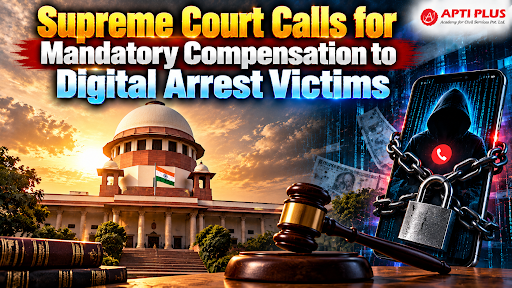
Why In News?
The Supreme Court bench led by Chief Justice of India Surya Kant directed the Reserve Bank of India (RBI) to ensure that its upcoming regulatory framework holds commercial banks strictly accountable for digital arrest resulting from institutional due diligence failures.
What Is Digital Arrest?
A digital arrest is a cyber-enabled extortion scam where cyber syndicates place victims under synthetic detention and surveillance through audio-video calls, having no legal status under Indian criminal law.
-
Fake Police and CBI Officials: Fraudsters impersonate senior officers of state police units and the Central Bureau of Investigation (CBI), using authentic uniforms and fabricated studio backdrops.
-
Impersonation of ED and Other Government Agencies: Criminals pose as high-ranking officials from the Enforcement Directorate (ED), narcotics departments, and customs authorities to fabricate grave allegations of money laundering and narcotics smuggling.
-
Fraud through Video Calls: Perpetrators exploit encrypted video communication applications such as WhatsApp and Skype, compelling targets to remain in continuous camera view to enforce visual confinement.
-
Threats of Arrest and Property Seizure: Con-artists subject victims to intimidation, threatening immediate physical arrest, public humiliation, asset freezing, and property attachment.
-
Forged Supreme Court Orders: Fraudsters display forged judicial warrants, counterfeit search notices, and fabricated orders bearing forged seals and signatures of the Chief Justice of India to establish deceptive authority.
-
Forced Digital Money Transfers: Scammers coerce victims into liquidating mutual funds, term deposits, and savings, transferring balances into bogus "safe government escrow accounts" for purported financial verification.
-
Psychological Manipulation and Fear: Operatives induce acute cognitive shock and panic, creating a state of waking hypnosis that impairs independent decision-making and isolates targets from family or legal counsel.
What Is The Scale Of Digital Arrest Fraud In India?
Authorities logged over 21,900 complaints of digital arrest fraud nationwide between January 1 and August 31, 2026. (Source: Cyber Crime Coordination Centre Status Report)
-
Registered digital arrest cases during this eight-month window accounted for direct financial extortion exceeding ₹647 crore.
-
Cyber fraud syndicates executed large-scale extortions leading to aggregate economic damages exceeding ₹3,000 crore.
-
Judicial interventions and coordinated law enforcement crackdowns resulted in an estimated 50% decline in overall cyber fraud instances compared to prior periods.
-
Senior Citizens as Major Targets: Cybercrime rings systematically target pensioners, retired public servants, and elderly savers due to their substantial accumulated lifetime savings and unfamiliarity with digital policing procedures.
-
Organised Cybercrime Networks: Highly structured crime syndicates deploy call centers, multi-layered digital communication rings, and automated call-spoofing technology to execute systematic extortion.
-
Cross-Border Financial Fraud: Syndicates coordinate transnational crime conduits that siphon illicit capital from domestic accounts into offshore jurisdictions via cryptocurrency conversions and foreign shell operations.
What Is The Supreme Court's Proposal?
Mandatory Compensation by Banks: The Supreme Court proposed that commercial banks must be legally mandated to indemnify victims of digital arrest whenever fraud occurs due to bank lapses.
Compensation Equivalent to the Victim's Financial Loss: The court mandated that restitution must be an indemnification of not less than the full amount lost by the account holder, ensuring zero debit on the victim's ledger.
Strict Liability for Financial Institutions: The apex court benchmarked a strict civil liability doctrine, holding that weaknesses in banking delivery systems make financial institutions strictly liable regardless of customer-level authorization.
Accountability for Failure of Due Diligence: Institutions that fail to exercise proper KYC oversight, overlook transaction deviations, or facilitate mule operations must bear direct financial accountability.
Prosecution of Bank Officials Involved in Collusion: The bench directed that banking employees and managers who facilitate, collude with, or negligently overlook fraudulent account operations must face criminal prosecution.
Mandatory Suspension of Suspicious Transactions: Core banking engines must temporarily freeze and hold abnormal transactions that sharply deviate from an account holder's established historical patterns.
Automated Reporting of Unusual Transactions: Banking systems must deploy automated alert protocols to flag out-of-pattern transfers without waiting for human batch auditing.
Physical Verification of High-Risk Transactions: Unusual fund transfers from vulnerable accounts must undergo mandatory written confirmation or physical verification before release.
Alerting Local Police Authorities: Commercial banks must automatically dispatch electronic alerts to the nearest jurisdictional police station the moment an abnormal high-value transaction is withheld.
RBI Oversight of Financial Institutions: The RBI must submit a comprehensive list of all authorized financial institutions and enforce these binding preventive guidelines across the banking sector without requiring case-by-case court impleadment.
Why Should Banks Be Held Accountable?
|
Existing Framework For Tackling Digital Arrest Fraud
Legal Provisions
-
Information Technology Act, 2000: Section 66D prescribes punishment for cheating by personation through computer resources and communication devices.
-
Bharatiya Nyaya Sanhita, 2023 (BNS):
-
Section 318: Prescribes penal liability and imprisonment for criminal cheating and dishonestly inducing delivery of property.
-
Section 319: Penalizes cheating by personation, covering criminals who pose as public officers and magistrates.
-
Section 336: Punishes the offense of forgery, penalizing the creation of false documents to commit fraud.
-
Section 338: Prescribes severe punishment for the forgery of valuable securities, judicial orders, and official agency warrants.
-
Section 340: Penalizes the fraudulent and dishonest use of forged documents as genuine.
-
Prevention of Money Laundering Act, 2002 (PMLA): Empowers enforcement authorities to trace, freeze, and attach criminal proceeds routed through domestic and offshore bank accounts.
-
Bharatiya Nagarik Suraksha Sanhita, 2023 (BNSS): Governs procedural criminal justice and lawful detention, establishing that custody requires physical execution, disclosure of arrest grounds, and formal documentation, thereby rendering virtual arrests legally void.
Institutional Framework
-
Ministry of Home Affairs (MHA): Serves as the nodal central ministry spearheading the national strategy and executive apparatus against cyber-enabled financial crimes.
-
Indian Cyber Crime Coordination Centre (I4C): Functions as an institutional framework under the MHA to coordinate cross-agency responses against organized cyber fraud.
-
National Cyber Crime Reporting Portal (NCRP): Operates as the centralized digital interface allowing citizens to formally report cybercrimes, identity theft, and online extortion.
-
Reserve Bank of India (RBI): Formulates statutory banking directives, monitors payment security protocols, and audits anti-fraud compliance.
-
Indian Computer Emergency Response Team (CERT-In): Functions as the national agency under the Information Technology Act, 2000 for collecting, analyzing, and responding to cybersecurity incidents.
-
Financial Intelligence Unit-India (FIU-IND): Coordinates financial intelligence gathering, analyzes suspicious transaction reports, and monitors money laundering networks.
-
Central Bureau of Investigation (CBI): Executes pan-India coordinated probes and cross-border investigations against transnational digital arrest syndicates.
-
State Cyber Crime Police: Investigates regional cyber incidents, registers FIRs, and coordinates local enforcement under the authority of state Directors General of Police (DGPs).
-
National Payments Corporation of India (NPCI): Operates retail payment and settlement systems, implementing transaction filters across UPI and IMPS networks.
-
National Critical Information Infrastructure Protection Centre (NCIIPC): Designated national agency for protecting critical digital infrastructure across banking, financial, and telecommunication backbones.
What Are The Major Challenges?
Social Engineering and Psychological Manipulation: Syndicates exploit fear of legal disgrace, using aggressive cognitive pressure to induce compliance before victims can verify claims.
Fear of Arrest and Legal Consequences: The intense social stigma associated with criminal prosecution compels law-abiding individuals to prioritize secret financial settlements over consulting police.
Cross-Border Cybercrime Networks: Extortion rings frequently operate from overseas jurisdictions, creating legal and diplomatic hurdles for extradition and physical apprehension.
Money Mules and Multiple Bank Accounts: Fraudsters purchase or rent thousands of mule accounts from low-income individuals to rapidly split, layer, and launder stolen balances.
-
Example: Delhi Police Janakpuri Cyber Cell Investigation (2026), unmasked an organized syndicate utilizing a fraudulently verified mule account in Yamuna Vihar to siphon ₹2.10 crore from a single victim within hours.
Delayed Reporting of Fraud: Victims report extortions days or weeks after the event due to prolonged digital confinement, allowing funds to clear the financial system before tracing begins.
Difficulty in Recovering Transferred Money: Fraud proceeds are rapidly withdrawn via ATMs, split across layered payment gateways, or converted into untraceable cryptocurrencies within minutes.
Weak Coordination Among Banks and Police: Fragmented information exchange between commercial bank compliance desks and district cyber police cells delays urgent account freezes.
-
Example: I4C Status Report (2026), documented that despite the recording of 21,900 complaints involving ₹647 crore, cyber syndicates successfully siphoned over ₹800 crore into untraceable cash and crypto off-ramps.
Limited Cyber Investigation Capacity: State police units and local stations frequently lack advanced forensic tools, specialized tracing software, and trained cyber personnel.
Misuse of Digital Communication Platforms: Instant messaging applications facilitate prolonged end-to-end encrypted video calls and display fake caller identities without proactive platform-level interception.
-
Example: Meta-owned WhatsApp informed the Supreme Court that it banned over 9,400 accounts linked to digital arrest and law enforcement impersonation scams over a 12-week period starting in January 2026
Lack of Effective Transaction Monitoring: Commercial banks routinely fail to employ automated AI systems capable of freezing abnormal, out-of-character transfers from retail accounts in real time.
Way Forward
Statutory Strict Liability and Zero-Debit Victim Restitution: The Reserve Bank of India (RBI) must mandate that commercial banks fully compensate digital arrest victims if institutional due diligence fails.
-
The upcoming Reserve Bank of India (Know Your Customer) Amendment Directions, 2026 must enforce zero debit on victim accounts and penalize colluding bank officials.
Mandatory Dynamic Cooling-Off Periods and Lag-Credit Mechanisms: The Reserve Bank of India must operationalize a mandatory cooling-off protocol under Section 35A of the Banking Regulation Act, 1949, temporarily halting out-of-pattern high-value transfers from retail savings accounts.
-
Example: RBI Digital Payment Safeguards Lag-Credit Policy Model (2026), enforces a mandatory algorithmic holding window on sudden large-value RTGS and NEFT transfers, requiring dual-factor biometric or physical verification before clearing.
Automated Real-Time Anomaly Flagging and Law Enforcement Integration: Banking core platforms must integrate Artificial Intelligence (AI) models to continuously evaluate behavioral divergence, automatically relaying alerts to the Indian Cyber Crime Coordination Centre (I4C) and local jurisdictional police.
-
Example: Ministry of Home Affairs Citizen Financial Cyber Fraud Reporting and Management System (CFCFRMS / Helpline 1930), which facilitated fund recovery and restoration in over 11 lakh cases across India.
Aggressive Elimination and Freezing of Mule Accounts: The central bank and commercial lenders must enforce stringent address verification and transaction scrutiny to identify and close mule accounts that crime networks use to layer, split, and launder extorted money.
-
Example: Inter-Departmental Cyber Fraud Committee SOP on Mule Accounts, an operational mandate requiring state Directors General of Police (DGPs) and banks to track First Information Reports (FIRs), share intelligence, and shut down fraudulent accounts across all states and Union Territories.
Enforceable Strict Liability Regime for Intermediaries: Telecom operators and messaging platforms must face statutory penalties under the Information Technology (Intermediary Guidelines and Digital Media Ethics Code) Rules, 2021 for failing to filter bulk cybercrime calls and fake caller IDs.
-
Example: Department of Telecommunications (DoT) Sanchar Saathi Portal and Chakshu Facility, utilized for crowdsourced reporting of suspicious communications and the nationwide blocking of fraudulent mobile connections and forged International Mobile Equipment Identity (IMEI) numbers.
Strengthening Public Verification Channels: Awareness initiatives must shift toward empowering citizens with verifiable authentication tools, enabling individuals to check official judicial portals to immediately verify purported arrest warrants, search notices, or court orders.
-
Example: e-Courts Case Status Portal and National Judicial Data Grid (NJDG), a public digital utility enabling instant cross-verification of authentic judicial orders to counter fabricated warrants used by cyber syndicates.
Institutionalized Zero-Debit Victim Restitution Protocols: Enacting a statutory guarantee ensuring zero liability for account holders where fraudulent transfers occurred through unflagged institutional lapses.
-
Example: UK Contingent Reimbursement Model (CRM Code), an international statutory benchmark mandating payment service providers to automatically reimburse authorized push payment fraud victims within five business days unless gross negligence is legally proven.
Conclusion
Holding financial institutions strictly liable and deploying automated algorithmic circuit-breakers are indispensable to eliminate digital arrest scams and safeguard citizens' fundamental right to financial liberty under Article 21 of the Constitution of India.
Source: THEHINDU
|
PRACTICE QUESTION Q. The increasing incidence of digital arrest fraud highlights the need to shift from a reactive approach to a preventive and accountability-based banking regulatory framework. Discuss. 250 words |