Why In News?
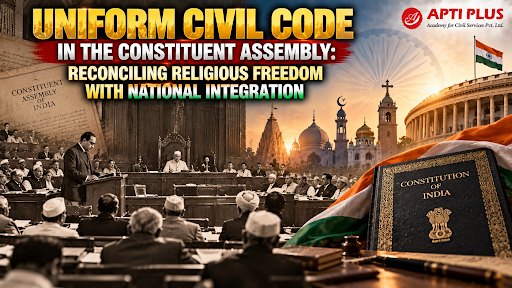
Debates on the Uniform Civil Code (UCC) highlight the November 1948 Constituent Assembly discussions on balancing secularism, religious autonomy, and gender equality under Draft Article 35 (Article 44).
Why Did the Constituent Assembly Place the Uniform Civil Code Under Directive Principles?
Advisory Committee Rejected Fundamental Right Status
In April 1947, the Advisory Committee on Fundamental Rights, Minorities and Tribal Areas, chaired by Sardar Vallabhbhai Patel, voted against including a Uniform Civil Code as a justiciable Fundamental Right under Part III, stated that immediate enforcement would provoke social instability in a newly partitioned nation.
Draft Article 35 Shifted to Non-Justiciable Directive Principles
The Drafting Committee transferred the provision to Part IV as Draft Article 35 (now Article 44), declaring: "The State shall endeavour to secure for the citizens a uniform civil code throughout the territory of India."
Article 37 Established the Governing Character
By designating Article 44 as a Directive Principle, the leaders made it non-enforceable by courts but "fundamental in the governance of the country," imposing a moral and legislative obligation on future Parliaments to implement it once socio-economic conditions matured.

What Objections Dissenting Members Raise Against Uniform Personal Laws?
Warned Against State Interference
Mohammad Ismail Khan argued that personal laws govern an individual's spiritual way of life, asserting that a secular state should not "compel people to give up their personal law" in an artificial quest for harmony.
Equated Statutory Imposition with Tyranny
B. Pocker (Madras) claimed that the British colonial regime had preserved personal laws for 175 years, stating that forcing minority communities to abandon religious laws would amount to "tyrannous interference" with traditional religious freedoms.
Clash with Freedom of Religion
Naziruddin Ahmad Argued (West Bengal) contended that uniform civil legislation violated Draft Article 19 (now Article 25), which guarantees freedom of conscience and the right freely to profess, practice, and propagate religion.
Disputed the Scope of the Civil Code
Mahboob Ali Baig (Madras) argued that the phrase "Civil Code" strictly applied to secular contracts, property transfers, and torts, and could not constitutionally encompass marriage, divorce, and inheritance, which he described as divinely commanded personal tenets.
Advocated Evolutionary Social Readiness
Syed Hussain Imam (Bihar) observed that a secular state is "non-religious rather than anti-religious or irreligious," urging the Assembly to postpone uniform civil laws until mass illiteracy was eradicated and economic advancement empowered citizens to negotiate reform independently.
How Did K.M. Munshi and Alladi Krishnaswami Ayyar Defend the Secular Code?
Asserted State Power to Enact Social Reform
K.M. Munshi clarified that under the exceptions to freedom of religion, the legislature maintains sovereign power to regulate secular activities associated with religious practices and enact social welfare and reform measures without violating minority rights.
Divorced Religion from Civil Rights
Munshi questioned why inheritance, succession, and marriage were treated as immutable religions, arguing: "We want to divorce religion from personal law... after all, we are an advancing society."
Cited Reforms in Islamic Nations
Munshi pointed out that sovereign Muslim-majority nations like Turkey and Egypt had codified civil laws without preserving autonomous personal-law enclaves for separate sects.
Framed the UCC as an Instrument of Gender Justice
Munshi stressed that existing personal systems—including classical Hindu law—discriminated against women, maintaining that without a common civil code, the state could not guarantee equal rights for women.
Unification of Criminal and Contract Law
Alladi Krishnaswami Ayyar reminded the Assembly that the British had introduced a single, uniform Indian Penal Code (1860) and Indian Contract Act (1872) covering all religious communities alike without causing civil revolt, proving that legal uniformity fosters national amity.
Vision Of Dr. B.R. Ambedkar for a Future Civil Code
Demonstrated That India Already Possessed a Uniform Legal System
Dr. B.R. Ambedkar pointed out that Parliament had already unified almost every human interaction across India through the Civil Procedure Code, Indian Penal Code, Criminal Procedure Code, Evidence Act, and Transfer of Property Act.
Identified the Unreformed Legal Enclave
Ambedkar noted that the civil law had merely failed to penetrate "this little corner" of Marriage, Divorce, and Succession, and defended Article 35 as an essential mechanism to complete India's civil codification.
Disproved the Historical Uniformity of Shariat
Ambedkar demonstrated that until the Shariat Application Act of 1937, Muslims in the United Provinces, Central Provinces, and Bombay were largely governed by customary Hindu succession laws, while the North-West Frontier Province (NWFP) remained exempt from Shariat until 1939.
Proposed a Non-Coercive, Voluntary Transition
Ambedkar suggested that a future Parliament could enact a civil code that applied initially on a purely voluntary basis, allowing citizens to opt in via personal declaration before making the code universally binding.
How Supreme Court Interpreted Article 44?
Shah Bano Ruling Regretted Legislative Inaction
In Mohd. Ahmed Khan vs Shah Bano Begum (1985), a Constitution Bench held that Section 125 of the CrPC applies to all divorced women regardless of religion, regretting that Article 44 had remained a "dead letter" due to a lack of political consensus.
Sarla Mudgal Verdict Prohibited Bigamous Conversions
In Sarla Mudgal vs Union of India (1995), the court ruled that a Hindu husband cannot convert to Islam to contract a second marriage without dissolving his first marriage under law, calling on the Union Government to retrieve Article 44 from the cold storage.
John Vallamattom Judgment Protected Equal Succession
In John Vallamattom vs Union of India (2003), Chief Justice struck down Section 118 of the Indian Succession Act as discriminatory against Christian testators, observing that common civil laws prevent sectarian discrimination.
Shayara Bano Precedent Invalidated Arbitrary Talaq
In Shayara Bano vs Union of India (2017), a 5-judge bench struck down instantaneous triple talaq (talaq-e-biddat) as arbitrary under Article 14, affirming that practices violating constitutional morality cannot claim immunity under personal laws.
Way Forward for Reforming Personal Laws in India
Implement the 21st Law Commission Recommendations
The 21st Law Commission Consultation Paper on Reform of Family Law (2018), noted that a total UCC is "neither necessary nor desirable at this stage," recommending Parliament to systematically eliminate discriminatory clauses from individual personal laws to ensure gender justice without enforcing uniformity.
Codify and Harmonize Marriage and Succession Protections
Harmonize basic legal rights—such as civil registration of marriages, minimum marriageable age, maintenance standards, and equal inheritance rights for daughters—across all communities to protect fundamental rights under Articles 14, 15, and 21.
Adopt Ambedkar’s Voluntary Civil Code Framework
Strengthen the Special Marriage Act, 1954 and the Indian Succession Act, 1925 to serve as an attractive, accessible civil option, encouraging voluntary participation rather than imposing sudden, punitive transitions.
Build Consensus Through Structured Consultations
The Government must engage with diverse faith groups, tribal representatives, and women's rights organizations to craft reforms that balance constitutional morality with India's rich pluralistic diversity.
Conclusion
The Constituent Assembly's visionary debates show that Article 44 was intended as a vehicle for gender equality and social cohesion, reminding modern policymakers that the true measure of a civil code lies in eradicating discrimination rather than imposing majoritarian uniformity.
Source: INDIANEXPRESS
|
PRACTICE QUESTION Q. Analyze how the Constituent Assembly reconciled the competing demands of religious freedom under Article 25 and social reform under Article 44 during the drafting of the Indian Constitution. 150 words |