Why In News?
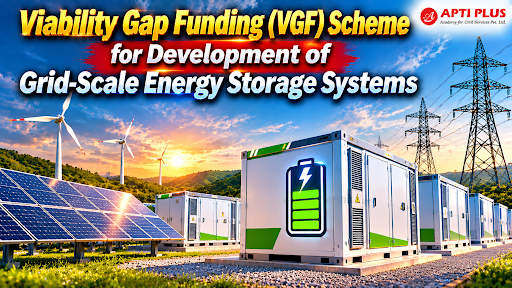
The Union Cabinet approved the Viability Gap Funding (VGF) Scheme for Development of Grid-Scale Energy Storage Systems.
What Are The Key Features Of The Scheme?
-
VGF Support: The scheme provides total financial support of ₹14,500 crore.
-
Five-Year Window: It runs from FY 2026–27 to FY 2030–31.
-
Investment Mobilised: It is expected to attract a total estimated investment of ₹97,600 crore. Every rupee of VGF is therefore expected to draw in nearly ₹6.7 of investment. (Source: PIB)
-
New Capacity Only: Support goes only to storage capacity that is yet to be commissioned, so it adds new capacity rather than rewarding existing projects.
|
Component |
Capacity |
Share |
|
Hydro Pumped Storage Plants (PSP) |
60 GWh |
About 65% |
|
Battery Energy Storage Systems (BESS) |
30 GWh |
About 33% |
|
Alternative / emerging storage technologies |
2 GWh |
About 2% |
|
Total |
92 GWh |
100% |
(Source: PIB)
Scale Relative To Need
-
170% Of Current Capacity: The new capacity equals about 170% of India's present grid-scale storage capacity. This implies current capacity of roughly 54 GWh.
-
2031–32 Target: The scheme will help meet India's projected requirement of 411 GWh of grid-scale storage by 2031–32.
Allocation And Eligibility
-
Competitive Bidding: Storage capacity will be allocated through tariff-based competitive bidding, so the developer offering the lowest tariff wins.
-
Who Can Apply: Public and private electricity distribution companies (DISCOMs) are eligible for VGF support for Battery Energy Storage System (BESS) and pumped storage projects.
-
Alternative Technologies: Projects based on emerging technologies will be implemented by public and private sector entities.
Domestic Manufacturing Push
-
40% Domestic Content Requirement: Battery Energy Storage System (BESS) projects must meet a minimum Domestic Content Requirement (DCR) of 40%.
-
Demand-Side Support: By guaranteeing demand for locally made batteries, the scheme complements supply-side incentives such as the PLI scheme for battery manufacturing.
Objectives
-
Integrate Renewables: Make greater use of solar and wind power by addressing their variability.
-
Grid Stability: Strengthen the grid and provide reliable, affordable, round-the-clock power.
-
Reduce Fossil Dependence: Cut reliance on conventional (mostly coal) generation for balancing the grid.
-
Energy Security: Reduce import dependence and advance Atmanirbhar Bharat and Viksit Bharat.
What Is Energy Storage And Why The Grid Needs It?
-
Meaning: An energy storage system (ESS) captures electricity when supply is high or cheap and releases it when demand is high or supply is low.
-
Grid-Scale Storage: Grid-scale systems are large installations connected to the transmission or distribution network, as opposed to small home batteries.
Renewable Variability Challenge
-
Solar's Daily Cycle: Solar power peaks around midday and falls to zero after sunset.
-
Wind's Seasonal Swings: Wind power is strong in the monsoon months but weak in others, and it varies hour to hour.
-
Demand Mismatch: India's electricity demand peaks in the evening, just as solar output disappears.
The "Duck Curve" Problem
-
Meaning: When large amounts of solar power enter the grid, the net demand that other plants must meet falls sharply at midday and rises steeply in the evening. On a graph, this shape resembles a duck.
-
Consequences: Grid operators must quickly ramp other plants up in the evening, and surplus midday solar may be curtailed (wasted).
-
Storage As Solution: Storage absorbs midday surplus and supplies it during the evening peak, flattening the curve.

Services Storage Provides
-
Energy Shifting: Moving energy from low-demand to high-demand hours.
-
Peak Support: Supplying power during demand peaks so new peaking plants are not needed.
-
Frequency Regulation: Keeping grid frequency stable (around 50 Hz in India) by responding within seconds to imbalances.
-
Reserves And Backup: Providing backup during sudden plant outages and supporting grid restoration after blackouts.
-
Transmission Relief: Reducing congestion on transmission lines by storing power close to where it is used.
Why India Need More Energy Storage?
Rapid Renewable Expansion
-
Non-Fossil Milestone: India crossed 50% of installed power capacity from non-fossil sources in 2025, five years ahead of its 2030 NDC target.
-
500 GW Target: India aims for 500 GW of non-fossil capacity by 2030, with most additions coming from solar and wind.
-
Net Zero 2070: India's long-term goal of net-zero emissions by 2070 requires a power system dominated by renewables.
Rising And Changing Demand
-
Record Peaks: Peak electricity demand crossed 270 GW in May 2026 and continues to rise with heatwaves, cooling needs and economic growth.
-
Electrification: Growth in electric vehicles, data centres and electric cooking will make demand larger and more variable.
Planning Projections
-
National Electricity Plan: The Central Electricity Authority (CEA), in its National Electricity Plan (2023), projected a storage requirement of about 411 GWh by 2031–32. This would come from about 175 GWh of pumped storage and about 236 GWh of battery storage.
-
Gap To Fill: With only a fraction of this capacity in place, India must add storage at a fast pace this decade. The 92 GWh scheme is a major step towards closing this gap.
What Are The Main Energy Storage Technologies?
Pumped Storage Projects (PSP)
-
How It Works: Water is pumped from a lower reservoir to an upper reservoir when electricity is cheap. When demand rises, the water flows down through turbines to generate power.
-
Strengths: PSPs offer long-duration, very large-scale storage, last 50 years or more and have low operating costs.
-
Weaknesses: They need suitable terrain and water, take 5–7 years or more to build and require environmental and forest clearances.
-
On-River Versus Off-River: Conventional PSPs are built on rivers. Off-river (closed-loop) PSPs use two reservoirs away from the main river channel and recirculate the same water. This greatly reduces the impact on rivers and ecosystems.
-
Example: The Pinnapuram Integrated Renewable Energy Project in Kurnool, Andhra Pradesh, combines solar, wind and off-river pumped storage. It is among the world's largest integrated renewable energy storage projects.
-
Policy Support: The Ministry of Power issued Guidelines to Promote Development of Pumped Storage Projects in 2023, easing clearances and allocation of sites.
Battery Energy Storage Systems (BESS)
-
How It Works: Batteries store electricity as chemical energy and release it on demand. Most grid batteries today use lithium-ion chemistry.
-
Main Chemistries:
-
Lithium Iron Phosphate (LFP): Safer and longer-lasting, increasingly preferred for grid storage.
-
Nickel Manganese Cobalt (NMC): Higher energy density, more common in electric vehicles.
-
Strengths: BESS can be built in 12–18 months, placed almost anywhere and respond within milliseconds.
-
Weaknesses: Batteries usually provide 2–4 hours of storage, degrade over time, carry fire risks and depend on imported cells and critical minerals.
-
Example: The 20 MW / 40 MWh Kilokari BESS in Delhi, commissioned in 2024, was described as South Asia's first utility-scale battery storage system at the distribution level.
Emerging And Alternative Technologies
-
Flow Batteries: Store energy in liquid electrolytes in external tanks. They allow long durations and long life.
-
Example: NTPC's R&D centre NETRA has set up a 3 MWh vanadium redox flow battery, testing long-duration storage for Indian conditions.
-
Sodium-Ion Batteries: Use abundant sodium instead of lithium, reducing dependence on scarce minerals.
-
Compressed Air Energy Storage (CAES): Store energy by compressing air in underground caverns or tanks.
-
Flywheels: Store energy as the kinetic energy of a spinning rotor, useful for very short bursts and frequency control.
-
Thermal Storage: Store heat in materials such as molten salt, often paired with concentrated solar power.
-
Green Hydrogen: Use surplus renewable power to produce hydrogen through electrolysis, which can be stored for long periods. This links to the National Green Hydrogen Mission (2023).
-
Gravity Storage: Lift heavy blocks when power is cheap and lower them to generate electricity later.
What Is Viability Gap Funding?
-
Meaning: Viability Gap Funding is government financial support that bridges the gap between a project's cost and the revenue it can earn. It makes socially valuable but financially weak projects attractive to investors.
-
Origin: The VGF concept was introduced by the Ministry of Finance in 2006 to support public-private partnership (PPP) infrastructure projects.
Why Storage Needs VGF
-
High Upfront Cost: Storage projects need large initial investment but earn revenue gradually over many years.
-
Lower Tariffs: VGF reduces the capital cost a developer must recover, which lowers the storage tariff paid by DISCOMs and, ultimately, consumers.
-
Kick-Starting A Market: Early support helps the industry achieve scale, after which costs fall and subsidies can be withdrawn.
How Has India's Energy Storage Policy Evolved?
|
Year |
Measure |
Key Feature |
|
2021 |
Production Linked Incentive (PLI) Scheme for Advanced Chemistry Cell (ACC) Batteries |
₹18,100 crore to build 50 GWh of domestic Advanced Chemistry Cell manufacturing |
|
2022 |
Energy Storage Obligation (ESO) |
Ministry of Power requires DISCOMs to meet a rising share of consumption through storage, reaching 4% by 2029–30 |
|
2022 |
Battery Waste Management Rules |
Extended Producer Responsibility for battery collection and recycling |
|
2023 |
First VGF scheme for BESS |
Support for 4,000 MWh of BESS, up to 40% of capital cost |
|
2023 |
Pumped Storage Guidelines |
Easier site allocation and clearances for PSPs |
|
2023 |
National Green Hydrogen Mission |
Long-duration storage potential through hydrogen |
|
2025 |
National Critical Mineral Mission |
Securing lithium, cobalt, nickel and other minerals |
|
2026 |
92 GWh VGF Scheme |
₹14,500 crore for PSP, BESS and emerging technologies, with 40% DCR |
What Is The Significance Of The Scheme?
Economic Significance
-
Lower Power Costs Over Time: Storing cheap solar power for evening use can reduce the need for expensive peak-hour power. (
-
Investment And Jobs: Mobilising about ₹97,600 crore will create jobs in construction, manufacturing and operations.
-
Avoided Infrastructure: Storage can reduce the need for new coal peaking plants and some transmission upgrades.
Environmental Significance
-
Less Curtailment: Storage reduces wasted renewable energy.
-
Lower Emissions: Replacing coal-based balancing power with stored renewable energy cuts carbon emissions.
-
Climate Commitments: It supports India's NDC targets and its net-zero goal.
Strategic Significance
-
Energy Security: A more renewable-based, storage-backed grid reduces dependence on imported fuels.
-
Industrial Policy: The 40% Domestic Content Requirement (DCR) links clean energy deployment with domestic manufacturing, reducing dependence on imported battery cells.
Technological Significance
-
Diversified Portfolio: Combining long-duration PSPs, fast-acting batteries and emerging technologies builds a balanced, resilient storage mix.
-
Innovation: The 2 GWh set aside for alternative technologies supports testing of new options suited to Indian conditions.
What Are The Key Challenges?
Import Dependence And Critical Minerals
-
Cells And Minerals Imported: India imports most battery cells and the critical minerals used to make them, such as lithium, cobalt and nickel.
-
Domestic Reserves Not Yet Usable: Discoveries have been slow to become production.
-
Example: In 2023, the Geological Survey of India reported inferred lithium resources of 5.9 million tonnes in Reasi, Jammu and Kashmir. Commercial mining has not yet started, and early auction attempts drew weak interest.
Slow Domestic Manufacturing
-
Production Linked Incentive (PLI) Delays: Domestic cell manufacturing under the PLI Advanced Chemistry Cell (ACC) scheme has scaled up slowly, so meeting the 40% DCR may be difficult in the early years.
-
Technology Gaps: India lacks mature domestic expertise in cell chemistry and advanced manufacturing processes.
Weak DISCOM Finances
-
Losses And Debt: Many DISCOMs face high Aggregate Technical and Commercial (AT&C) losses and heavy debt, which can delay payments to developers.
-
Contract Risk: Developers may demand higher tariffs to cover payment risk, which raises the cost of storage.
Pumped Storage Execution Hurdles
-
Long Timelines: PSPs take many years to build, so the 60 GWh target is ambitious within a five-year window.
-
Clearances And Land: Projects need forest and environmental clearances, and often affect local and tribal communities.
-
Ecological Concerns: On-river projects can alter river flows and submerge forests.
Market Design Gaps
-
Limited Revenue Streams: India's power markets do not yet fully reward storage for all the services it provides, such as fast frequency response.
-
Regulatory Clarity: Rules on ownership, grid charges and dispatch of storage are still evolving.
Safety, Degradation And Waste
-
Fire Risk: Large lithium-ion installations can catch fire due to "thermal runaway", so strict safety standards are needed.
-
Battery Ageing: Batteries lose capacity over time and need replacement within 10–15 years.
-
E-Waste: Used batteries contain hazardous materials that need safe recycling.
Technology And Cost Uncertainty
-
Rapid Change: Fast-changing technology and falling prices can make early projects look expensive later, creating "lock-in" risk.
Way Forward
Secure The Mineral Supply Chain
-
Overseas Partnerships: Expand mining partnerships and acquisitions abroad.
-
Example: KABIL (Khanij Bidesh India Ltd), a joint venture of NALCO, HCL and MECL, signed an agreement in 2024 to explore five lithium blocks in Catamarca, Argentina.
-
Strategic Alliances: Use partnerships such as the Minerals Security Partnership and agreements with Australia to diversify supply.
-
Domestic Processing: Build refining and processing capacity under the National Critical Mineral Mission and the new ₹2,814 crore capex scheme.
Strengthen Domestic Manufacturing
-
Speed Up PLI Projects: Remove bottlenecks in technology access, land and finance for ACC gigafactories.
-
Gradual DCR Increase: Raise domestic content requirements in steps as domestic capacity grows, to avoid project delays.
-
Research And Innovation: Fund research into sodium-ion, solid-state and flow batteries through institutions such as IITs and CSIR labs.
Fix DISCOM Finances
-
Payment Security: Use mechanisms such as letters of credit and the Late Payment Surcharge Rules, 2022 to ensure timely payments
-
Loss Reduction: Continue reforms under the Revamped Distribution Sector Scheme (RDSS) to reduce AT&C losses.
Improve Market Design
-
Value All Services: Let storage earn revenue from energy shifting, ancillary services and capacity support.
-
Time-Of-Day Tariffs: Wider time-of-day pricing can reward storage that shifts power to peak hours.
-
Clear Regulations: Provide clear rules on storage ownership, grid connection and dispatch.
Fast-Track Pumped Storage Sustainably
-
Prefer Off-River Sites: Prioritise closed-loop PSPs that reduce river impacts.
-
Single-Window Clearance: Speed up approvals while protecting forests and community rights.
-
Use Existing Reservoirs: Convert existing hydro reservoirs into pumped storage where feasible.
Ensure Safety And Circularity
-
Safety Standards: Enforce strict Bureau of Indian Standards (BIS) standards for battery installations, including fire detection and suppression.
-
Recycling Ecosystem: Strengthen collection and recycling under the Battery Waste Management Rules, 2022 to recover lithium, cobalt and nickel.
Conclusion
The ₹14,500 crore VGF scheme for 92 GWh of grid-scale storage is the missing link between India's rapid renewable growth and a reliable, round-the-clock clean power system. Its success will depend on securing minerals, scaling domestic manufacturing, fixing DISCOM finances, designing smarter markets and building pumped storage sustainably, so that India can power Viksit Bharat with clean, affordable and secure energy.
Source: PIB
|
PRACTICE QUESTION Q. Energy storage is the missing link in India's renewable energy transition. Discuss. (10 Marks, 150 Words) |