Why In News?
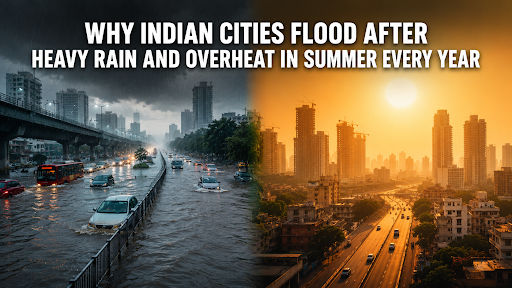
Indian cities suffer from severe flooding and summer overheating because rapid, concrete-heavy construction destroys natural drainage and green cover, trapping heat while preventing rainwater from absorbing into the ground.
Why are Indian Cities Flooding After Heavy Rain and Overheating in Summer Every Year?
Indian cities face an identical root cause for both summer heat stress and monsoon inundation: the total replacement of natural, permeable blue-green ecosystems with impermeable concrete, asphalt, and densely built infrastructure.
-
Compound Urban Vulnerability: The same asphalt roads and concrete rooftops that prevent rainwater from infiltrating the soil during downpours absorb solar radiation during the day, creating suffocating nighttime heat traps.
-
Unplanned Urbanisation Boom: India's urban population is projected to reach 951 million by 2050, with over 65% of India’s 7,933 urban settlements lacking a formal master plan to guide risk-sensitive development.
-
High Economic Toll: According to the World Bank, timely urban climate adaptation could prevent annual urban flood losses of $5 billion by 2030 and over $30 billion annually by 2070.

What Causes Urban Flooding?
Concretisation & Impermeable Surfaces: Concrete and bitumen surfaces surge the stormwater runoff coefficient from 0.1–0.2 (natural soil) to 0.8–0.9, forcing 90% of rainfall into surface runoff instead of groundwater infiltration.
Severe Drainage Capacity Deficit: Most municipal stormwater drainage networks are archaic, designed for rainfall intensities of only 12–20 mm/hour, whereas climate change regularly delivers cloudburst-like downpours exceeding 50–100 mm/hour.
Destruction & Encroachment of Urban Wetlands: Over the last four decades, cities have systematically built over water bodies; for example, Bengaluru has lost over 79% of its water bodies, and Chennai lost over 650 wetlands.
Disruption of Natural Drainage Channels (Rajakaluves): Real estate construction directly on natural stormwater pathways, floodplains, and inter-lake connection channels creates artificial bottlenecks.
Solid Waste Clogging: Indiscriminate dumping of unsegregated municipal garbage and construction debris into open drains severely restricts hydraulic flow capacity.
Why do Indian Cities Overheat? (Urban Heat Island Effect)
The Urban Heat Island (UHI) effect is a microclimatic phenomenon where urban areas experience significantly higher ambient temperatures—ranging from 3°C to 8°C warmer—than adjacent rural and suburban peripheries.
-
High Thermal Mass Absorption: Concrete, asphalt, steel, and masonry absorb vast amounts of shortwave solar radiation during the day and re-radiate it as thermal infrared heat after sunset.
-
Depletion of Vegetative Cover: Massive loss of urban tree canopies eliminates natural evaporative cooling provided by plant evapotranspiration.
-
Elevated Night-Time Temperatures (Sweltering Nights): Trapped urban heat prevents nighttime cooling, with minimum temperatures remaining 4.5°C to 6.4°C above normal, denying the human body critical nocturnal recovery.
-
Anthropogenic Heat Injection: Continuous waste heat exhaust from millions of vehicular combustion engines, industrial units, and air-conditioning compressors raises localized ambient temperatures by 2°C–4°C.
-
Urban Canyon Geometry: Narrow streets flanked by high-rise glass-facade towers trap heat and block natural wind ventilation corridors.
How does Climate Change Increase Urban Risks?
Surge in Short-Duration Extreme Rainfall: Warmer atmospheres hold 7% more moisture per 1°C of warming (Clausius-Clapeyron relationship), generating intense sub-hourly downpours that overwhelm municipal drainage.
Prolonged and Severe Heatwaves: The frequency, duration, and geographical spread of heatwaves have expanded, with urban centers recording unprecedented land surface temperatures nearing 50°C.
Compound & Cascading Climate Disasters: Concurrent extreme events—such as summer heatwaves followed immediately by torrential urban deluges—exhaust emergency response systems.
Floods and Heatwaves Linked to Flawed Urban Planning
|
What are the Major Government Initiatives?
AMRUT & AMRUT 2.0: Focuses on expanding city-wide stormwater drainage, rejuvenating urban water bodies, and developing green parks across 500 cities.
Smart Cities Mission: Deployed Integrated Command and Control Centres (ICCCs) across 100 cities for real-time flood monitoring, sensor-based weather alerts, and emergency response coordination.
ClimateSmart Cities Assessment Framework (CSCAF): Evaluates Indian cities on 28 indicators across urban planning, green cover, stormwater management, and energy efficiency.
National Programme on Climate Change and Human Health (NPCCHH): Operates under the Ministry of Health and Family Welfare to manage heat-related illness surveillance via the Integrated Disease Surveillance Programme (IDSP).
What are the Major Challenges?
Fragmented Institutional Governance: Overlapping jurisdictions between Municipal Corporations, Urban Development Authorities, PWD, Irrigation Departments, and Disaster Authorities create operational paralysis.
Critical Municipal Financial Deficit: Indian Urban Local Bodies (ULBs) generate municipal revenue equivalent to less than 1% of GDP, leaving them financially incapable of financing multi-crore climate adaptation infrastructure.
Acute Deficit of Urban Planners: India has only 1 urban planner per 4 lakh urban citizens, compared to international benchmarks of 1 per 10,000 citizens.
Absence of Localized Hyper-Local Climate Data: Lack of automated weather stations (AWS) and ward-level thermal mapping hampers precision early warnings.
Post-Disaster Reactive Spending Bias: Disaster financing remains heavily skewed toward post-flood relief rather than ex-ante risk reduction and wetland rejuvenation.
Way Forward
Adopt the 'Sponge City' Urban Design Model: Transform urban landscapes into giant water-absorbing sponges by integrating permeable pavements, bioswales, rain gardens, and retention wetlands that absorb, store, and purify stormwater.
Mandate Blue-Green Infrastructure (BGI) Corridors: Legally protect and interlink urban wetlands, river floodplains, and stormwater drains, enforcing strict no-construction buffer zones.
Scale Mandatory Cool Roofs Policies: Mandate solar-reflective high-albedo white paint coatings on rooftops across government buildings, low-income housing, and commercial complexes, reducing indoor temperatures by 2°C to 5°C.
Deploy Ward-Level Urban Disaster Management Authorities (UDMAs): Operationalize Section 41A of the Disaster Management Act by appointing full-time urban hydrologists, GIS planners, and disaster experts within municipal corporations.
Implement Urban Agro-Forestry & Miyawaki Mini-Forests: Convert unused public lands, traffic islands, and railway buffers into dense native micro-forests to restore vegetative cooling and lower surface heat.
Mandate Strict Digital Rainwater Harvesting (RWH) Compliance: Enforce geo-tagged, functional rainwater harvesting systems on all residential and commercial buildings exceeding 100 sq. metres.
Unlock Municipal Green Bonds & Climate Finance: Enable creditworthy ULBs to issue Municipal Green Bonds to finance stormwater network modernization, permeable roads, and ecological lake restoration.
Conclusion
Transforming Indian cities from concrete heat traps into climate-resilient Sponge Cities requires integrating Blue-Green infrastructure, institutionalizing Urban Disaster Management Authorities, and enforcing risk-informed urban planning under Article 21.
Source: INDIANEXPRESS
|
PRACTICE QUESTION Q. What is the Urban Heat Island (UHI) effect? Discuss its socio-economic impacts on vulnerable urban populations and highlight the role of 'Cool Roofs' and urban forestry in mitigating heat stress. (10 Marks, 150 Words) |