Why In News?
The Supreme Court invoked Article 142 to quash FIRs linked to nationwide exam-related protests, bringing renewed debate over the breadth of the Court's “complete justice” jurisdiction.
What is Article 142?
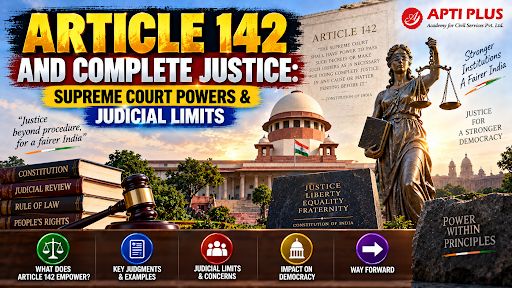
Article 142(1) empowers the Supreme Court to pass any decree or order necessary to do “complete justice” in a cause or matter pending before it; such orders are enforceable throughout India.
It enables the Court to fill procedural or remedial gaps where ordinary legal mechanisms may not provide an adequate remedy, making it a powerful instrument of constitutional adjudication.
Article 142(2) gives the Supreme Court powers concerning attendance of persons, discovery or production of documents, and investigation or punishment of contempt.
Significance of Article 142Justice Beyond Technicalities: Prevents rigid procedural rules from producing manifest injustice where exceptional circumstances demand a tailored remedy. Constitutional Flexibility: Allows the Supreme Court to respond to novel legal and social problems for which legislation may not yet provide an adequate remedy. Victim-Centric Justice: Can provide effective compensation, rehabilitation or other relief where ordinary remedies are inadequate or fragmented. Institutional Gap-Filling: Article 142 is valuable when legal silence or procedural limitations obstruct an otherwise justified remedy. The Supreme Court has described the provision as a broad but self-restrained power intended to prevent injustice. Constitutional Safety Valve: Properly used, it functions as a constitutional safety valve, ensuring that justice is not defeated merely because existing procedural law cannot anticipate every factual situation. |
Applications of Article 142
Bhopal Gas Tragedy: In Union Carbide Corporation vs Union of India (1989), the Court used Article 142 to facilitate a settlement providing US$470 million compensation to victims.
Divorce: In Shilpa Sailesh vs Varun Sreenivasan (2023), the Court held that Article 142 can be used to dissolve a marriage on the ground of irretrievable breakdown, even where the statutory procedure does not independently provide such relief.
Environmental Protection: The Court has used Article 142 to craft environmental remedies and enforce regulatory obligations where ordinary mechanisms proved inadequate.
Human Rights: It has enabled tailored remedies where strict application of existing procedures could leave victims without effective relief.
Ayodhya Dispute: Article 142 was invoked while moulding the final relief in the Ayodhya title dispute, demonstrating its capacity to balance competing claims beyond a simple win–loss adjudication.
Perarivalan Case: In 2022, the Court used Article 142 to order the release of A.G. Perarivalan, demonstrating its use in exceptional criminal-justice situations.
What are the Constitutional Limits on Article 142?
Subservience to Fundamental Rights: In Prem Chand Garg vs Excise Commissioner, U.P. (1962), a Constitution Bench established that an order under Article 142 cannot violate Fundamental Rights guaranteed under Part III.
Supplementing, Not Supplanting, Enacted Statutes: In Supreme Court Bar Association vs Union of India (1998), the Court ruled that Article 142 is curative and cannot be used to supplant express statutory provisions or bypass an existing legislative scheme.
Public Policy Constraints: In E.S.P. Rajaram vs Union of India (2001), the Court held that power cannot be exercised in direct contravention of statutory prohibitions founded on fundamental public policy considerations.
Requirement of a Pending "Cause or Matter": The power cannot be exercised in the abstract; it requires a live, justiciable proceeding formally pending before the apex court.
Doctrine of Constitutional Morality: The power must respect institutional comity and structural separation of powers between the judiciary, executive, and legislature.
Why is Article 142 Controversial?
Erosion of Separation of Powers: Expansive remedial interventions blur the line between adjudication and legislation, leading to concerns of judicial overreach into domains reserved for Parliament and the Executive.
Subversion of Codified Criminal Procedure: Bypassing regular statutory quashing procedures (Section 528 BNSS / Section 482 CrPC) via blanket Article 142 orders circumvents evidentiary scrutiny by trial courts and High Courts.
Subjective Discretion and Unpredictability: Because "complete justice" lacks codified statutory parameters, rulings risk devolving into "palm tree justice", varying with the judicial philosophies of individual benches.
Absence of Democratic Accountability: Unlike elected lawmakers, judges are insulated from electoral accountability, making court-mandated socio-economic directives controversial.
Economic and Socio-Policy Disruptions: Broad remedial fiats (e.g., the 2016 Highway Liquor Ban or the 2014 cancellation of 214 coal block allocations) can cause unintended commercial disruptions, investor anxiety, and revenue loss.
Polyvocal Fragmentation Across Benches: With 34 judges sitting in division benches of two or three, divergent applications of Article 142 create conflicting precedents across similar matters.
Way Forward
Develop Codified Jurisprudential Guidelines: The Supreme Court should establish structured self-restraint guidelines delimiting clear thresholds for when ordinary procedural law can be bypassed.
Mandatory Constitution Bench Threshold: Invocations impacting nationwide public policy, broad commercial sectors, or regulatory regimes should be reserved exclusively for benches of five or more judges.
Explicit Recording of Statutory Inadequacy: Benches must be required to provide reasoned justifications on record explaining why ordinary statutory remedies are demonstrably inadequate.
Strict Adherence to Institutional Comity: Article 142 must be used strictly to supplement statutory law, upholding the precedent in Supreme Court Bar Association (1998).
Mandatory Socio-Economic Impact Assessments: Before issuing wide-ranging structural or commercial directives, the Court should solicit expert empirical assessments on employment, revenue, and industrial continuity.
Prospective Application of Regulatory Decrees: Sweeping regulatory directives under Article 142 should be applied prospectively to safeguard commercial certainty and legitimate expectations.
Harmonious Alignment with Codified Criminal Codes: Ordinary criminal complaints must be adjudicated through High Courts under Section 528 of BNSS, 2023, reserving Article 142 for exceptional constitutional deadlocks.
Application of the Proportionality Test: Remedial orders must represent the least intrusive means necessary to deliver complete justice without encroaching on legislative turf.
Conclusion
Article 142 serves as an essential "complete justice" mechanism, yet its constitutional validity relies on judicial self-restraint, adherence to statutory limits, and respect for the separation of powers to prevent extraordinary relief from replacing standard legislation.
Source: INDIANEXPRES
|
PRACTICE QUESTION Q. With reference to Article 142 of the Constitution of India, which of the following statements is/are correct?
Select the correct answer using the code given below: (a) 1 and 2 only (b) 1 and 3 only (c) 2 and 3 only (d) 1, 2, and 3 Answer: (b) Explanation: Statement 1 is correct: As per Article 142(1) of the Constitution of India, the Supreme Court in the exercise of its jurisdiction may pass any decree or order necessary for doing "complete justice" in any cause or matter pending before it. Statement 2 is incorrect: In the landmark Supreme Court Bar Association v. Union of India (1998) case, a Constitution Bench held that Article 142 cannot be used to supplant or completely override express statutory laws enacted by Parliament. The court ruled that the power is curative in nature and is meant to supplement, rather than replace, substantive statutory law. Statement 3 is correct: Article 142 clearly states that any decree passed or order made by the Supreme Court shall be enforceable throughout the territory of India in a manner prescribed by Parliament, or until then, by the President of India. |