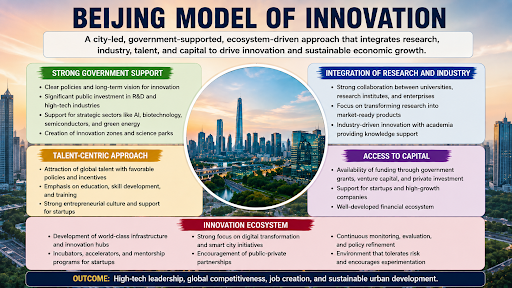
Why In News?
Beijing's state-led innovation model offers India a strategic roadmap for accelerating deep-tech growth and long-term development.
What is the Beijing Model of Innovation?
The Beijing Model refers to China's state-led innovation strategy, where the central government directs, funds, and coordinates technological development through long-term industrial policy rather than leaving it primarily to market forces.
State-led innovation strategy: China's innovation is anchored by top-down five-year plans, with the 15th Five-Year Plan (2026-2030) placing targeted support behind AI, robotics, quantum, biomanufacturing, and 6G to push them toward commercial viability faster.
Mission-oriented R&D: Programs like "Made in China 2025" set sector-specific self-sufficiency targets, backed by over $300 billion in initial funding.
Innovation-driven economic growth: China has shifted from being a destination for imported technology to becoming an exporter of R&D breakthroughs.
Key Features of the Beijing Model
Massive public investment in R&D: China's total R&D expenditure reached 3.6 trillion yuan in 2024, an 8.3% year-on-year increase, with R&D intensity at 2.68% of GDP.
Strong basic research push: Basic research investment grew 10.5% to 249.7 billion yuan in 2024, now constituting 6.91% of total R&D spending, signalling a long-term view beyond applied/commercial research.
Strong industrial policy: Sector-specific plans (MIC 2025, 15th Five-Year Plan) set explicit self-reliance targets for critical technologies, backed by state financing and coordinated implementation.
Industry-academia collaboration: Institutions like Tsinghua University partner directly with global corporates (e.g., McKinsey's Innovation & Learning Center, Beijing) to build model factories and digital-technology testbeds, tightly linking research to industrial application.
Technology commercialisation: China emphasises speed-to-market, visible in the rapid real-world deployment of humanoid robots and industrial AI, not just lab-stage research.
Innovation clusters: Hubs like Hangzhou (home to both DeepSeek and Unitree Robotics) show how geographic clustering of talent, capital, and government support accelerates breakthroughs.
Focus on strategic technologies: Even under export restrictions on advanced lithography tools, China's SMIC developed limited 7nm chip production capabilities, showcasing the resilience built into the state-backed R&D ecosystem.
Priority Sectors
-
Artificial Intelligence
-
Semiconductors
-
Electric Vehicles
-
Robotics
-
Biotechnology
-
Quantum Technologies
-
Space Technology
Lessons for India
Increase R&D investment: India's GERD stood at just 0.64-0.65% of GDP, compared to China's 2.68%, the US's 3.47%, and Israel's 5.71% — gaps limiting India's innovation capacity.
Strengthen industry-academia linkages: India's private sector contributes only 36.4% of GERD, compared to China's 77% and the US's 75%, showing the industry-research gap India must close.
Promote deep-tech startups: China's Hangzhou cluster model (DeepSeek, Unitree) shows how concentrated ecosystems of talent and capital can produce globally competitive breakthroughs rapidly.
Improve technology commercialisation: India must move faster from lab-stage research to market-ready deployment, mirroring China's emphasis on speed-to-commercialisation.
Develop innovation clusters: Geographic and sectoral clustering of research, capital, and industry — as seen in China's tech hubs — can be replicated through India's innovation cluster and PM SHRI/ANRF frameworks.
Way Forward For India
Expand public-private partnerships to lift India's private R&D contribution closer to global benchmarks.
Strengthen ANRF: Fully operationalise the Anusandhan National Research Foundation and its ₹1 lakh crore RDI Fund/Special Purpose Fund to channel patient capital into deep-tech, similar in scale-ambition to China's mission funding.
Encourage high-risk research: Build funding mechanisms tolerant of failure and long gestation periods, essential for frontier technologies.
Build global innovation partnerships: Pursue strategic technology collaborations that complement India's market-driven model, as India's approach — unlike China's centralised one — relies more on international alliances and private participation.
Promote indigenous technologies: Scale up India Semiconductor Mission, National Quantum Mission, and similar missions with clear, time-bound self-reliance targets, drawing on China's mission-mode discipline while retaining India's democratic, decentralised strengths.
Conclusion
The Beijing Model shows what sustained, mission-mode state investment can achieve, but India's task is to match that ambition and R&D intensity while building on its own strength — a vibrant, market-driven private innovation ecosystem.
Source: THEHINDU
PRACTICE QUESTIONQ. "China's Beijing Model demonstrates the power of state-led, mission-mode innovation, while India follows a market-driven approach." Compare the two models and discuss what lessons India can draw for strengthening its science and technology ecosystem. (250 words) |