Why In News?
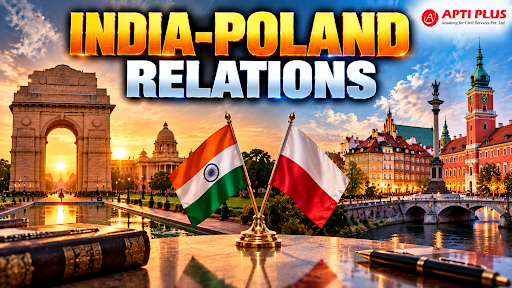
Polish PM Donald Tusk met Indian PM Narendra Modi in New Delhi (Oct 21–23, 2026) to boost bilateral ties and advance the India-Poland Action Plan (2024–2028).
Key Outcomes of the Polish Prime Minister’s Visit to India
Economic Trade Targets: Both leaders formally committed to doubling bilateral trade by 2030 from its current baseline of roughly $6 billion to $12 billion.
Defence Industry Dialogue: Institutionalized a Defence Industry Dialogue to transition bilateral military ties toward co-development, co-production, and direct business-to-business (B2B) defense technology transfers.
Classified Information Pact: Pushed forward final negotiations on the Agreement on Mutual Protection and Exchange of Classified Information to facilitate joint military hardware manufacturing.
Critical Minerals & Circular Economy: Advanced an MoU on geology, mining, and critical minerals, targeting collaboration in rare-earth element refining, battery recycling, and coal gasification.
Space and High-Tech Innovation: Encouraged institutional collaboration between the Indian Space Research Organisation (ISRO) and the Polish Space Agency (POLSA), alongside joint research in artificial intelligence (AI), semiconductors, and quantum computing.
Multilateral and Climate Alignment: Poland formally announced its accession to the India-led Coalition for Disaster Resilient Infrastructure (CDRI) and backed India’s bid for a permanent seat on a reformed United Nations Security Council (UNSC) as well as its non-permanent UNSC (2028–29) candidacy.
-
India invited Poland to join the Indo-Pacific Oceans Initiative (IPOI), the International Solar Alliance (ISA), and the Global Biofuels Alliance (GBA).
Counter-Terrorism Framework: Reaffirmed joint action against cross-border terrorism, condemned the April 2025 Pahalgam attack, and called for early adoption of the Comprehensive Convention on International Terrorism (CCIT) at the UN.
India-Poland Strategic Partnership
Historical Foundation: Bilateral ties share deep historic roots dating back to World War II, when Maharaja Digvijaysinhji Ranjitsinhji of Nawanagar (known in Poland as the Good Maharaja) and the Principality of Kolhapur provided refuge to over 5,000 Polish women and children between 1942 and 1948.
Diplomatic Evolution: Formal diplomatic relations were established in 1954. Ties were elevated to a Strategic Partnership during Prime Minister Narendra Modi's visit to Warsaw in August 2024 (the first by an Indian Prime Minister in 45 years), structured around the Action Plan (2024–2028).
Economic Dimension: Poland is India’s largest economic and investment partner in Central and Eastern Europe (CEE). Total bilateral trade reaching approx $6 billion in 2025.
-
Poland currently maintains a trade deficit with India.
-
Polish Exports to India: Valued around €1.4 billion, with primary categories including machinery, mechanical and electrical equipment (such as turbojet engines), mineral products (coke and semi-coke), and base metals.
-
Polish Imports from India: Valued around €4.3 billion, with main items including textiles and textile products, machinery and electrical equipment, base metals, and chemical/pharmaceutical products.
-
Indian investments in Poland exceed $3 billion (mainly in IT and pharmaceuticals), while Polish investments in India stand at $685 million.
Defence Cooperation: India posted a dedicated Defence Attaché in Warsaw, while Indian armed forces utilize Polish military hardware, including contracts with WB Electronics for Warmate loitering munitions and reconnaissance drones.
Humanitarian & Crisis Synergy: During 2022, Polish authorities provided vital transit and logistical support under Operation Ganga, enabling India to safely evacuate over 2,000 Indian students fleeing the Ukraine conflict.
Diaspora & Cultural Ties: Poland hosts an Indian community of over 26,000 legal residents. Academic ties are anchored by a long tradition of Indology studies, including an ICCR Chair of Indian Studies at Jagiellonian University in Kraków.
About PolandPoland is a Central European country bordered by seven nations: Germany, the Czech Republic, Slovakia, Ukraine, Belarus, Lithuania, and Russia (Kaliningrad Oblast), with a coastline along the Baltic Sea.
|

Strategic Significance of India-Poland Partnership
Gateway to Central & Eastern Europe (CEE): As the 6th-largest economy in the European Union (EU), Poland serves as India's primary trade and logistics hub to access the broader European Single Market.
EU Institutional Synergies: Polish backing accelerates the ratification of the EU-India Free Trade Agreement (FTA) and operationalization of the India-EU Trade and Technology Council (TTC).
Sub-Regional Engagement: Provides a framework to engage with the Visegrad Group (V4+India) (Poland, Hungary, Czech Republic, Slovak Republic) and link Polish port infrastructure with the India-Middle East-Europe Economic Corridor (IMEC).
Defence Industrial Modernisation: Offers India an additional European avenue for military hardware technology transfer, maintenance, and co-production under the Make in India initiative.
Global Governance Alignment: Polish backing strengthens India's bid for UNSC structural reforms, while joint participation in the CDRI enhances climate-resilient infrastructure across the Global South.
Challenges in India-Poland Strategic Partnership
Geopolitical Divergence on Russia
-
Stance on Ukraine: Poland acts as a strict frontline NATO state with hardline positions against Russia.
-
Strategic Autonomy: India maintains its policy of strategic autonomy, diplomatic neutrality, and ongoing defense/energy imports from Moscow, creating friction in alignment on European security.
Defense and Technology-Sharing Hurdles
-
Classified Information Pact: Joint military production and tech-sharing under Atmanirbhar Bharat have faced delays. European and Polish firms cannot transfer critical military technology without a finalized Agreement on Mutual Protection and Exchange of Classified Information (though negotiations have progressed).
-
Procurement Gaps: Translating the newly formed Defence Industry Dialogue into concrete co-development projects remains an ongoing test.
Trade and Regulatory Barriers
-
Trade Imbalance & Tariffs: Bilateral trade exceeds USD 6 billion, but Poland has raised concerns over a trade deficit and demands the reduction of high Indian tariffs.
-
SPS & EU Standards: Polish agricultural, dairy, and meat exporters face strict Indian Sanitary and Phytosanitary (SPS) barriers, while Indian exporters face complex EU regulations, compliance costs, and the REACH framework for chemicals.
Diaspora, Mobility, and Institutional Gaps
-
Mobility Agreements: Indian IT professionals, students, and workers face visa challenges due to the absence of a comprehensive Migration and Mobility Partnership Agreement (MMPA).
-
Social Security: The lack of a formal Social Security Agreement results in dual-taxation and pension hurdles for professionals working in each other's countries.
-
Implementation Lags: Bridging political declarations from high-level visits (such as PM Donald Tusk's October 2026 visit) into ground-level economic outcomes requires overcoming administrative red tape and low business awareness among small and medium-sized enterprises (SMEs).
Way Forward to Improve India-Poland Relations
Finalize Bilateral Security Treaties: Expedite the parliamentary ratification and formal execution of the Agreement on Mutual Protection and Exchange of Classified Information to unlock B2B defense manufacturing.
Capitalize on EU-India Institutional Trade Pacts: Leverage the upcoming EU-India Free Trade Agreement (FTA) to remove tariff barriers on 96% of product lines and reduce non-tariff regulatory frictions for Indian exporters.
Operationalize Critical Mineral Supply Chains: Conclude the pending MoU on geology, mining, and critical minerals to integrate Polish expertise in deep underground mining and clean coal gasification into India's industrial sector.
Institutionalize Regional Formats & Mobility: Strengthen engagements through the Visegrad Group (V4+India) framework, establish direct commercial flight routes, and execute the Comprehensive Framework of Cooperation on Mobility to facilitate legal migration for skilled Indian professionals and students.
Conclusion
Elevating India-Poland ties into a functional Strategic Partnership bridges historical goodwill with modern industrial synergies, serving as India's vital gateway to Central Europe and a key pillar of its broader European strategy.
Source: PIB
|
PRACTICE QUESTION Q. Which of the following groups of countries completely shares a land border with Poland? A) Germany, Czech Republic, Slovakia, Ukraine, Belarus, Lithuania, Russia B) Germany, Austria, Slovakia, Ukraine, Belarus, Latvia, Russia C) Germany, Czech Republic, Hungary, Ukraine, Belarus, Lithuania, Estonia D) Denmark, Germany, Czech Republic, Slovakia, Ukraine, Belarus, Lithuania Answer: A Explanation: Poland is bordered by 7 countries: Germany to the west; the Czech Republic and Slovakia to the south; Ukraine and Belarus to the east; and Lithuania and the Russian exclave of Kaliningrad Oblast to the northeast. Neither Austria, Hungary, Latvia, Estonia, nor Denmark shares a land border with Poland. |