Why In News?
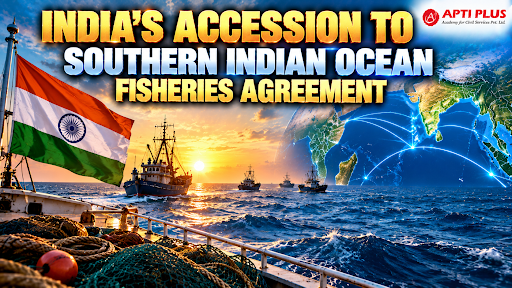
The Union Cabinet approved India's formal accession to the Southern Indian Ocean Fisheries Agreement (SIOFA).
What Is Southern Indian Ocean Fisheries Agreement (SIOFA)?
Origin: Signed in Rome in July 2006, under the auspices of the Food and Agriculture Organization (FAO), it entered into force in June 2012. Its secretariat is located in Saint-Denis, Réunion Island (France).
Mandate: SIOFA is an independent Regional Fisheries Management Organisation (RFMO) established to ensure the long-term conservation and sustainable management of non-tuna fishery resources in international waters.
Jurisdictional Area: Covers international waters of the Southern Indian Ocean between eastern Africa and Western Australia, extending beyond national Exclusive Economic Zones (EEZs).
Regulated Species: Applies to deep-sea and demersal resources, including oceanic squids, patagonian toothfish, alfonsino, orange roughy, molluscs, and crustaceans.
Explicit Exclusions: Excludes highly migratory species listed under Annex I of UNCLOS (such as tuna, managed separately by the Indian Ocean Tuna Commission - IOTC) and sedentary species subject to coastal state jurisdiction under Article 77(4) of UNCLOS.
Governance Bodies: Governed by the decision-making Meeting of the Parties, supported by the specialized Scientific Committee and Compliance Committee.
Strategic Significance of India’s Full Contracting Status
Decision-Making & Voting Power: Elevates India's status from a Cooperating Non-Contracting Party (CNCP) (held since 2022) to a full Contracting Party, granting binding voting rights and representation in the Scientific Committee and Compliance Committee.
High-Seas Fleet Expansion: Authorizes Indian-flagged fishing vessels to harvest high-value deep-sea stocks in international waters, enabling operations beyond the traditional 60–80 nautical mile coastal limit.
Global Ocean Presence: Secures a recognized operational footprint alongside major distant-water fishing fleets in the high seas, which constitute 65% of the global ocean.
Maritime Domain Awareness: Enhances regional maritime security and anti-IUU fishing (Illegal, Unreported, and Unregulated) enforcement through active participation in SIOFA's High Seas Boarding and Inspection (HSBI) Scheme.
Policy Convergence: Direct alignment with India's MAHASAGAR vision, national Blue Economy goals, and the Guidelines for Sustainable Harnessing of Fisheries in the High Seas, 2025 promulgated by the Ministry of External Affairs (MEA).
Conclusion
Full accession to SIOFA transitions India from coastal operations into active global high-seas fisheries governance, securing economic harvesting rights and a strategic maritime footprint in the Southern Indian Ocean.
Source: PIB
|
PRACTICE QUESTION Q. With reference to the Southern Indian Ocean Fisheries Agreement (SIOFA), consider the following statements:
Which of the statements given above are correct? (a) 1 and 2 only (b) 2 and 3 only (c) 1 and 3 only (d) 1, 2 and 3 Answer: (c) Explanation: Statement 1 is correct: The Southern Indian Ocean Fisheries Agreement (SIOFA) is an independent Regional Fisheries Management Organisation (RFMO) signed in Rome in 2006 and entered into force in 2012. Its Secretariat is officially based in Saint-Denis, Réunion Island (France). Statement 2 is incorrect: SIOFA's mandate is specifically focused on non-tuna fishery resources (such as deep-sea fish, alfonsino, orange roughy, molluscs, and crustaceans). It explicitly excludes highly migratory tuna and tuna-like species listed under Annex I of UNCLOS, which are managed by the Indian Ocean Tuna Commission (IOTC). Statement 3 is correct: Under the text of the agreement and Article 77(4) of the United Nations Convention on the Law of the Sea (UNCLOS), sedentary species subject to the fishery and continental shelf jurisdiction of coastal states are excluded from SIOFA’s area of competence. |