Why In News?
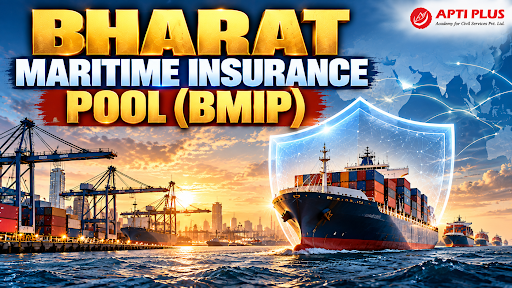
The sovereign-backed Bharat Maritime Insurance Pool (BMIP) insures high-risk merchant and domestic voyages, protecting Indian shipping from global cartels and geopolitical chokepoints.
What is the Bharat Maritime Insurance Pool (BMIP)?
About: A specialized, national risk-pooling consortium established by Indian general insurance and reinsurance companies to underwrite maritime, war, and protection risks domestically.
Domestic Insurance Pool: Aggregates statutory balance sheet capacity across state-owned and private general insurers, led by the General Insurance Corporation of India (GIC Re), to retain maritime underwriting risks within Indian borders.
Sovereign-Backed Mechanism: Anchored by an official backstop and sovereign guarantee from the Government of India to absorb catastrophic losses exceeding standard commercial reinsurance ceilings.
Launched in May 2026: Formally operationalized in May 2026 under the aegis of the Ministry of Ports, Shipping and Waterways, the Ministry of Finance, and the Insurance Regulatory and Development Authority of India (IRDAI).
Domestic Marine Underwriting Capacity: Establishes independent national underwriting, risk-assessment, and claims-settlement capacity, breaking India's historic reliance on external marine syndicates.
What Risks Does BMIP Cover?
-
Hull and Machinery (H&M): Protection against physical damage, mechanical breakdown, and structural destruction of the ship’s hull, engines, navigation systems, and on-board equipment.
-
Cargo Insurance: Compensation for loss, damage, contamination, or theft of commercial freight and bulk cargo transit across deep-sea voyages.
-
Protection and Indemnity (P&I): Third-party marine liabilities including accidental oil pollution liabilities, crew repatriation, wreck removal, environmental salvage, and collision damages.
-
War Risk Cover: Comprehensive insurance shielding against damage, seizure, or destruction arising from regional armed conflicts, civil commotions, terrorism, piracy, and sea-mine strikes.
-
High-Risk Maritime Corridors: Covers merchant vessels navigating contested and volatile waterways such as the Red Sea, Bab-el-Mandeb, Persian Gulf, Strait of Hormuz, and the Black Sea.
-
Indian-Flagged Vessels: Full-spectrum risk coverage extended to ships registered under the Merchant Shipping Act, 1958.
-
Indian-Controlled Vessels: Available for foreign-flagged or chartered vessels owned or operatively chartered by Indian public or private corporate entities transporting national strategic cargo.
Strategic Significance
Continuity of Maritime Trade: Prevents sudden halts in merchant shipping operations during regional military standoffs or geopolitical blockades.
Lower Insurance and Freight Costs: Competitive domestic pricing dampens predatory war-risk surcharges, lowering the landed cost of imported commodities and boosting export competitiveness.
Reduced Foreign Exchange Outflow: India earlier faced an estimated annual outflow of USD 45–60 million in P&I premiums to foreign providers, which is now retained within the domestic financial system.
Domestic Financial Capacity: Retains underwriting premiums within the Indian financial sector, boosting liquidity and capital formation for domestic general insurers and GIC Re.
Shipping Industry Support: Encourages Indian maritime entrepreneurs to expand national merchant fleet tonnage under the Indian flag without fearing international coverage withdrawal.
Trade Resilience: Shields key agricultural exports, refined petroleum products, and critical pharmaceutical shipments from sudden logistics bottlenecks.

Source: PIB
|
PRACTICE QUESTION Q. With reference to the Bharat Maritime Insurance Pool (BMIP), consider the following statements: 1. It is a sovereign-backed domestic insurance pool created to provide underwriting coverage including war risk and Protection & Indemnity (P&I) for shipping. 2. It was established under the leadership of the General Insurance Corporation of India (GIC Re) in coordination with domestic general insurers. 3. The pool exclusively provides insurance coverage to military naval warships of the Indian Navy and excludes all commercial merchant vessels. Which of the statements given above is/are correct? (a) 1 and 2 only (b) 2 and 3 only (c) 1 and 3 only (d) 1, 2 and 3 Answer: (a) Explanation: Statement 1 is correct: The Bharat Maritime Insurance Pool (BMIP) was established with sovereign backing (a government guarantee of ₹12,980 crore) to underwrite major maritime risks, including Hull & Machinery, Cargo, Protection & Indemnity (P&I), and War Risk coverage. This shields the broader economy from severe supply-chain disruptions. Statement 2 is correct: The pool operates under the administration and leadership of the General Insurance Corporation of India (GIC Re), bringing together domestic general insurance companies to pool capacity and collectively manage high-exposure risks. Statement 3 is incorrect: BMIP does not exclusively serve military naval vessels; sovereign naval warships generally operate under state self-insurance frameworks. BMIP was specifically designed to cover commercial merchant shipping—specifically Indian-flagged vessels, vessels owned/controlled by Indian entities, and commercial cargo ships originating from or bound for India—ensuring trade continuity and reducing expensive capital outflows to foreign P&I clubs. |