Why In News?
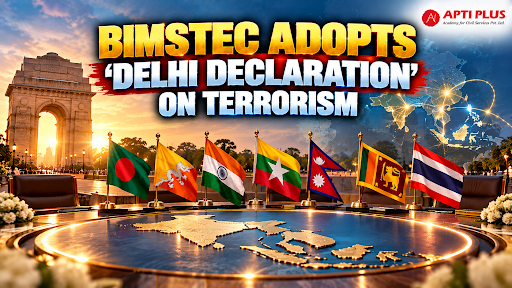
The Bay of Bengal Initiative for Multi-Sectoral Technical and Economic Cooperation (BIMSTEC) adopted the ‘Delhi Declaration’ during the first-ever BIMSTEC Home Ministers’ Meeting in New Delhi.
What IS BIMSTEC?
Origins: The Bay of Bengal Initiative for Multi-Sectoral Technical and Economic Cooperation (BIMSTEC) is a regional multilateral grouping established in June 1997 through the Bangkok Declaration. Originally formed as BIST-EC, it was renamed BIMSTEC following the admission of Myanmar (1997), and Nepal and Bhutan (2004).
Membership Structure: Comprises 7 member states bridging South Asia (Bangladesh, Bhutan, India, Nepal, Sri Lanka) and Southeast Asia (Myanmar, Thailand).
Demographic & Economic Weight: Represents 1.7 billion people (22% of the global population) with a combined Gross Domestic Product (GDP) of US$ 5 trillion.
Institutional Architecture:
-
Permanent Secretariat: Located in Dhaka, Bangladesh (operationalized in 2014).
-
BIMSTEC Charter: Adopted at the 5th Summit in Colombo (2022) and entered into force on 20 May 2024, formally transforming the grouping into an intergovernmental organization.
-
Reorganized Pillars: Cooperation is structured across 7 prioritized pillars, with each led by a member country. India leads the Security pillar, which encompasses Counter-Terrorism and Transnational Crime (CTTC), Disaster Management, and Energy Security.

What Is The BIMSTEC Delhi Declaration?
Adopted at the inaugural First BIMSTEC Home Ministers' Meeting (HMM) held in New Delhi on 13 October 2026, chaired by the Union Home Minister of India.
Core Mandate: Establishes a unified security framework for the Bay of Bengal region, strongly condemning terrorism, violent extremism, radicalization, and cross-border security threats in line with UN Security Council (UNSC) Resolution 1267.
Five Approved Regional Security Initiatives:
-
BIMSTEC Convention against Trafficking in Persons: Legal framework for cross-border prevention, criminalization of trafficking syndicates, and victim protection.
-
BIMSTEC Plan of Action on Drug Control: Operations targeting illicit narcotics, psychotropic substances, and precursor chemicals.
-
MoU on Capacity Building for Anti-Money Laundering (AML) and Countering Financing of Terrorism (CFT): Joint training, financial intelligence sharing, and counter-proliferation financing.
-
BIMSTEC Plan of Action on Illicit Financial Flows and Their Prevention: Identification and disruption of illicit financial channels and money laundering avenues.
-
Plan of Action for Disaster Preparedness and Coordination: Institutionalized regional risk planning, early warning systems, and tsunami risk reduction, supported by the proposed BIMSTEC Disaster Management Centre in Jamnagar, Gujarat.
Recognition of Forced Criminality: Conceptualizes forced criminality, where human trafficking victims are forced under debt bondage and abuse into operating online cyber-scam networks. It mandates a victim-centred response coordinating states of origin, transit, destination, scam-centre locations, and jurisdictions of defrauded individuals.
Legal Enforcement Instruments: Reaffirms implementation of the BIMSTEC Counter-Terrorism Convention (in force since March 2021) and the BIMSTEC Convention on Mutual Legal Assistance in Criminal Matters (signed March 2022), while urging early finalization of draft conventions on Extradition and Transfer of Sentenced Persons.
Strategic Significance
Geopolitical Bridge: Serves as a natural strategic bridge linking South Asia with ASEAN countries, maintaining contiguous regional stability across the Bay of Bengal littoral zone.
Convergence with Indian Foreign Policy Doctrines: Direct operational vehicle for India's Neighbourhood First Policy, Act East Policy, and MAHASAGAR Policy.
Functional Alternative to SAARC: Provides a vibrant, consensus-based sub-regional platform for South Asian cooperation where SAARC initiatives have stalled due to regional friction.
Institutionalization of Hard Security: Upgrades BIMSTEC from purely economic and technical cooperation to a structured security arrangement through regular Home Ministers' Meetings (HMM), National Security Advisors (NSA) dialogues, and the Joint Working Group on Counter-Terrorism and Transnational Crime (JWG-CTTC).
Net Security Provider & First Responder: Highlights India's role as a net security provider and first responder in Humanitarian Assistance and Disaster Relief (HADR) through regional institutions like the BIMSTEC Disaster Management Centre (Jamnagar) and the BIMSTEC Centre for Weather and Climate (BCWC) in Noida.
Conclusion
The BIMSTEC Delhi Declaration transforms the Bay of Bengal into an integrated regional security domain by binding human protection and victim-centred anti-trafficking measures with enforcement against cross-border terrorism and financial crime.
Source: THEHINDU
|
PRACTICE QUESTION Q. The term "Golden Triangle", frequently mentioned in the context of regional security and organized crime, refers to the border tri-junction of which of the following countries? (a) India, Myanmar, and Bangladesh (b) Myanmar, Thailand, and Laos (c) Thailand, Cambodia, and Vietnam (d) Afghanistan, Pakistan, and Iran Answer: (b) Explanation: The Golden Triangle refers to the mountainous region where the borders of Myanmar, Thailand, and Laos meet. It is one of Asia's primary opium and synthetic drug-producing hubs. (The tri-junction of Afghanistan, Pakistan, and Iran is known as the "Golden Crescent"). |