Why In News?
With the Union Government's approval of the PM Surya Sarovar Yojana (PM-SSY) for 5,000 MW of floating solar capacity, attention turns to canal networks, offering an estimated 131 GW of land-neutral canal-top and canal-bank solar potential.
How India’s Canal Network Offers a Land-Neutral Path to Solar Expansion?
Land Scarcity Constrains Ground-Mounted Utility Parks: Developing standard ground-mounted solar parks requires 4 to 5 acres of contiguous land per Megawatt (MW) of installed capacity.
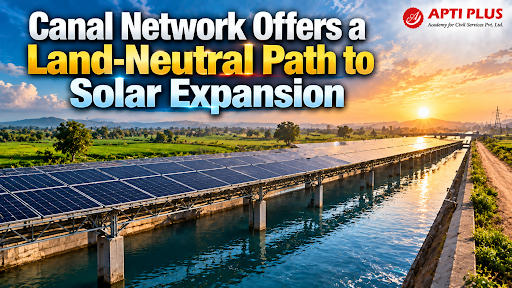
Canal-Top Systems Neutralize Land Conflicts: India operates one of the world's largest irrigation architectures, spanning over 120,000 kilometres of canals across agricultural basins; mounting photovoltaic modules on structural frames directly over water surfaces completely bypasses land acquisition and displacement disputes.
National Assessments Identify a 131 GW Clean Frontier: A comprehensive 2024 resource assessment placed India's combined technical potential for canal-top and canal-bank solar PV at roughly 131 GW, offering a major domestic pathway toward achieving the national target of 500 GW of non-fossil power capacity by 2030.

How Does the Water-Energy Nexus Enhance Photovoltaic Efficiency and Conserve Water?
Evaporative Cooling Boosts Solar Power Yield: High ambient summer temperatures (exceeding 40°C–45°C) degrade the operating efficiency of silicon solar cells by 0.4% to 0.5% for every degree rise above 25°C; the natural evaporative cooling effect from flowing water beneath canal-top panels lowers module operating temperatures, boosting electricity output.
Canal Shading Curbs Evaporative Water Loss: Shading canal surfaces with solar panels shields flowing water from direct solar irradiance and dry desert winds, reducing evaporation losses by 70% to 80%; a 1 MW canal-top plant saves an estimated 90 lakh litres of water annually.
Algal Blooms and Aquatic Weeds Decline: Solar canopies block sunlight penetration into canal waters, inhibiting the rapid proliferation of invasive weeds (such as water hyacinth) and algae that clog downstream irrigation sluices and reduce water flow velocity.

Which Engineering and Financial Bottlenecks Hinder Nationwide Scaling?
High Structural Costs Expand Capital Budgets: Constructing heavy, hot-dip galvanized steel bridge trusses that span canal widths of 10 to 40 metres without central support pillars drives installation costs to ₹6.0 to ₹7.5 crore per MW, compared to ₹3.5 to ₹4.2 crore per MW for ground-mounted arrays.
Humid Microclimates Accelerate Metal Corrosion: Continuous moisture evaporation beneath the panels creates a humid microclimate that accelerates the galvanic corrosion of steel fasteners and mounts, requiring specialized corrosion-resistant alloys that raise lifecycle maintenance budgets.
O&M Access and Cleaning Difficulties: Maneuvering cleaning equipment over deep, swiftly flowing irrigation canals presents safety and logistical risks for maintenance crews, while heavy seasonal silt cleaning by irrigation departments risks damaging overhead module structures.
Inter-Departmental Jurisdictional Silos: State Irrigation and Water Resources Departments control the physical right-of-way (RoW) along canals, while State Electricity Distribution Companies (Discoms) and private developers execute power purchase agreements (PPAs), creating bureaucratic delays in revenue-sharing and leasing clearances.
What Comprehensive Policy Roadmap Must India Adopt to Scale Canal-Top Solar?
Standardize Lightweight Composite Truss Engineering: Transition from heavy structural steel to corrosion-resistant aluminium alloys and lightweight carbon-fiber composite space-frames, lowering project cost.
Establish Joint SPVs Between Water and Power Departments: Form formal Special Purpose Vehicles (SPVs) between State Irrigation Departments and State Power Transmission Utilities, instituting fixed canal lease rental models or water-savings royalty sharing to align institutional incentives.
Adopt Robotic Waterless Cleaning Technology: Deploy automated, lightweight robotic crawlers equipped with microfiber brushes to clean panel glass without using water, eliminating manual labor risks over flowing canals and conserving agricultural water supplies.
Integrate Canal Solar with Rural Agricultural Feeders: Connect canal-top plants directly to dedicated rural power feeders under the PM-KUSUM scheme, powering agricultural solar water pumps locally to minimize high-voltage transmission line costs and grid wheeling losses.
Mandate Environmental-Ecological Impact Audits: Require state environmental agencies to monitor dissolved oxygen (DO) levels, aquatic biodiversity, and macro-invertebrate health beneath long canal-top installations to preserve the ecological vitality of flowing water bodies.
Conclusion
Canal-top solar technology balances India's land, energy, and water needs, turning irrigation networks into dual-purpose clean energy corridors.
Source: THEHINDU
|
PRACTICE QUESTION Q. Examine the techno-economic viability of canal-top solar photovoltaic systems in India, and evaluate their potential to resolve the growing conflict between agricultural land security and renewable energy expansion. 250 words |