Why In News?
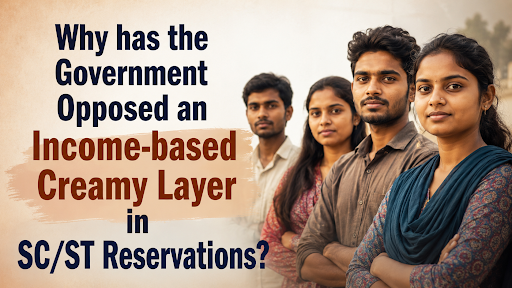
The Union Ministry of Social Justice and Empowerment filed a counter-affidavit before the Supreme Court, opposing a PIL seeking an income-based "creamy layer" in SC/ST reservations, arguing this is a policy matter for Parliament, not the judiciary.
What is the Creamy Layer Concept?
The Creamy Layer refers to the socially advanced and economically better-off members of Other Backward Classes (OBCs) who are excluded from reservation benefits to ensure that affirmative action reaches the genuinely backward sections.
The exclusion is based on the principle that reservation under Article 16(4) is meant for inadequately represented backward classes, not the advanced sections within them.
Origin of the Principle: The 9-Judge Constitution Bench in Indra Sawhney vs Union of India (1992) upheld 27% reservation for OBCs but directed the exclusion of the Creamy Layer.
-
The Creamy Layer principle currently applies only to OBC reservations under Central Government services and educational institutions.
-
The DoPT periodically revises the criteria. The present income ceiling is ₹8 lakh per annum, excluding income from salary and agriculture.

Why Centre Opposed Income-based Creamy Layer for SC/STs?
Reservation Addresses Historical Discrimination: SC/ST reservation is based on historical and social disabilities, not merely economic deprivation; therefore, income alone cannot determine continued disadvantage.
Economic Mobility Does Not End Caste-based Exclusion: Economically successful SC/ST individuals may still face discrimination in housing, marriage, employment and social interactions, making social stigma distinct from economic status.
Constitutional Objective of Affirmative Action: Reservation seeks substantive equality under Articles 15(4), 15(5), 16(4), 16(4A) and Article 46, ensuring adequate representation and social justice rather than functioning as a poverty-alleviation programme.
Judicial Distinction Between OBC and SC/ST Reservations: Courts treated OBC reservations and SC/ST reservations as constitutionally distinct, with the Creamy Layer principle evolving specifically in the OBC context.
Legislative and Democratic Domain: Change in SC/ST reservation policy should emerge through Parliamentary deliberation and democratic consensus, rather than judicial extension of the OBC Creamy Layer doctrine.
Judicial Intervention
Indra Sawhney Judgment, 1992
The 9-judge bench upheld 27% OBC reservation, capped total reservation at 50% (with exceptions), and introduced the creamy layer exclusion for OBCs only, explicitly holding it had no relevance to SC/STs.
M. Nagaraj Judgment, 2006
The Supreme Court upheld Article 16(4A) (reservation in promotion) but required the State to show quantifiable data on backwardness, inadequate representation, and administrative efficiency before granting SC/ST reservation in promotions.
Jarnail Singh Judgment, 2018
The Court held that the State need not collect quantifiable data on backwardness for SCs/STs since they are presumed backward due to historical discrimination, but reaffirmed the creamy layer exclusion applies to promotions in this specific context.
State of Punjab v. Davinder Singh, 2024
A 7-judge Constitution Bench held that state governments possess the constitutional power to create sub-classifications within Scheduled Castes (SCs) and Scheduled Tribes (STs) to ensure equitable distribution of reservation benefits.,
Arguments in Favour of Income-based Creamy Layer
Aids the most deprived: Excluding wealthier members enhances intra-group equity and directs benefits to truly disadvantaged sections, aligning with the Indra Sawhney (1992) precedent for OBCs.
Curbs elite capture: Prevents affluent families from monopolising quotas, creating space for first-generation learners. The Standing Committee on Welfare of OBCs advised rationalising criteria to ensure equitable distribution.
Promotes distributive justice: Income-based exclusion aligns affirmative action with substantive equality under Articles 14 and 16 by prioritising the socio-economically disadvantaged.
Improves public legitimacy: Periodic review of creamy layer norms, as recommended by the National Commission for Backward Classes (NCBC), ensures benefits reach intended beneficiaries.
Supports sub-classification: Economic filters complement sub-categorisation to enhance representation for more backward groups, consistent with constitutional recognition.
Arguments Against Income-based Creamy Layer
Historical disadvantage overrides income: Reservation addresses historical social and educational disadvantage rather than poverty alone, as economic growth does not eliminate caste discrimination.
Supreme Court clarification: The Court ruled that parental income alone cannot determine OBC creamy layer status; evaluation must include social advancement, service status and occupational position.
Exclusion risks: Income-based testing risks excluding discriminated families with temporary gains while including advanced groups with low declared incomes.
Administrative challenges: Informal employment, agricultural exemptions, and under-reporting complicate tracking income, wealth, and occupation.
Weakens constitutional rationale: The Centre argued before the Supreme Court that backward class reservation is fundamentally based on historical and social disadvantage, not solely on economic criteria, cautioning against a purely income-based sub-quota.
NCBC's approach: The National Commission for Backward Classes supports a multi-dimensional creamy layer framework combining income with occupational status, constitutional posts, public employment hierarchy, and property criteria, rather than a single income threshold.
Way Forward
Evidence-Based Reform: Conduct a national socio-economic assessment before changing policies, per the Government's 2026 affidavit.
Target the Most Deprived: Operationalise SC sub-classification, allowed in Davinder Singh (2024), to aid marginalised groups instead of immediate income exclusion.
Periodic Impact Assessment: Setup an independent review mechanism to regularly evaluate the representation, educational outcomes and socio-economic mobility of SC/ST communities, mirroring the DoPT's periodic reviews of OBC creamy layer norms.
Improve Foundational Capabilities: Enhance school education, scholarships, hostels, digital access, and skill development in SC/ST-dominated regions to back affirmative action with capability development, in line with Article 46.
Data-Driven Governance: Build an integrated reservation monitoring dashboard using SECC, Aadhaar-enabled beneficiary databases and educational/employment outcomes to improve transparency while protecting privacy.
Learn From Global Model: To address historical discrimination, countries like South Africa periodically review affirmative action outcomes, showing the value of evidence-based policy recalibration over static approaches for representational equity.
Conclusion
The Centre's opposition shows India's reservation debate is shifting from "how much reservation" to "who truly needs it," without yet settling whether caste or income should decide the answer.
Source: THEHINDU
PRACTICE QUESTIONQ. With reference to the "creamy layer" principle in India, consider the following statements:
Which of the statements given above is/are correct? (a) 1 only (b) 2 only (c) Both 1 and 2 (d) Neither 1 nor 2 Answer: (c) Explanation: Statement 1 is correct: The concept of the "creamy layer" was officially introduced by the Supreme Court of India in the landmark Indra Sawhney & Others v. Union of India case (1992). The court ruled that advanced sections of a backward class (the "creamy layer") must be excluded from the benefits of reservation. Statement 2 is correct: In the 1992 Indra Sawhney judgment, the nine-judge bench explicitly restricted the application of the creamy layer exclusion to Other Backward Classes (OBCs). The court held that this concept was not applicable to Scheduled Castes (SCs) and Scheduled Tribes (STs). |