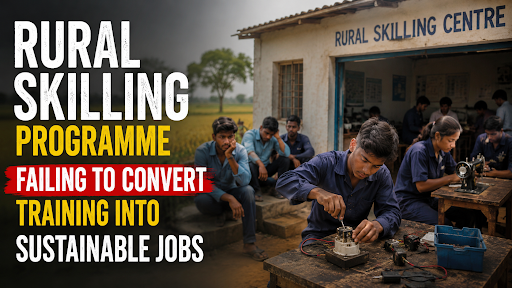
Why In News?
The Parliamentary Standing Committee on Rural Development and Panchayati Raj highlights that DDU-GKY training and initial placement do not ensure sustained employment.
What Is Deen Dayal Upadhyaya Grameen Kaushalya Yojana?
DDU-GKY, launched in 2014, is the "placement-linked skill development programme” aimed at enhancing rural youth employability through industry-oriented training.
Nodal ministry: implemented by the Ministry of Rural Development's Department of Rural Development, with State governments delivering the programme through Project Implementing Agencies (PIAs).
Target group: rural poor youth, with the scheme specifically designed to reach populations most likely to otherwise remain outside formal wage employment.
Placement-linked skill development: unlike generic skilling programmes, DDU-GKY's funding and design are tied to verified job placement outcomes for trainees.
The scheme has a Central Budget allocation of ₹750 crore for FY 2026-27.
What Does the Latest Data Show?
As of June 2026, a total of 18.45 lakh candidates had been trained and 12.35 lakh candidates had been placed under DDU-GKY since the scheme's 2014-15 inception.
This implies a placement rate of roughly 67% of those trained — but the Parliamentary Standing Committee raised concern that this headline figure does not capture whether placements persist beyond the initial job entry.
Placement versus long-term employment: the Committee distinguished between the scheme's placement statistic (a point-in-time measure) and sustained employment (a durability measure), finding the former is currently tracked far more than the latter.
Why Are Trained Youth Not Getting Sustainable Jobs?
Skill-employment mismatch: training content in some Project Implementing Agencies may not align closely enough with the specific, evolving skill demands of local or destination-market employers.
Low wages: entry-level placements in sectors like retail, hospitality, and security services often offer wages insufficient to retain workers once initial job-linked incentives or contractual periods end.
High relocation costs: many DDU-GKY placements require candidates to relocate to urban centres for work, and the financial and social costs of relocation can outweigh the wage benefit for some rural candidates, leading to early attrition.
Poor working conditions: informal or semi-formal employment conditions in some placement sectors contribute to voluntary attrition even where wages are nominally acceptable.
Weak industry linkages: the Committee's recommendation for "mandatory industry linkages" implies that current employer partnerships are not sufficiently robust to guarantee placement quality or retention support.
Limited post-placement support: the Committee's call for "regular post-training follow-ups, mentorship and credit facilitation" points directly to an existing gap — DDU-GKY's institutional support largely ends at the point of initial placement rather than continuing through the retention-critical early months of employment.
Major Problems in Rural Skill Development
Training quality: variation in Project Implementing Agency (PIA) quality directly affects whether trainees receive genuinely job-ready skills or merely certificate-oriented instruction.
Outdated courses: skilling curricula that lag behind evolving industry requirements reduce trainees' actual employability even after formal course completion.
Lack of local employment: many rural districts simply lack sufficient local formal-sector jobs, forcing placement into distant urban markets regardless of a candidate's preference or capacity to relocate.
Poor infrastructure: training centre infrastructure gaps — equipment, connectivity, practical training facilities — can directly limit the quality of skill transfer.
Weak labour market information: without granular, real-time data on which skills specific regional labour markets actually demand, training allocation risks mismatching supply and demand.
Limited career counselling: candidates frequently lack structured guidance on trade selection suited to their aptitude and local/regional job market realities, contributing to early job dissatisfaction and attrition.
Committee's Recommendations
Near 100% placement tracking: the Committee recommended the Department of Rural Development (DoRD) ensure near-complete tracking of placement outcomes, closing the current data gap between reported placements and verified, sustained employment.
Mandatory industry linkages: formal, binding partnerships between Project Implementing Agencies and employers, rather than informal or one-off placement arrangements.
District-level placement cells: localised institutional infrastructure to support both initial placement and ongoing retention monitoring closer to trainees' home districts.
Local placement drives: prioritising placement opportunities within or near a candidate's home region where feasible, reducing relocation-driven attrition.
Migration assistance: structured support — potentially including relocation cost assistance and destination-city support services — for candidates who do need to migrate for placement.
Mentorship and retention support: continued institutional engagement with placed candidates through their early employment period, directly addressing the "post-placement support" gap identified as a driver of attrition.
Outcome-based assessment of training agencies: shifting PIA evaluation and funding criteria toward verified, sustained employment outcomes rather than initial training-completion or placement-day metrics alone.
The Committee recommended enhanced credit flow for rural enterprises and gender-responsive skilling, reflecting a broader push to link skilling with entrepreneurship and address women's specific labour-market barriers.
Source: THEHINDU
|
PRACTICE QUESTION Q. Examine the structural barriers preventing rural skill development programmes from converting training into sustainable employment. 150 words |