Why In News?
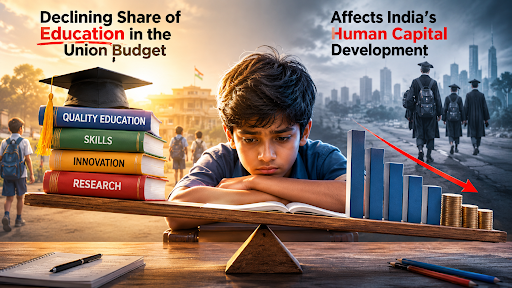
The Ministry of Education's share in the Union Budget sharply declines from 4.6% in 2013-14 to 2.5% in 2025-26, while public expenditure stagnates at 4% of the GDP against the 6% target of the National Education Policy (NEP) 2020.
Why is Public Investment in Education Important?
Human Capital Creation: Every additional ₹1 crore spent on education directly increases the Gross Domestic Product (GDP) by ₹24.01 crore, transforming the youth population into a highly skilled and productive workforce. (Source: NITTTR Chennai)
Demographic Dividend Support: Tertiary education yields a 9.8% return on investment, guaranteeing that youth enter the job market with robust, industry-relevant employability skills. (Source: NCAER)
Inclusive Development: Each additional year of schooling boosts personal income by 7%, pulling families out of poverty, narrowing gender disparities, and empowering marginalized groups. (Source: NITTTR Chennai)
National Competitiveness: Higher funding drives technological adoption and positions India as a global knowledge economy, addressing the reality where universities produce only 10% of India's research publications. Source: NITI Aayog)
Foundational Learning: Early childhood education yields the highest economic returns at 7% to 10% annually, building strong reading and math skills early to reduce school dropout rates. (Source: NITTTR Chennai)
Concerns Regarding the Declining Budget Share
Infrastructure Deficits: Only 54% of government schools feature integrated science labs, a mere 45% have functional computer facilities, and only 32% provide friendly toilets for Children with Special Needs (CWSN). (Source: UDISE+)
Declining Learning Quality: 57% of Grade 5 students cannot read a simple Grade 2 text, while the PARAKH 2024 assessment shows average math scores dropping from 54/100 in Grade 3 to 37/100 in Grade 9. (Source: Annual Status of Education Report)
Research and Innovation Bottlenecks: India spends an incredibly low 0.65% of its GDP on Research and Development (R&D), while Higher Education Institutions under-utilize 50% of allocated research funds. (Source: NITI Aayog)
Skill Development Gap: Only 26% of youth aged 15-29 years receive vocational training (compared to 80% in Japan), creating a "productivity paradox" of deep underemployment. (Source: Periodic Labour Force Survey)
Severe Teacher Shortages: Indian schools suffer from nearly 10 lakh vacant teaching posts, while central universities face a 29% faculty vacancy rate, severely diluting teaching quality. (Source: Standing Committee on Education)
Major Government Initiatives in Education
National Education Policy (NEP) 2020: Targets a 100% Gross Enrolment Ratio (GER) in school education and a 50% GER in higher education by 2030.
Samagra Shiksha: Allocates a record ₹42,100 crore in the 2026-27 budget to integrate school education across all levels.-
PM SHRI Schools: Upgrades 14,500 government schools to showcase NEP goals, backed by an allocation of ₹7,500 crore for 2026-27.
National Digital Education Architecture (NDEAR): Establishes a nationwide digital framework to eliminate the digital divide in classrooms.
SWAYAM and DIKSHA Platforms: Deliver curriculum-aligned virtual content and QR-coded textbooks to scale up digital learning.
National Research Foundation (NRF): Fosters an innovation-driven culture and funds interdisciplinary research across universities.
PM Vidyalaxmi Scheme: Guarantees 75% of outstanding education loans up to ₹7.5 lakh to support meritorious students in higher education.
Challenges in the Education Sector
Learning Outcome Gaps: Prioritizes student enrolment over actual learning outcomes, causing massive drops in math and language proficiency in higher grades.
Digital Divide: Restricts access as only 48% of government schools have internet access, and a shocking 5% possess computers actively used for teaching. (Source: UDISE+)
Unqualified Teaching Staff: Leaves over 50% of pre-primary teachers without professional teaching qualifications, harming early childhood care. (Source: UDISE+)
Regional Inequalities: Creates stark disparities, where Tamil Nadu achieves a 47% GER in higher education while Bihar lags at just 17%. (Source: All India Survey on Higher Education)
Inadequate Public Spending: Stagnates government spending at 2.4% to 2.6% of the overall union budget, forcing an over-reliance on private coaching and out-of-pocket expenses.
Employability Concerns: Fails to meet modern industry demands due to an outdated curriculum, drastically reducing graduate employability.
Examination Integrity Failures: Destroys student trust and triggers immense anxiety through repeated controversies like the 2026 NEET-UG paper leak.
Measures to Strengthen India's Education Sector
Escalate Public Investment: Executes a progressive budget increase to reach the 6% of GDP target recommended by the Kothari Commission.
Enhance School Quality: Focuses on the NIPUN Bharat Mission to guarantee foundational reading and arithmetic skills by Grade 3.
Support Higher Education and Research: Distributes funds equitably to State Public Universities which serve nearly 80% of students but remain critically underfunded. (Source: NITTTR Chennai)
Expand Digital and Skill-Based Learning: Integrates vocational education starting from Grade 6 to build a highly employable workforce.
Teacher Capacity Building: Fills existing vacancies through regular appointments and trains educators using digital platforms like NISHTHA.
Outcome-Based Monitoring: Adopts performance-based budgeting and establishes an Education Expenditure Monitoring Authority to eliminate fund under-utilisation.
Secure Examination Systems: Transforms the National Testing Agency (NTA) into a fully secure, digital authority to prevent paper leaks and restore youth confidence.
Conclusion
To achieve Viksit Bharat 2047, India must elevate education spending to 6% of GDP, secure examination systems, and prioritize foundational learning to harness demographic dividend.
Source: INDIANEXPRESS
|
PRACTICE QUESTION Q. Discuss the implications of declining budgetary prioritisation of education for India's long-term economic and social development. 150 words |