Why In News?
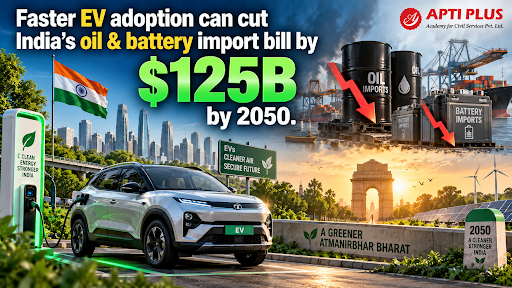
The International Council on Clean Transportation (ICCT) study projected that rapid electric vehicle adoption could slash India's combined oil and battery import bill by $125 billion annually by 2050.
Highlights of the Report
Import Savings: Rapid electrification of passenger vehicles and two-wheelers can eliminate $125 billion in combined oil and battery import costs annually by 2050, driven primarily by petroleum displacement.
Domestic Manufacturing Boost: Expanding domestic gigafactories under the Production Linked Incentive (PLI) scheme adds an extra $31 billion in annual savings.
Key Policy & Sectoral Priorities: Priority areas include heavy-duty freight electrification and enforcing stricter Corporate Average Fuel Economy (CAFE-III) fuel economy standards.
What are Electric Vehicles?
Battery Electric Vehicles (BEVs): Pure zero-emission automobiles powered entirely by chemical energy stored in rechargeable lithium-ion battery packs like the Tata Nexon EV.
Plug-in Hybrid Electric Vehicles (PHEVs): Dual-powertrain automobiles combining an electric traction motor with an internal combustion engine, such as the Toyota Innova Hycross.
Hybrid Electric Vehicles (HEVs): Self-charging passenger vehicles that regenerate kinetic braking energy into a small auxiliary battery without external grid plugging.
Fuel Cell Electric Vehicles (FCEVs): Advanced vehicles utilizing compressed green hydrogen inside fuel cells to generate electricity, piloted under Indian Oil's green hydrogen bus trials.
Why is EV Adoption Important for India?
Curbing Crude Oil Import Bill: Replaces imported fossil fuel in a nation spending over $120 billion annually to import 87% of its crude requirements.
Urban Air Quality Restoration: Slashes tailpipe PM2.5 and nitrogen oxide emissions across polluted cities monitored under the National Clean Air Programme (NCAP).
Paris Climate Commitment Delivery: Accelerates India’s Nationally Determined Contribution (NDC) goal to reduce the emissions intensity of GDP by 45% by 2030.
Renewable Grid Energy Balancing: Utilizes parked vehicle-to-grid (V2G) EV batteries to absorb surplus solar power generated during peak daylight hours.
Industrial Job Creation in Manufacturing: Drives domestic component fabrication under Make in India, creating high-skill engineering jobs in auto clusters like Chennai and Pune.
Lower Operating Costs for Commuters: According to the Union Road Transport and Highways Minister, the running cost of an EV is about ₹1 per km, compared to ₹5-₹7 per km for petrol or diesel vehicles.
What is the Battery Challenge?
Supply Chain Concentration in China: China accounted for 70% of electric car production and over 80% of battery cell production, as well as about 85% of global production of cathode active material and more than 90% of production of anode active material used in electric car batteries. (Source: IEA)
Upstream Critical Mineral Scarcity: India possesses negligible commercial domestic mining output for battery-grade lithium, cobalt, nickel, and spherical graphite.
Early-Stage Mineral Discovery Hurdles: Developing the 5.9-million-tonne inferred lithium discovery at Salal-Haimana in Jammu & Kashmir requires multi-year commercial extraction testing.
High Battery Replacement Capital Costs: The battery pack constitutes nearly 40% of the upfront retail purchase price of an electric passenger vehicle. (Source: NITI Aayog)
Thermal Management in Tropical Climates: Ambient summer temperatures exceeding 45°C induce thermal runaway risks in uncertified lithium nickel-manganese-cobalt (NMC) battery chemistries.
What are the Major Challenges?
High Upfront Purchase Disparity: Electric passenger four-wheelers remain 25% to 40% costlier than internal combustion engine counterparts due to battery cell costs. (Source: NITI Aayog)
Highway Fast-Charging Deficit: India has 52,718 public electric vehicle (EV) charging stations, including 16,561 public charging stations equipped with fast EV chargers for cars.
Severe Range Anxiety Among Drivers: Inadequate fast-charging plazas on national highways deter long-distance intercity travel for commercial fleet operators.
Distribution Grid Transformer Overloading: Uncontrolled evening home charging surges threaten to overload local 11-kV distribution transformers managed by state DISCOMs.
Commercial Freight Electrification Gaps: Electric heavy-duty commercial trucks face limited market availability and payload penalties from heavy battery pack weights.
Nascent Battery Recycling Infrastructure: Informal scrap processing predominates, causing environmental hazards and preventing circular recovery of battery-grade lithium and nickel.
What are the Major Government Initiatives?
PM E-DRIVE Scheme (₹10,900 Crore Outlay): Subsidizes 24.7 lakh electric two-wheelers, 3.1 lakh e-rickshaws, and 14,028 e-buses while deploying 72,300 fast chargers.
PLI Scheme for Advanced Chemistry Cells: Incentivizes domestic manufacturing of 50 GWh battery capacity, awarded to firms like Ola Electric and Reliance New Energy.
PLI for Automotive and Auto Components: Supports domestic manufacturing of advanced electronic powertrains, sensor suites, and electric drive motors.
Overseas Mineral Acquisitions via KABIL: Khanij Bidesh India Ltd signed a ₹200-crore exploration pact for 5 lithium brine blocks in Catamarca Province, Argentina.
Critical Mineral Blocks Domestic Auction: Amended the MMDR Act in 2023 to enable private commercial auction of offshore and domestic lithium and graphite blocks.
Battery Waste Management Rules, 2022: Mandates 90% recovery of battery materials under Extended Producer Responsibility (EPR) targets enforced by CPCB.
Fiscal Concessions & Tax Relief: Levies a preferential 5% GST rate on EVs compared to 28% on petrol vehicles, offering income tax deductions under Section 80EEB.
Way Forward
Deploy Fast Charging Along National Expressways: Install 150-kW DC fast-charging plazas every 25 kilometers along the Delhi-Mumbai and Yamuna Expressways under PM E-DRIVE.
Scale Sodium-Ion & Solid-State Battery R&D: Finance pilot manufacturing of sodium-ion battery packs developed by CSIR-CECRI to eliminate foreign lithium dependence.
Establish Circular Battery Recycling Parks: Provide capital subsidies under the National Clean Energy Fund to build hydrometallurgical black mass recycling hubs in Gujarat.
Mandate Zero-Emission Trucking Corridors: Deploy megawatt charging stations to pilot electric freight corridors along the Golden Quadrilateral highway network.
Implement Time-of-Day (ToD) Charging Tariffs: Enforce cheaper daytime electricity rates to incentivize EV owners to charge vehicles during peak solar generation hours.
Formulate a National Battery Swapping Policy: Standardize battery pack dimensions and interoperable connectors for electric two-wheelers and three-wheelers.
Learn from Global Successful Model
-
Norway’s 80% New Car Electrification Model: Leveraged carbon tax penalties on petrol cars and zero VAT on BEVs to achieve 82% EV sales penetration.
-
CATL’s Battery Swapping Network in China: Deployed EVOGO modular battery-swapping stations across 10 major Chinese cities, swapping batteries in under 60 seconds.
Conclusion
Accelerating electric vehicle adoption paired with domestic battery gigafactories decouples Indian economic growth from volatile crude oil imports and secures strategic energy sovereignty.
Source: MONEYCONTROL
|
PRACTICE QUESTION Q. Examine how accelerating electric vehicle adoption can insulate India against geopolitical crude oil shocks while creating new critical mineral vulnerabilities. (10 Marks, 150 Words) |