Why In News?
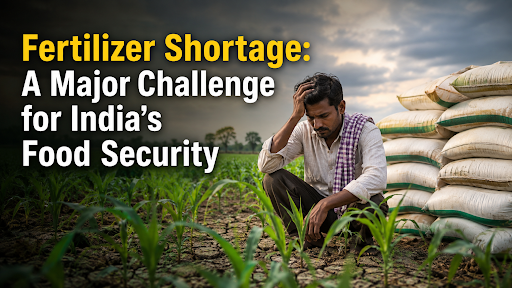
The Parliamentary Standing Committee on Chemicals and Fertilisers flagged that recurring fertiliser shortages and distribution disruptions occur despite adequate national availability, pointing to gaps in Centre-State coordination and last-mile delivery.
Fertiliser Sector In India
India is the second-largest consumer of fertilisers globally and the third-largest producer, making the sector critical for food security and agricultural productivity.
The sector is regulated by the Department of Fertilizers under the Ministry of Chemicals & Fertilizers, with subsidies ensuring affordable fertiliser availability to farmers.
Types of fertilizers: Broadly divided into Nitrogenous (Urea), Phosphatic (DAP, SSP), Potassic (MOP), and complex/NPKS fertilizers combining multiple nutrients.

Structure of the Fertiliser Sector
Nitrogenous Fertilisers (Urea)
-
Urea remains price-controlled under the New Urea Policy, with subsidy provided directly to manufacturers.
Phosphatic & Potassic (P&K) Fertilisers
-
Governed under the Nutrient Based Subsidy (NBS) Scheme (2010), where subsidy is linked to nutrient content rather than product price.
-
The Union Cabinet approved ₹41,533.81 crore as the tentative NBS outlay for Kharif 2026 to ensure affordable P&K fertilisers.
Why India Face Fertilizer Shortage?
Fertilizer shortage refers to the inadequate or delayed availability of key nutrients — Urea (Nitrogen), DAP (Phosphorus), MOP (Potash), and NPKS complexes — at the point of sale, especially during peak sowing periods.
Seasonal demand-supply gap: Demand spikes sharply during the Kharif (June-October) and Rabi (October-March) sowing windows, creating short, intense periods where any delay in dispatch or distribution causes visible shortages, even if annual national stock is sufficient.
-
Fertilizer must reach farmers within the narrow sowing window; a delay of even 2-3 weeks can force farmers to skip application or under-fertilise, directly hitting crop yield.
The Parliamentary Standing Committee on Chemicals and Fertilisers called for a strategic fertiliser supply disruption contingency framework, with alternate sourcing, strategic buffer stocks, coordinated logistics, and periodic review of gas allocation .
Causes of Fertilizer Shortage
Import dependence: India imports nearly 100% of Muriate of Potash (MOP) and about 90% of phosphatic raw materials or finished Di-Ammonium Phosphate (DAP), creating an acute macroeconomic vulnerability to international supply shocks and maritime chokepoint disruptions.
Global supply chain disruptions: Geopolitical disruptions like the West Asia conflict and Strait of Hormuz closure jeopardize LNG imports. This directly impacts domestic Urea production, as natural gas serves as the essential feedstock for urea manufacturing facilities.
Geopolitical conflicts: Wars and sanctions (e.g., affecting Russia and Belarus, major global Potash exporters) disrupt global fertilizer trade flows and raise prices.
Rising input costs: Volatile global raw material and fertilizer prices inflate the subsidy burden and hinder import planning, prompting the government to consider this price volatility when setting NBS rates.
Distribution bottlenecks: Even with adequate national stock, poor last-mile logistics, delayed rail movement, and Centre-State coordination gaps cause localised shortages in specific districts or states.
Government Initiatives to Support Fertilizer Sector
Nutrient Based Subsidy (NBS) Scheme: Provides subsidy on Phosphatic and Potassic (P&K) fertilizers based on nutrient content; the Parliamentary Standing Committee recommended rationalising NBS rates and expanding the number of P&K fertilizers covered to encourage domestic production.
New Urea Policy: Aims to boost domestic urea production capacity and reduce import dependence through new investment incentives, including six new urea plants set up under the New Investment Policy-2012.
PM-PRANAM Scheme (PM Programme for Restoration, Awareness, Nourishment and Amelioration of Mother Earth): Incentivises States to reduce chemical fertilizer usage and promote balanced and alternative fertilizers.
Neem-coated Urea: Mandatory coating that reduces diversion of subsidised urea for industrial use and improves nitrogen use efficiency in soil.
One Nation One Fertilizer: Mandates uniform branding ("Bharat") for all subsidised fertilizers across companies, improving quality perception and reducing confusion for farmers.
Integrated Fertilizer Management System (iFMS): An online tracking system used by the government to monitor fertilizer movement, allocation, and stock levels in real time.
Nano fertilizers: Promoting nano-urea and nano-DAP as lower-volume, cost-effective alternatives to conventional fertilizers.
Challenges In Fertilizer Sector
Import dependency: Heavy reliance on import exposes India to global price volatility, export restrictions and geopolitical shocks.
-
The Parliamentary Standing Committee on Chemicals & Fertilizers recommended a dedicated task force to expand indigenous P&K manufacturing through fiscal and tax incentives.
Regional supply imbalances: Local shortages persist despite adequate national stocks due to weak rail logistics, poor last-mile distribution and Centre-State coordination.
-
The Parliamentary Standing Committee recommended a national contingency logistics framework with buffer stocks and dynamic inter-state allocation.
Fertilizer diversion and black marketing: Diversion, forced bundling, pilferage and substandard fertilizers continue despite large subsidies.
-
The Parliamentary Standing Committee recommended random quality inspections, stricter enforcement under the Fertilizer (Control) Order, 1985, and stronger digital monitoring of movement.
Imbalanced nutrient use: Subsidised urea has diverted fertilizer consumption away from the recommended 4:2:1 N:P:K ratio, reducing nutrient-use efficiency and degrading soil health.
-
The Parliamentary Standing Committee recommended expanding the Nutrient-Based Subsidy (NBS) regime and rationalising subsidy rates to encourage balanced fertilization.
High fiscal burden: Fertilizer subsidies remain vulnerable to global price movements.
-
The Parliamentary Committee recommended realistic subsidy budgeting, proximity-based fertilizer allocation and freight optimisation to reduce logistics costs without affecting availability.
Way Forward
Build fertilizer self-reliance
Expand domestic urea, phosphatic and potassic fertilizer capacity through fiscal incentives and long-term raw material partnerships, as recommended by the Parliamentary Standing Committee on Chemicals & Fertilizers.
Develop resilient supply chains
Institutionalise buffer stocks, diversified import sourcing, multimodal logistics and real-time allocation using the Integrated Fertilizer Management System (iFMS) to minimise regional shortages.
Promote balanced nutrient management
Link NBS reforms, PM-PRANAM, Soil Health Cards and precision agriculture to encourage scientific fertilizer application and restore the recommended nutrient balance.
Accelerate nano and alternative fertilizers
Scale up Nano Urea, Nano DAP and bio-fertilizers. A National Productivity Council assessment found that Nano Urea, when used with the recommended basal dose of conventional urea, increased crop yields by 1.65–14.82%.
Strengthen regulatory oversight
Deploy AI-enabled stock monitoring, GPS-based fertilizer tracking, e-authentication at retail points and stricter enforcement against diversion and forced bundling under the Fertilizer (Control) Order, 1985.
Adopt a risk-based fertilizer strategy
Periodically assess geopolitical risks, diversify supplier countries and establish strategic reserves of critical fertilizers and raw materials to protect food security during global disruptions.
Conclusion
India's fertilizer challenge is less about national scarcity and more about fragile import dependence and last-mile delivery gaps, both of which demand a standing contingency framework, not just crisis-driven fixes.
Source: THEHINDU
|
PRACTICE QUESTION Q. "Despite adequate national fertilizer stocks, India continues to witness localised shortages during peak cropping seasons." Analyse the causes of this paradox and suggest measures to strengthen India's fertilizer supply chain. (250 words) |