Why In News?
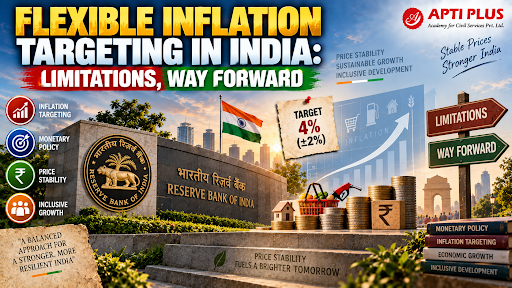
Experts questioned the efficacy of the Monetary Policy Committee's 4% inflation target, citing persistent food supply shocks.
What is Inflation Targeting?
It is a central bank monetary policy where the institution sets a clear, public numerical goal for the inflation rate over the medium term.
-
Numerical Inflation Mandate: Legally commits the monetary authority to achieve a transparent, pre-announced target rate of consumer inflation.
-
Rule-Governed Policy: Replaces discretion with systematic repo rate adjustments to maintain macroeconomic price stability.
-
Anchoring Expectations: Communicates transparent policy projections to anchor inflation expectations across businesses, consumers, and investors.
How Does Inflation Targeting Work?
|
India’s Inflation Target
Statutory 4% Headline Target: Sets an explicit headline CPI inflation target of 4.0% notified by the Central Government in consultation with the Reserve Bank under Section 45ZA of the RBI Act.
Symmetric +/- 2% Tolerance Band: Establishes a flexible tolerance corridor ranging between an upper tolerance limit of 6.0% and a lower tolerance limit of 2.0%.
Statutory Accountability Failure Trigger: Deems the monetary framework failed if headline inflation breaches the 2% to 6% band for three consecutive quarters, requiring an explanatory report to Parliament.
Monetary Policy Committee (MPC) Authority: Empowers a six-member statutory committee (three internal RBI officials and three external government-appointed experts) to set the repo rate by majority vote.
Monetary Policy Framework In India
Formal RBI-Government Agreement: Institutionalized through the Monetary Policy Framework Agreement signed in February 2015 based on the Urjit Patel Committee recommendations.
Legislative Enactment in 2016: Codified into law through amendments to the Reserve Bank of India Act, 1934 via the Finance Act, 2016.
Policy Repo Rate Mechanism: Adjusts the benchmark rate at which scheduled commercial banks borrow overnight liquidity against government securities from the RBI.
Liquidity Adjustment Facility (LAF) Operations: Manages banking system liquidity daily through the Standing Deposit Facility (SDF) and Marginal Standing Facility (MSF) corridor.
Forward-Looking Inflation Forecasting: Formulates bimonthly policy stances based on quarterly Surveys of Professional Forecasters and Household Inflation Expectations Surveys.
What are the Limitations?
Vulnerability to Perishable Food Shocks: Food and beverage items constitute 36.75% weight in the CPI basket, which monetary interest rate levers cannot directly expand.

Imported Crude Oil Volatility: India imports over 87% of its crude requirements, transmitting West Asian geopolitical crude spikes directly into domestic transport logistics costs.
Climate and Weather-Induced Disruptions: Unseasonal monsoon deluges and heatwaves cause frequent supply-side price spikes in perishables like tomatoes, onions, and potatoes (TOP).
Large Unorganized Informal Economy: Over 90% of India's labor workforce operates in informal markets with limited access to formal bank loans, bypassing monetary rate transmission.
Disproportionate Employment Costs: Aggressive monetary tightening dampens labor-intensive micro, small, and medium enterprise (MSME) hiring without addressing supply bottlenecks.
Way Forward
Strengthen Farmgate Cold-Chain Logistics: Utilize capital outlays under the ₹1-lakh-crore Agriculture Infrastructure Fund (AIF) to build decentralized cold storages for perishables.
Formalize Monetary-Fiscal Policy Coordination: Complement RBI interest rate action with government fiscal measures like strategic food buffer releases and tariff cuts.
Refine CPI Basket Weights to Reflect Modern Spending: Periodic update base year of the Consumer Price Index using the latest Household Consumer Expenditure Survey (HCES).
Debate Exclusion of Food from the Primary Policy Anchor: Targeting Core Inflation (excluding volatile food and fuel) while monitoring headline CPI under a dual-indicator framework.
Enhance Full Banking System Transmission: Mandate standardized external benchmark lending linkages across commercial bank deposit rates to eliminate transmission delays.
Conclusion
While Flexible Inflation Targeting anchored macroeconomic stability for a decade, combining monetary policy with proactive agricultural supply-chain management is essential for durable price stability in India.
Source: THEHINDU
|
PRACTICE QUESTION Q. Analyze the limitations of monetary policy instruments in curbing inflation in India given the high weight of food items in the Consumer Price Index basket. (10 Marks, 150 Words) |