Why In News?
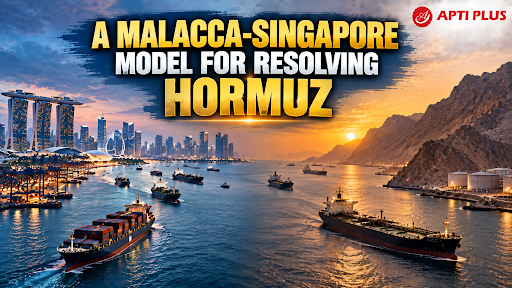
Recent diplomatic consultations between Iran and Oman have explored establishing a joint framework to manage ship transits and maritime security through the Strait of Hormuz.
What is the Strait of Hormuz?
Strategic Oil Transit Route: The Strait of Hormuz is a narrow maritime passage connecting the Persian Gulf to the Gulf of Oman and the Arabian Sea.
Persian Gulf Connectivity: At its narrowest point, the territorial seas of Iran and Oman overlap, leaving no high seas corridor and placing transiting vessels under the Transit Passage regime.
Global Energy Trade: The strait handled 20.7 million to 20.9 million barrels per day of crude oil and petroleum products in 2024–2025, accounting for 20% to 25% of global seaborne oil trade.
Maritime Chokepoint Vulnerability: Because Hormuz represents a singular maritime outlet for Persian Gulf oil producers, security disruptions—such as mine deployments and vessel detentions, forcing merchant ships to anchor outside the strait.

What is the UNCLOS Legal Framework Governing Transit Passage in International Straits?
Codification of Global Commons: The United Nations Convention on the Law of the Sea (UNCLOS) establishes the legal regime governing international straits connecting one part of the High Seas or Exclusive Economic Zone (EEZ) to another.
Innocent Passage versus Transit Passage: While foreign vessels in coastal Territorial Seas (up to 12 nautical miles) enjoy Innocent Passage—which coastal states can temporarily suspend for essential security reasons—straits used for international navigation operate under Transit Passage pursuant to UNCLOS Part III (Articles 37–44).
Non-Suspendable Rights: Under UNCLOS Article 38(1) and Article 44, Transit Passage guarantees continuous, expeditious, and non-suspendable navigation and overflight for all commercial and military vessels. Coastal states cannot hamper, suspend, or deny passage through international straits.
Prohibition of Transit Tolls: UNCLOS Article 26(1) prohibits levying any tolls, taxes, or transit fees on foreign vessels solely by reason of their passage through territorial waters or international straits.
-
Charges are permissible under UNCLOS Article 26(2) only as specific service fees for direct operational assistance, such as pilotage, towing, or waste reception.
The Burden-Sharing Clause: UNCLOS Article 43 mandates that user states and bordering states "should cooperate by agreement" to maintain navigational aids and prevent marine pollution.
-
However, the use of non-binding hortatory language ("should" instead of "shall") leaves user states without mandatory financial obligations, creating a structural legal gap.
How Malacca Cooperative Mechanism Function as a Regional Governance Model?
Coordinated Maritime Security: Bordered by Indonesia, Malaysia, and Singapore (with Thailand joining later), the Straits of Malacca and Singapore are governed cooperatively without resorting to unilateral tolls or transit restrictions.
Joint Surveillance & Information Sharing: Security is maintained through the Malacca Strait Patrols (MSP), created in 2004, which combines coordinated naval patrols (MSSP), joint aerial surveillance (Eyes in the Sky / EiS), and real-time intelligence pooling via the Intelligence Exchange Group (IEG).
Voluntary User-State Funding: Established in 2007 under UNCLOS Article 43, the Aids to Navigation Fund (ANF) collects voluntary financial contributions from major user nations—including Japan, China, South Korea, India, and the UAE—to maintain lighthouses, buoys, and digital traffic systems, raising over $23 million by 2023.
Protection of Commercial Shipping: Supplementary frameworks like the Revolving Fund Committee (RFC) provide immediate cash advances for oil spill cleanups, reducing piracy from 79 incidents in 2004 down to 12 in 2008.

Why is Applying the Malacca Governance Blueprint to the Strait of Hormuz Is Challenging?
Fundamental Geopolitical Divergence: Unlike Southeast Asia, where littoral states share decades of institutional trust under ASEAN, the Strait of Hormuz is fraught with active state-level military confrontation involving Iran, neighboring Gulf states, and external powers.
Geographic Bottleneck and Rerouting Options: Hormuz represents a singular maritime outlet connecting the Persian Gulf to the Arabian Sea; a blockage leaves vessels completely stranded without alternative sea routes.
-
In contrast, a blockage in Malacca allows ships to reroute through alternative Indonesian archipelagic waterways, such as the Sunda Strait or Lombok Strait.
Strategic Incentives and State Behavior: The Malacca littoral nations derive their primary economic legitimacy from keeping shipping lanes open.
-
Conversely, Iran views Hormuz as strategic leverage, using threats of closure, sea mining, and vessel seizures during regional conflicts.
Unilateral Tolls vs Voluntary Financing: Proposals to levy compulsory transit tolls in Hormuz conflict directly with UNCLOS Article 26 freedom of navigation rules.
-
Mandatory passage fees cannot legally replicate the Malacca model, which relies strictly on voluntary user-state contributions through the Aids to Navigation Fund (ANF).
Unresolved Boundary Disputes: Iran maintains territorial disputes over the Three Emirati Islands (Greater Tunb, Lesser Tunb, and Abu Musa) and claims expansive coastal controls over passage.
-
In contrast, Malaysia and Indonesia successfully resolved their long-standing maritime boundary disputes in 2023.

Way Forward
Maritime Information Sharing & Sensor Fusion: Transitioning from military sea-denial tactics to deterrence by detection, using persistent Intelligence, Surveillance, and Reconnaissance (ISR), multi-sensor intelligence fusion, and automated AIS tracking to observe anomalies and prevent unlawful interdictions.
Treaty-Backed Burden Sharing: Institutionalizing user-state co-financing protocols—such as a proposed IMO Maritime Corridor Security and Safety Fund (MCSSF)—to ensure flag states and commercial beneficiaries share the financial cost of maritime security under UNCLOS Article 43.
Regional Confidence Building & Multilateral Governance: Utilizing the International Maritime Organization (IMO) and regional forums to de-escalate tensions, establish clear codes of conduct, and guarantee non-discriminatory navigation across global chokepoints.
Conclusion
Unilateral attempts to monetize or restrict international straits violate international law. Securing key chokepoints requires replacing uncompensated coastal state burdens with binding, treaty-backed user-state co-financing frameworks under UNCLOS.
Source: THEHINDU
|
PRACTICE QUESTION Q. Consider the following statements regarding the United Nations Convention on the Law of the Sea (UNCLOS):
Which of the statements given above are correct? (a) 1 and 2 only (b) 2 and 3 only (c) 1 and 3 only (d) 1, 2, and 3 Answer: (b) Explanation: Statement 1 is incorrect: While UNCLOS is famously referred to as the "Constitution for the Oceans" (a phrase coined by Tommy T.B. Koh at the final session of UNCLOS III), it was adopted in 1982 and did not enter into force until November 16, 1994 (after Guyana became the 60th state to ratify it), which is after 1990. Statement 2 is correct: The United Nations Convention on the Law of the Sea (UNCLOS) is recognized as the only comprehensive international legal convention that establishes the jurisdictional framework across distinct maritime spaces (such as Internal Waters, Territorial Sea, Contiguous Zone, Exclusive Economic Zone, and the Continental Shelf). Statement 3 is correct: India signed the convention in 1982 and subsequently ratified it in 1995, making it a full state party. |