Why In News?
Researchers are developing hydrogel carriers that release zinc, iron and other micronutrients slowly to crop roots, to cut fertiliser loss and tackle hidden hunger.
What Are Hydrogels?
-
Hydrogels are three-dimensional (3D), water-insoluble networks of crosslinked hydrophilic (water-attracting) polymers that can absorb and retain vast amounts of water or biological fluids (often 70% to 99% by weight) without dissolving.
-
Because they are soft, flexible, and rich in water, they closely mimic living tissues and act as "smart" materials that can swell or shrink in response to external stimuli like temperature, pH, light, or chemical signals.
Key Characteristics
-
High Water Retention: Crosslinking prevents the polymer chains from dissolving in water while allowing the network to swell significantly.
-
Biocompatibility & Softness: High water content and rubbery/viscoelastic mechanics make them compatible with biological systems and soft tissues.
-
Stimuli-Responsiveness: Many hydrogels alter their volume, permeability, or structure when exposed to changes in pH, temperature, ionic strength, or specific biomolecules.
-
Porosity: Allows diffusion of nutrients, oxygen, and therapeutic molecules.
Types & Sources
-
By Origin:
-
Natural: Derived from biopolymers such as alginate, chitosan, hyaluronic acid, gelatin, collagen, and fibrin (or naturally occurring gels like mucus and clots).
-
Synthetic: Lab-engineered polymers such as polyvinyl alcohol (PVA), polyethylene glycol (PEG), polyacrylamide, and sodium polyacrylate.
-
By Crosslinking:
-
Physical hydrogels: Held together by reversible non-covalent interactions (hydrogen bonds, ionic interactions, hydrophobic associations).
-
Chemical hydrogels: Held by strong covalent bonds, offering greater mechanical stability.
Major Applications
-
Healthcare & Medicine: Used in controlled and targeted drug delivery (including injectable hydrogels designed for localized cancer therapy), wound dressings and burn care (maintaining a moist healing environment), tissue engineering scaffolds, and soft contact lenses.
-
Environment & Sustainability: Applied in water purification and pollutant removal—for instance, engineered hydrogels developed to trap and degrade microplastics in water—as well as moisture harvesting and agricultural water retention.
-
Consumer & Emerging Tech: Found in hygiene products (diapers, sanitary pads) and emerging fields like soft robotics, bioelectronics, and humidity/cooling systems.
Hydrogels For Targeted Micronutrient Delivery In Crops
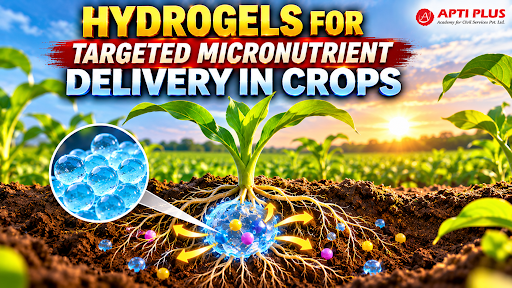
Hydrogels for micronutrient delivery in crops use three-dimensional, water-retaining polymer networks to encapsulate essential trace elements (such as iron, zinc, boron, and manganese) and release them gradually near plant roots.
How It Works
-
Water & Nutrient Trapping: Hydrophilic, cross-linked polymer chains swell upon absorbing water and hold dissolved micronutrients or fertilizer ions inside their 3D matrix.
-
Controlled & Stimuli-Responsive Release: Instead of washing away in a single rain or irrigation event, nutrients diffuse slowly into the rhizosphere. Advanced "smart" hydrogels respond to soil cues—such as pH shifts (for example, seaweed-based beads releasing micronutrients when soil turns acidic), moisture levels, or temperature—matching release to crop demand.
-
Swell–Dry Cycling: Repeated hydration and drying cycles help maintain root-zone moisture and steady ionic availability across the growing season.
Types of Hydrogels
-
Synthetic Superabsorbent Polymers (SAPs): Such as potassium polyacrylate; offer high water retention and durability, but are petroleum-derived and raise concerns over soil persistence or microplastics.
-
Biopolymer-Based Hydrogels: Derived from natural sources like alginate (seaweed), chitosan, cellulose, or starch; offer better biodegradability and eco-friendliness, though mechanical strength and shelf life can vary.
Key Benefits for Agriculture
-
Higher Nutrient-Use Efficiency: Cuts leaching and runoff losses, helping address micronutrient deficiencies (like zinc or iron deficiency) without excessive application.
-
Water Conservation & Drought Resilience: Retains moisture in porous or rainfed soils, reducing irrigation frequency and buffering crops against water stress.
-
Reduced Environmental Footprint: Lowers nitrate/ion leaching into groundwater and curbs eutrophication in water bodies.
-
Synergy with Bio-Inputs: Can also carry beneficial microbes, biostimulants, or soil-remediation agents alongside nutrients.
Limitations & Challenges
-
Cost & Scalability: Higher unit costs compared to conventional fertilizers can limit adoption among small and marginal farmers.
-
Soil Chemistry & Degradation: High salinity or multivalent ions in soil can reduce swelling capacity, while non-biodegradable synthetic polymers pose long-term ecological questions.
-
Field Standardization: Dosage and release rates depend heavily on crop type, soil texture, climate, and tillage practices.
Source: INDIANEXPRESS
|
PRACTICE QUESTION Q. Consider the following statements: Statement-I: Hydrogel-based delivery can reduce losses of applied micronutrients compared with conventional soil application. Statement-II: Micronutrients held in the cross-linked polymer network are released gradually as the gel swells and its chains relax. Which one of the following is correct in respect of the above statements? (a) Both Statement-I and Statement-II are correct and Statement-II explains Statement-I (b) Both Statement-I and Statement-II are correct, but Statement-II does not explain Statement-I (c) Statement-I is correct, but Statement-II is incorrect (d) Statement-I is incorrect, but Statement-II is correct Answer: (a) Explanation: Statement-I is correct: Conventional soil application of micronutrients (such as zinc, iron, or boron) often results in significant losses due to leaching, surface runoff, and chemical fixation in the soil. Encapsulating them in hydrogels (superabsorbent polymers) minimizes these environmental losses and improves nutrient-use efficiency. Statement-II is correct: Hydrogels consist of a three-dimensional, cross-linked polymer network. When exposed to soil moisture, the hydrogel absorbs water, swells, and undergoes polymer chain relaxation, allowing the entrapped micronutrients to diffuse out slowly into the root zone. Because the micronutrients are released gradually rather than all at once (Statement-II), plants can absorb them steadily over time, directly preventing sudden leaching or soil fixation losses (Statement-I). |