Why In News?
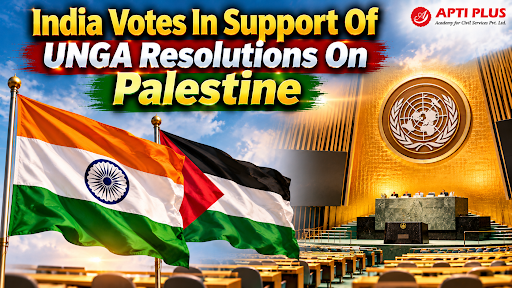
India voted in favour of four United Nations General Assembly (UNGA) resolutions on Palestine, covering self-determination, refugee aid, refugee properties and Israeli settlements.
What Did The UNGA Resolutions On Palestine Say?
-
Right Of The Palestinian People To Self-Determination: It was adopted with 162 votes in favour and 8 against. It reaffirms the right to an independent State of Palestine and urges UN bodies to support its early realisation.
-
Operations Of The UN Relief And Works Agency For Palestine Refugees In The Near East (UNRWA): It was adopted with 143 votes in favour, 9 against and 20 abstentions. It stresses unimpeded operation and emergency services for Palestine refugees.
-
Palestine Refugees' Properties And Their Revenues: It was adopted with 155 votes in favour and 9 against. It says refugees are entitled to their property and its income, and asks both sides to settle the issue in final-status talks.
-
Israeli Settlements In The Occupied Palestinian Territory: It was adopted with 143 votes in favour, 11 against and 17 abstentions. It calls the settlements in East Jerusalem and the occupied Syrian Golan illegal and demands an immediate halt to all settlement activity.
-
Permanent Sovereignty Over Natural Resources: The Second Committee of the UNGA approved a draft by Uruguay with 151 votes in favour, 7 against and 11 abstentions. India voted in favour, and the draft goes to the full Assembly.

United Nations General Assembly (UNGA)
|
What Is India's Long-Standing Position On Palestine?
-
Early Recognition: India recognised the Palestine Liberation Organisation as the sole legitimate representative of the Palestinian people in 1974. It recognised the State of Palestine in 1988.
-
Two-State Solution: India backs a sovereign, independent and viable Palestine living side by side with Israel in peace. It wants talks within secure and recognised borders.
-
Voting Record: India voted for the 2012 resolution giving Palestine observer State status. It also voted for the May 2024 resolution granting Palestine added rights, which was adopted with 143 votes in favour.
-
De-Hyphenation: India treats its ties with Israel and Palestine separately. Full diplomatic relations with Israel began in 1992.
-
Selective Abstentions: India abstained on some Gaza texts, such as the June 2025 ceasefire resolution adopted with 149 votes in favour, 12 against and 19 abstentions.
Initiatives Taken By India In Support Of The Palestinian People
-
Humanitarian Relief: India has sent medicines and relief supplies to Gaza through Egypt since October 2023. These were delivered alongside diplomatic calls for sustained humanitarian access.
-
Support To UNRWA: India contributes to the programme budget of the UN Relief and Works Agency (UNRWA), including US$5 million in 2023-24. The agency serves about 5.9 million registered Palestine refugees.
-
Budgetary Support: India gives periodic budgetary support to the Palestinian Authority to help it meet administrative costs. This is separate from its project grants.
-
Development Projects: India has funded the India-Palestine Techno Park at Ramallah, at about $12 million.It also announced a super-speciality hospital at Beit Sahour at about $30 million.
-
Education And Training: India built schools such as the Jawahar Lal Nehru School in Abu Dis and a Centre of Excellence in IT at Al-Quds University. Palestinian officials and students receive training and scholarships in India.
-
Diplomatic Engagement: India's Representative Office to Palestine moved from Gaza to Ramallah in 2003. Prime Minister Narendra Modi visited Ramallah in February 2018 and received the Grand Collar of the State of Palestine.
What Are The Key Challenges In Resolving The Palestine Question Through UNGA Resolutions?
Limited Legal Force Of Resolutions
-
Recommendatory Nature: UNGA resolutions cannot compel states to act. Settlement activity has continued despite repeated Assembly calls to halt it.
-
Security Council Deadlock: Binding action needs the UN Security Council, where a veto by a permanent member can block it. Resolution 2334 of 2016 held that settlements have no legal validity, yet expansion has continued.
Humanitarian Crisis In Gaza
-
Displacement And Hunger: UN agencies report that most of Gaza's 2.1 million people were displaced. The Integrated Food Security Phase Classification confirmed famine in Gaza Governorate in August 2025.
-
Curbs On UNRWA: Israeli laws in force since January 2025 bar UNRWA operations in Israel and East Jerusalem. The agency serves about 5.9 million registered refugees across five fields.
Legal And Territorial Realities
-
Unlawful Occupation: The International Court of Justice held in its July 2024 advisory opinion that Israel's continued presence in the occupied territory is unlawful. The Assembly then set a 12-month deadline, adopted with 124 votes in favour, which passed in September 2025 without compliance.
-
Settlement Expansion: The UN reports about 700,000 settlers in the West Bank including East Jerusalem. This weakens the territorial base of a future Palestinian State.
India's Balancing Act
-
Strategic Stakes With Israel: Israel is a key partner for India in defence, agriculture and technology. Abstentions on some texts reflect this balancing.
-
West Asia Interests: About 9 million Indians live in the Gulf Cooperation Council countries, and the region supplies a large share of India's crude oil and remittances. India must protect these interests while backing Palestine.
-
Connectivity Plans: The India-Middle East-Europe Economic Corridor, announced at the G20 in 2023, depends on regional stability.
Divided International Community
-
Falling Support: Votes in favour fell from 162 on self-determination to 143 on settlements and UNRWA. Abstentions of 17 to 20 show that many states avoid taking sides.
-
Opposition By Major Powers: The United States and Israel have voted against these texts, and Washington calls them one-sided. This limits their weight in negotiations.
Fragile Peace Process
-
Ceasefire Governance: Security Council Resolution 2803 of November 2025 endorsed a Gaza peace plan with an International Stabilisation Force and a Board of Peace. Next-phase steps and the role of the Palestinian Authority remain unclear.
-
Palestinian Division: The split between Hamas in Gaza and Fatah in the West Bank since 2007 weakens a single negotiating voice.
What Is The Way Forward For India's Role In Resolving The Palestine Question?
Revive Two-State Negotiations
-
Final-Status Talks: Talks on borders, Jerusalem, refugees and security should resume under an agreed timeline. The Arab Peace Initiative of 2002 offers a ready framework.
-
Support For Regional Conferences: India can back the France and Saudi Arabia co-chaired conference process on a two-state outcome. This gives its vote a diplomatic follow-up.
Reform Of The UN Security Council
-
Veto Restraint: The 2022 Assembly resolution requires a General Assembly debate within 10 working days of any veto. India can press for wider use of this check.
-
Permanent Membership: India seeks expanded permanent and non-permanent seats through the text-based negotiations. A reformed Council can enforce its own decisions.
Secure Humanitarian Access
-
Sustained UNRWA Funding: The Assembly renewed the UNRWA mandate for three years in December 2025 with 151 votes in favour. India can raise and regularise its contributions.
-
Unimpeded Aid Corridors: India can use the IBSA Fund and bilateral supplies to back safe aid routes. This links its relief efforts to the resolutions it voted for.
Balanced Diplomacy
-
Principled Voting: India should explain its votes and abstentions on each text, based on international law and its two-state position. Clear reasoning protects credibility with both sides.
-
Bridge To The Global South: India can use its ties with Israel, the Gulf and Palestine to promote dialogue. Its stance of opposing terrorism while backing statehood is accepted by both camps.
Gaza Reconstruction And Recovery
-
Funding Needs: The 2025 Rapid Damage and Needs Assessment by the UN, World Bank and European Union put Gaza's reconstruction need at US$53 billion over 10 years. India can contribute through grants and project support.
-
Indian Expertise: Indian public and private firms can help in housing, power, water and health services. Projects can be linked to the economic corridor.
Strengthen Palestinian Institutions
-
Unified Governance: Reform of the Palestinian Authority and credible elections can reunite Gaza and the West Bank under one authority.
-
Digital Public Infrastructure: India can share its digital payment and identity systems to improve service delivery and transparency.
Conclusion
India's vote reflects its principled support for Palestinian statehood within a two-state solution. Lasting peace needs binding Security Council action, humanitarian access and balanced diplomacy. India can add value through aid, reform and dialogue.
Source: NEWINDIANEXPRESS
|
PRACTICE QUESTION Q. India's voting on Palestine resolutions at the UN General Assembly reflects a balance between principle and pragmatism. Discuss. (15 Marks, 250 Words) |