Why In News?
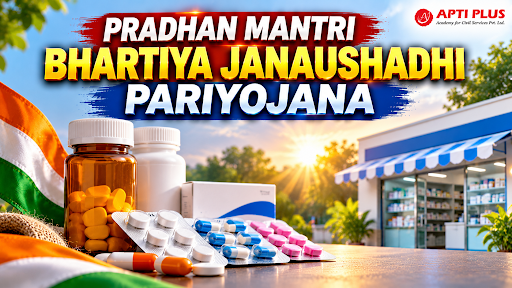
The need to expand the Pradhan Mantri Bhartiya Janaushadhi Pariyojana (PMBJP) has gained attention amid low awareness, patchy medicine availability and high out-of-pocket spending on medicines.
What Is The Pradhan Mantri Bhartiya Janaushadhi Pariyojana (PMBJP)?
-
Origin: The scheme began in November 2008 as the Jan Aushadhi Scheme. Only 80 stores were operational till May 2014, after which it was revamped.
-
Objective: It makes quality generic medicines available at affordable prices to all, especially the poor and the disadvantaged.
-
Administration: Department of Pharmaceuticals (DoP) under the Ministry of Chemicals and Fertilisers. It is implemented through the Pharmaceuticals and Medical Devices Bureau of India (PMBI).
-
Network: There were 20,149 Jan Aushadhi Kendras (JAKs) in 776 of 784 districts as of 30 June 2026. The target is 25,000 Kendras by March 2027.
-
Product Basket: It covers 2,110 medicines and 315 surgical items and consumables across 29 therapeutic groups. (Source: PIB)
-
Price Advantage: Maximum retail prices are generally 50-80% lower than comparable branded medicines.
-
Reach: About 10-12 lakh people buy medicines from the Kendras every day.
-
Savings: Medicines worth ₹7,700 crore were sold by June 2025, saving citizens about ₹38,000 crore against branded equivalents. (Source: PIB)
How Does PMBJP Deliver Affordable And Quality-Assured Generic Medicines?
-
Procurement: The PMBI buys medicines only from suppliers certified under World Health Organization-Good Manufacturing Practices (WHO-GMP). Vendor facilities are audited routinely.
-
Batch Testing: Every batch is tested at laboratories accredited by the National Accreditation Board for Testing and Calibration Laboratories (NABL). Medicines are dispatched to Kendras only after passing.
-
Quality Record: The Not of Standard Quality (NSQ) rate is 0.34% for PMBI products against 3.70% for open-market medicines.
-
Franchise Model: Kendras are opened by entrepreneurs, cooperatives, hospitals and other agencies through applications on the Jan Aushadhi portal.
-
Trade Margin: Operators earn a 20% margin on the maximum retail price, excluding taxes.
-
Pricing Logic: Generic medicines are cheaper because they carry no brand promotion cost. They contain the same active ingredient, strength and dosage form as branded drugs.
|
Pharmaceuticals and Medical Devices Bureau of India (PMBI)
|
Initiatives Taken By Government To Expand Access To Affordable Generic Medicines
Jan Aushadhi Sugam Mobile Application: The app was launched in 2019 and is free on Android and iOS. It finds the nearest Kendra through Google Maps, shows medicine availability and compares prices with branded alternatives.
Jan Aushadhi Suvidha Sanitary Napkins: Oxo-biodegradable napkins have been sold at ₹1 per pad since 2019. More than 100 crore pads were sold by 31 January 2026, including over 22.50 crore in 2025-26 alone. (Source: PIB)
Financial Incentives To Kendra Owners: The normal incentive is 20% of monthly purchases, capped at ₹20,000 a month and ₹5 lakh in total. A one-time grant of ₹2 lakh goes to women, Divyangjan, Scheduled Caste and Scheduled Tribe entrepreneurs, and Kendras in aspirational, Himalayan, island and North-Eastern regions.
Stocking Mandate: Owners become eligible for incentives on the basis of stocks of 200 high-demand medicines kept by them. This keeps essential medicines on the shelf and protects patient trust.
Last-Mile Locations: Kendras are being set up at 116 railway stations as of January 2026 and inside government hospital premises. Partnership with cooperatives brings outlets to rural areas through PACS.
Independent Quality Verification: In April 2026 the PMBI tied up with the Indian Pharmacopoeia Commission (IPC). PMBI can now send randomly selected batches from Kendras to IPC for testing, adding an independent layer to NABL testing.
Jan Aushadhi Diwas And Saptah: Jan Aushadhi Diwas is observed on 7 March every year, and the eighth edition fell in 2026. Health check-up camps ran at over 250 locations from 1 to 5 March under the theme "Janaushadhi Sasti Bhi, Bharosemand Bhi, Sehat Ki Baat, Bachat Ke Saath".
What Are The Key Challenges In Expanding The PMBJP?
Uneven Geographic Coverage
-
State Concentration: Outlets grew from 80 to 6,520 during 2014-20, yet only five States had more than 500 each. Uttar Pradesh now leads with 4,226 Kendras. (Source: Parliamentary Standing Committee on Chemicals and Fertilizers)
-
District-Level Focus: Coverage is counted by district, which hides gaps at the block level. Hilly and North-Eastern areas also need more distributors.
Supply Chain And Stock Availability
-
MSME Dependence: About 90% of PMBI suppliers are Micro, Small and Medium Enterprises (MSMEs). Raw material price swings cause procurement delays.
-
Delivery Lag: PMBI targets dispatch within 48 hours of an order and delivery within 10 days of dispatch. Remote Kendras can still run out of stock, which pushes patients back to private chemists.
Awareness And Perception Gaps
-
Footfall As A Proxy: The government infers high awareness from 10-12 lakh daily buyers. This count does not show how many patients in need never visit a Kendra.
-
Quality Perception: Generics are still seen by many as inferior, although only 0.46% of procurement failed standards in 2019-20. Wider public communication is needed to close this gap. (Source: Parliamentary Standing Committee)
Doctor Prescribing Practices
-
Brand-Name Prescriptions: Patients buy what the doctor writes, so brand-name prescriptions limit generic sales. Kendras cannot substitute drugs on their own.
-
Generic-Name Mandate On Hold: The National Medical Commission (NMC) directed doctors in 2023 to write generic names. The direction was put on hold after objections from doctors' bodies.
Financial And Governance Constraints
-
Dependence On Grants: The nodal agency was not financially self-sustaining, and administrative costs and outlet incentives still rely on central grants.
-
Expertise Gap: Only two of ten governing council members were pharmaceutical experts. Quality and procurement decisions need more technical depth.
Limited Product Basket And Household Burden
-
Basket Gaps: The basket grew from 1,250 medicines in 2021 to 2,110 now. High-value restricted medicines are still bought case by case from rate-contract manufacturers. (Source: Department of Pharmaceuticals)
-
Out-Of-Pocket Burden: Households paid ₹4,06,197 crore, or ₹2,901 per person, out of pocket in 2023-24. This was 42.7% of total health expenditure. (Source: National Health Accounts 2023-24)
What Is The Way Forward For Strengthening The PMBJP?
Balanced Block-Level Expansion
-
State-Wise Planning: A State-wise review of implementation can target the 25,000-Kendra goal at low-coverage States first. Block-level mapping should replace district-level counts. (Source: Parliamentary Standing Committee)
-
Rural And Remote Outlets: More Kendras can be opened through cooperatives and in slum and hilly areas. Adequate distributors are needed in Himachal Pradesh, West Bengal and the North-East.
Resilient And Transparent Supply Chain
-
Faster Delivery: Dispatch time can be cut to one day and delivery across India, including remote areas, to two days.
-
Live Stock Tracking: Real-time stock data with automated reordering can be added to the Sugam app. A procurement policy should balance large manufacturers and MSMEs.
Stronger Quality Assurance
-
Published Test Results: Random batch testing by the IPC should be done regularly and its results published. Open data builds trust among patients and doctors.
-
Tougher Penalties: The ban on suppliers of non-standard medicines can be extended from two years to at least five years.
-
Bioequivalence Labelling: Showing bioequivalence status on labels can reassure doctors that Jan Aushadhi generics match branded drugs.
Doctor Engagement And Public Awareness
-
Prescriber Outreach: Doctors' associations can be engaged once quality data are published. Generic-name prescribing can then be revived with their support.
-
Wider Communication: Kendras should be positioned as affordable stores for everyone, not only the poor. Social media campaigns and the Sugam app can carry this message.
-
Awareness Survey: A nationally representative survey can measure awareness, usage, prescribing and availability, and guide targeted campaigns.
Sound Finances And Governance
-
Grant Support: Central grants can cover salaries and outlet incentives until the PMBI becomes self-sustaining.
-
Expert Governance: More pharmaceutical experts and eminent medical administrators should join the PMBI governing council.
Basket Review And Health Scheme Convergence
-
Expert Basket Review: A committee of eminent medical practitioners can review the basket regularly. It should add medicines for chronic and cancer care.
-
Convergence: Kendras can be linked with Ayushman Arogya Mandirs and Ayushman Bharat Pradhan Mantri Jan Arogya Yojana (AB PM-JAY) hospitals. This would cut medicine costs for beneficiaries at the point of care.
Conclusion
The PMBJP has made quality generic medicines cheaper for millions and cut out-of-pocket spending. Reliable stock, doctor trust and balanced coverage must now match its scale. This will turn the network of Kendras into a dependable pillar of universal health coverage.
Source: THEHINDU
|
PRACTICE QUESTION Q. Consider the following statements regarding the Pradhan Mantri Bhartiya Janaushadhi Pariyojana (PMBJP):
Which of the statements given above are correct? (a) 1 and 2 only (b) 2 and 3 only (c) 1 and 3 only (d) 1, 2 and 3 Answer: (d) Explanation: Statement 1 is correct: PMBJP is implemented by the Pharmaceuticals and Medical Devices Bureau of India (PMBI) under the Department of Pharmaceuticals, Ministry of Chemicals and Fertilisers. Statement 2 is correct: Medicines are procured from WHO-GMP-certified manufacturers and tested batch-wise at NABL-accredited laboratories before distribution. Statement 3 is correct: Jan Aushadhi Kendra operators earn a 20% trade margin on the MRP (excluding taxes), alongside performance-linked incentives. |