Why In News?
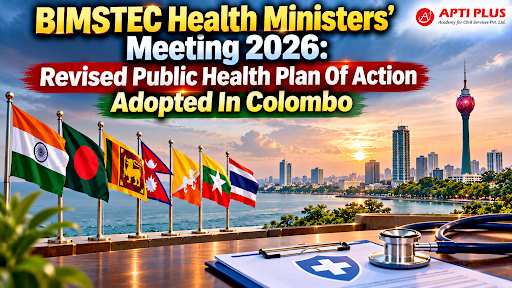
The first BIMSTEC Health Ministers' Meeting in Colombo unanimously adopted a joint ministerial statement and a revised public health action plan for 2026-2030.
What Is BIMSTEC?
BIMSTEC (Bay of Bengal Initiative for Multi-Sectoral Technical and Economic Cooperation) is an international regional organization that connects countries around the Bay of Bengal.
-
Origin: Established on June 6, 1997, through the signing of the Bangkok Declaration. It was originally named BIST-EC (Bangladesh, India, Sri Lanka, and Thailand Economic Cooperation) before Myanmar, Nepal, and Bhutan joined later.
-
Member States: BIMSTEC includes seven member countries split between South Asia and Southeast Asia:
-
South Asia (5): Bangladesh, Bhutan, India, Nepal, and Sri Lanka
-
Southeast Asia (2): Myanmar and Thailand
-
Headquarters: Located in Dhaka, Bangladesh (established in 2014).
-
Scale: The region represents over 1.8 billion people (roughly 22% of the global population) with a combined GDP of around $5 trillion.
-
Purpose: It promotes rapid economic growth, social progress, and technical cooperation in areas like trade, investment, energy, transport, tourism, and counter-terrorism.

Highlights of the First BIMSTEC Health Ministers' Meeting
-
Participants: Ministers and senior representatives from Bangladesh, Bhutan, India, Myanmar, Nepal, Sri Lanka and Thailand attended.
-
Plan Of Action Priorities: The revised plan covers disease surveillance, pandemic preparedness, digital health, traditional medicine, One Health and healthcare workforce development.
-
Joint Statement Commitments: Members reaffirmed Universal Health Coverage (UHC) and Sustainable Development Goal (SDG) 3, and flagged early warning systems, antimicrobial resistance and climate-related health responses.
-
Digital Health Framework: The statement proposes exploring a BIMSTEC Digital Health Framework covering telemedicine, interoperable electronic health records and AI in diagnostics and disease modelling.
-
Centres Of Excellence: Members welcomed a regional public health centre in Sri Lanka, a tropical medicine centre in Thailand, Bangladesh's proposed Regional Zoonotic Disease Observatory and India's traditional medicine centre.
-
Meeting Cycle: Ministers will meet every two years, and Thailand offered to host the second meeting in 2028.
-
Bangladesh's Pledge: Bangladesh's Health Minister said his country is committed to achieving UHC by 2030.
Why is BIMSTEC Important For India?
-
Alternative to SAARC: With the South Asian Association for Regional Cooperation (SAARC) effectively deadlocked due to political tensions with Pakistan, BIMSTEC provides India a vital regional platform to pursue cooperation with its neighbors.
-
Policy Convergence: It aligns directly with India's core regional foreign policies:
-
Neighbourhood First Policy: Prioritizes close relations and cooperation in India’s immediate periphery.
-
Act East Policy: Connects South Asia with Southeast Asia through Myanmar and Thailand.
-
MAHASAGAR & Indo-Pacific Vision: Reinforces maritime presence and integration across the Bay of Bengal.
-
Developing India’s Northeast: By linking landlocked Northeastern States to the Bay of Bengal through transit routes via Bangladesh and Myanmar (such as the Kaladan Multimodal Project and the India-Myanmar-Thailand Trilateral Highway), BIMSTEC boosts regional trade and economic growth in the region.
-
Security and Counter-Terrorism Leadership: India acts as the lead country for security cooperation, maritime security, cyber security, and disaster management. India hosts mechanisms like the BIMSTEC Home Ministers’ Meeting and the Disaster Management Centre in Gandhinagar.
-
Energy Security and Connectivity: India leads efforts on the BIMSTEC Grid Interconnection to share clean energy under its "One Sun, One World, One Grid" vision, alongside regional transport and communication master plans.
-
Counterbalancing China: It helps build economic and strategic resilience against the rising footprint of China's Belt and Road Initiative in the Bay of Bengal littoral states.
What Are The Key Challenges In India's Engagement With BIMSTEC?
Free Trade Area Remains Stalled
-
Two Decades Of Negotiation: The framework agreement for the BIMSTEC Free Trade Area was signed in 2004 in Phuket.
-
Constituent Agreements Pending: Six agreements are still under discussion: goods, services, investment, customs cooperation, dispute settlement and trade facilitation.
-
Customs Draft Unfinished: The Working Group on Customs Cooperation was still deliberating the draft customs mutual assistance agreement in 2025.
Connectivity Projects Lag Behind Plans
-
Transport Master Plan: The Master Plan for Transport Connectivity was endorsed at the Fifth Summit, but the ADB draft is still under consideration, and a Motor Vehicle Agreement is under discussion.
-
Grid Plan Incomplete: A coordination committee is still discussing an ADB-prepared master plan and the technical and commercial aspects of the grid.
-
Trilateral Highway Pending: The External Affairs Minister said the Trilateral Highway will link India's Northeast to the Pacific once completed. Completion remains pending.
Institutional Machinery Is Slow
-
Consensus Decision Rule: Decisions are made by consensus, so a single member can delay outcomes.
-
Plans Still Being Finalised: Plans of Action for several sectors are still being finalised. India has provided draft plans and hosted meetings.
-
Young Charter: The Charter has been in force for under three years since May 2024. Sectoral machinery is still maturing.
Security Cooperation Has Gaps
-
Conventions Not Concluded: An MoU on human trafficking has a draft agreed, while conventions on the transfer of sentenced persons and extradition remain under discussion.
-
Stalled Security Chiefs' Track: In September 2025, the MEA spokesperson said "one particular country" was holding up progress on the security chiefs' mechanism.
Political Volatility Among Members
-
Bangladesh Transition: A new Bangladesh government took office in February 2026. Bilateral issues such as the Ganga Water Treaty are handled through the Joint Rivers Commission.
-
Myanmar's Junta Leadership: Myanmar's Senior General attended the 2025 Summit, and India held a bilateral meeting with him. Engagement with a military leadership complicates consensus on democratic norms.
Announcement-To-Delivery Gap
-
Facilities Still Being Established: The Disaster Management Centre, the Technology Transfer Facility (Colombo) and the Cultural Facilities (Thimphu) are still "being established".
-
Commerce Chamber Pending: The BIMSTEC Chamber of Commerce is also still being established.
What Is The Way Forward For India In BIMSTEC?
Conclude The Free Trade Area In Phases
-
Use The Vision 2030 Roadmap: The Bangkok Vision 2030 provides a roadmap for early completion of negotiations on the constituent agreements. Set deadlines for each of the six agreements.
-
Sequence By Readiness: Conclude customs cooperation and trade facilitation first, as the customs draft is nearing completion.
Operationalise Connectivity
-
Implement The Maritime Agreement: Use the maritime transport agreement now in force to streamline port procedures and shipping links.
-
Finalise Road And Grid Instruments: Conclude the Motor Vehicle Agreement and finance the ADB master plans. Complete the Trilateral Highway with Myanmar and Thailand.
Strengthen Institutions
-
Act On Eminent Persons Group Ideas: The Goa outcomes included an Eminent Persons Group. Take up its recommendations on institutional reform.
-
Fund The Secretariat Better: Raise member contributions beyond India's US$1 million grant to reduce dependence.
Deepen The Security Architecture
-
Implement The Delhi Declaration: Convert the Declaration into joint operations and information sharing on trafficking and drug control.
-
Finish Pending Conventions: Conclude the human trafficking MoU, then take up extradition and transfer of sentenced persons.
-
Keep Bilateral Issues Separate: Resolve water and border issues in bilateral mechanisms, so they do not stall BIMSTEC decisions.
Use Digital And Financial Linkages
-
Digital Public Infrastructure Pilot: India proposed a pilot study on regional needs in Digital Public Infrastructure. Convert it into pilots with Nepal and Bhutan.
-
Payment Linkages: The Prime Minister proposed linking India's Unified Payments Interface (UPI) with payment systems of BIMSTEC members. Begin with willing members.
Conclusion
BIMSTEC is where India's Neighbourhood First, Act East and MAHASAGAR policies meet. Its value now depends on concluding the trade area and connectivity agreements that remain pending.
Source: DDINDIA
|
PRACTICE QUESTION Q. Consider the following statements: Statement-I: Landlocked Nepal and Bhutan are full members of BIMSTEC. Statement-II: BIMSTEC is a Bay of Bengal-centred grouping, so membership is open only to littoral states. Which one of the following is correct in respect of the above statements? (a) Both Statement-I and Statement-II are correct and Statement-II explains Statement-I (b) Both Statement-I and Statement-II are correct, but Statement-II does not explain Statement-I (c) Statement-I is correct, but Statement-II is incorrect (d) Statement-I is incorrect, but Statement-II is correct Answer: (c) Explanation: Statement-I is correct: The Bay of Bengal Initiative for Multi-Sectoral Technical and Economic Cooperation (BIMSTEC) is a seven-member regional organization comprising Bangladesh, Bhutan, India, Myanmar, Nepal, Sri Lanka, and Thailand. Both Nepal and Bhutan are landlocked countries and became full members of the grouping in July 2004. Statement-II is incorrect: While BIMSTEC is centered on the Bay of Bengal region, membership is not restricted strictly to littoral (coastal) states. According to the BIMSTEC official history, the grouping brings together both littoral and adjacent hinterland countries that depend on the Bay of Bengal for maritime trade and transit, which is why landlocked Nepal and Bhutan are included. |