Why In News?
Global manufacturers target specific Indian states over the nation as a whole for China+1 diversification, relying on local ecosystems and skilled labor.
What Is The China+1 Strategy?
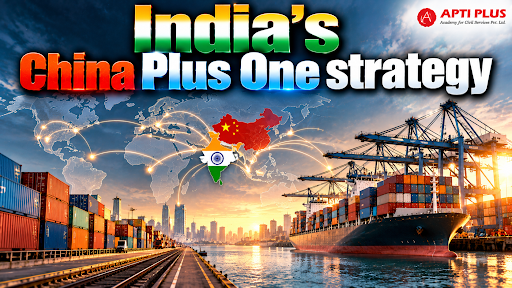
Meaning: The China+1 strategy involves maintaining manufacturing operations in China while setting up additional production facilities in at least one other country. Companies use this approach to reduce supply chain risks without completely leaving China.
Supply Chain Diversification: Global firms are spreading production across countries to reduce dependence on a single manufacturing base. This helps them manage tariff changes, shipping delays and geopolitical disruptions.
Reducing Dependence on China: China accounts for nearly 32% of global manufacturing value added and exports about $3.4 trillion in merchandise annually. Companies are seeking alternative suppliers in electronics, solar equipment and pharmaceutical ingredients.
Geopolitical Factors: Trade disputes, changing US tariffs, EU sustainability requirements and disruptions along shipping routes such as the Red Sea have increased the need for diversified supply chains.
India's Competitive Advantages: India offers a large consumer market, a young workforce with a median age of around 28 years, and strengths in textiles, pharmaceuticals, agriculture, chemicals and engineering goods. Merchandise exports reached $441.78 billion in FY 2025–26.
China+1 vs China Plus Many: China+1 adds at least one alternative manufacturing base, while China Plus Many distributes production across several countries.
-
Vietnam is competitive in garments and electronics, Mexico benefits from proximity to the US, and India has strengths in pharmaceuticals, textiles, food products, engineering components and specialty chemicals.
Why Do Global Companies Prefer Certain Indian States?
Availability of Land and Industrial Infrastructure: Top destination states develop plug-and-play industrial parks and integrated zones that eliminate early setup friction for foreign investors.
-
Mega industrial regions like the Dahej PCPIR in Gujarat span over 250 sq. km. with dedicated processing zones and shared utility infrastructure.
Reliable Electricity Supply: Uninterrupted power availability is critical for time-sensitive, high-precision manufacturing. Industrialized states offer specialized power feeds and open-access renewable energy options, preventing reliance on expensive backup diesel generation.
Skilled and Semi-skilled Workforce: Access to technical institutes, engineering colleges, and vocational training facilities provides a steady talent pipeline across shop-floor and managerial cadres. States with robust academic-industry linkages ensure quicker worker onboarding and higher labor productivity.
Faster Regulatory Approvals: Citizen-centric Ease of Doing Business reforms—such as single-window clearance portals, digitized inspection systems, and the elimination of mandatory annual license renewals—substantially reduce administrative friction.
-
Under federal incentives, 15 States completed stipulated EoDB reform criteria to secure additional borrowing permissions of ₹38,088 crore from the Ministry of Finance.
Established Supplier Networks: Specialized industrial clusters concentrate ancillary suppliers, component fabricators, and testing laboratories in close physical proximity. Industrialized clusters in Maharashtra, Gujarat, and Tamil Nadu lower raw material freight costs and lead times through mature localized supply chains.
Logistics and Port Connectivity: Proximity to deep-water sea ports, international air cargo terminals, and National Highway freight corridors facilitates frictionless export-import workflows.
-
Key maritime hubs like Nhava Sheva (JNPT), Mundra, Chennai, and the upcoming Vadhavan Deep-Water Port (capable of handling 25,000 TEU vessels) provide direct shipping lane access.
Policy Continuity: Predictable regulatory regimes, long-term state industrial policies, and fiscal stability shield foreign capital from administrative reversals or sudden policy shifts.
-
Land-use zoning stability and statutory investor protection frameworks boost investor confidence across multi-year capital expenditure cycles.
State-level Industrial Specialisation: Leading states have built distinct sectoral competitive advantages:
-
Maharashtra: Commands 31% of India's total FDI equity inflows ($16.7 billion), anchoring financial services in Mumbai and auto-IT manufacturing in Pune.
-
Karnataka: Has attracted $39.4 billion in cumulative FDI, leading in aerospace, defense, biotechnology, and software engineering.
-
Tamil Nadu: Dominates automotive corridors, renewable power installations, and consumer electronics manufacturing.
-
Gujarat: Leads export-oriented manufacturing, hosting chemical complexes, precision engineering, and semiconductor plants.
What Can India Learn from Tamil Nadu and Karnataka?
Tamil Nadu’s Automobile and Electronics Manufacturing Ecosystem: Tamil Nadu has cultivated an end-to-end industrial ecosystem spanning traditional automotive corridors from Chennai to Hosur and advanced electronics assembly lines.
Sriperumbudur’s Electronics Manufacturing Cluster: Located near Chennai, Sriperumbudur has evolved into a premier electronics hub housing major multinational original equipment manufacturers (OEMs) and component suppliers.
Foxconn’s iPhone Assembly Operations: High-profile investments, such as Foxconn's expansive assembly units in Tamil Nadu, demonstrate the state's capacity to scale high-precision consumer electronics manufacturing for global exports.
Tata Electronics’ Manufacturing Expansion: Investments by Tata Electronics in precision component manufacturing highlight the rapid deepening of local domestic manufacturing capabilities within the state.
Hosur’s Industrial Ecosystem: The Hosur belt leverages cross-border proximity to Bengaluru to house major automotive, electric vehicle, and advanced engineering manufacturing clusters.
Karnataka’s Software and Engineering Talent: Karnataka leverages its dense concentration of R&D centers, technical universities, and specialized engineering labor to attract high-tech manufacturing capital.
Bengaluru’s Technology and Innovation Ecosystem: Bengaluru serves as India's primary technology hub, integrating global R&D centers, software design labs, and advanced hardware prototyping facilities.
Devanahalli’s Emerging Electronics Manufacturing Hub: Devanahalli, situated near Bengaluru's international airport, is rapidly developing into a major industrial zone for electronics, aerospace components, and IT hardware.
Long-term Investment in Skills and Suppliers: Both states demonstrate the necessity of multi-decade public-private investments in workforce skilling, supplier incubation, industrial housing, and infrastructure front-loading.
-
Indian states must build professional bureaucratic state capacity by studying former East Asian developmental states (Japan, South Korea, Taiwan) to manage conditional industrial subsidies and public-private partnerships effectivel
What Measures Has the Central Government Introduced?
Production Linked Incentive (PLI) Scheme: Covers 14 strategic sectors—including electronics, telecom, solar PV modules, pharmaceuticals, automobiles, and textiles—offering performance-linked financial outlays to scale domestic production and export competitiveness.
-
Key sectoral outlays include ₹24,000 crore ($2.7 billion) for High Efficiency Solar PV Modules and ₹12,195 crore for Telecom & Network Equipment.
Electronics Components Manufacturing Scheme (ECMS): Administered by the Ministry of Electronics and Information Technology (MeitY), ECMS provides turnover-linked, capex, and hybrid financial support for multi-layer PCBs, connectors, passive components, and sub-assemblies to deepen upstream electronics ecosystems.
Make in India: Launched in 2014 to transform India into a global manufacturing hub, the initiative focuses on reducing administrative burdens, modernizing infrastructure, opening FDI limits across sectors, and targeting a 25% manufacturing share in GDP.
National Industrial Corridor Development Programme: Envisages multi-modal industrial nodes connected by high-speed rail and road networks, anchored by integrated industrial regions with pre-cleared utility connections.
PM Gati Shakti National Master Plan: A digital GIS-based platform designed to break institutional silos, coordinate multi-modal logistics infrastructure planning, lower national logistics costs from 8% of GDP, and eliminate transport bottlenecks.
Foreign Direct Investment Policy: Permits up to 100% FDI under the automatic route across most manufacturing sub-sectors, single-brand retail, and construction development to streamline entry for global capital.
Trade and Tariff Policy: Utilizes targeted Basic Customs Duty (BCD) rates (e.g., 20% on solar cells and modules), Quality Control Orders (QCOs) issued by the Bureau of Indian Standards (BIS), and anti-dumping duties (ADD) to safeguard domestic producers from sub-standard import dumping.
Ease of Doing Business Reforms: Overseen by the Department for Promotion of Industry and Internal Trade (DPIIT), reforms mandate computerized random inspection systems, centralized regulatory filings, and the elimination of renewal requirements.
Centre-State Coordination: Driven through NITI Aayog's Governing Council, competitive federalism benchmarks, and institutional linkages that tie central borrowing allocations or infrastructure funding to state-level statutory reforms
What Challenges Limit India's Manufacturing Growth?
Uneven Industrial Development across States: Industrial capital and FDI remain heavily concentrated in a few southern and western coastal states (Maharashtra, Karnataka, Tamil Nadu, Gujarat), while inland regions lag due to weaker infrastructure and institutional capacity.
Policy Uncertainty after Elections: Sudden administrative shifts, local planning area cancellations, or revisions to state industrial master plans create execution delays and erode investor confidence.Infrastructure and Logistics Gaps: National logistics costs remain elevated at 8% of GDP, constrained by a heavy reliance on road freight, inadequate port-linked chemical handling berths, limited specialized cold chain tankage, and power reliability issues.
Shortage of Skilled Workers: A severe mismatch persists between academic curricula and shop-floor requirements; in technical sectors like telecommunications and IT hardware, only 40% of computer science and technical graduates are directly employable without extensive retraining.
Limited Domestic Supplier Capacity: Micro, Small, and Medium Enterprises (MSMEs)—which constitute over 95% of manufacturing units—often lack access to cheap capital, advanced automation, and international quality compliance certifications.
High Dependence on Imported Inputs: Fast-growing domestic assembly operations remain structurally reliant on foreign supply chains for core components.
-
India relies on China for over 80% of critical inputs across 71 core electronics lines, 100% of PV-grade polysilicon, and over 80% of telecom active components like baseband units and integrated circuits, contributing to a $112.1 billion bilateral trade deficit with China in FY 2025–26.
Land Acquisition Challenges: Securing contiguous, litigation-free land parcels for large-scale industrial projects faces prolonged delays due to complex local land title records and coastal regulation constraints.
Environmental and Resource Constraints: Coastal ecology protection, stringent effluent discharge limits, and local community resistance can stall large capital-intensive projects, as seen in lagging coastal industrial regions.
Unequal Access to Investment Incentives: High minimum revenue and capital expenditure eligibility thresholds under major schemes often favor large multinational conglomerates while excluding smaller domestic component manufacturers
How Can India Strengthen Its Manufacturing Ecosystem?
Strengthening State-level Industrial Ecosystems: Move from fragmented industrial notifications toward dedicated, empowered management boards (modeled on Singapore's Jurong Island) with pre-built shared utility pipelines, common effluent plants, and plug-and-play factory spaces.
Ensuring Long-term Policy Continuity: Guarantee statutory stability for land zoning, taxation schedules, and import-export frameworks across multi-year investment cycles to minimize political risk for long-term private capital.
Expanding Technical Education: Modernize vocational training centers and technical institutes under industry-led skill development councils, expanding initiatives like the Samarth Scheme for textiles and specialized ESDM skilling programs.
Deepening Domestic Component Manufacturing: Shift national policy focus from basic product assembly to localized Bill-of-Materials (BOM) component manufacturing, supported by price-gap incentives for domestic electro-mechanical inputs.
Strengthening MSME Supplier Networks: Establish cluster-level testing and certification centers to help MSMEs obtain international quality compliance standards (BIS, OEKO-TEX, ISO), while facilitating credit flow and technology adoption.
Linking Incentives with Domestic Value Addition: Re-design schemes like the PLI to introduce mandatory domestic value addition thresholds and milestone-based R&D incentives rather than granting benefits solely on gross assembly turnover.
Improving Logistics and Port Connectivity: Accelerate PM Gati Shakti multi-modal links, build dedicated deep-water container terminals like Vadhavan Port, expand dedicated freight corridors (DFC), and modernizing chemical and bulk port handling berths.
Promoting Research and Development: Incentivize private sector R&D expenditure—moving closer to global benchmarks (3% to 6% of revenue)—through tax super-deductions, public-private research consortiums, and national research grants.
Strengthening Centre-State Coordination: Enhance competitive federalism frameworks where the central government provides infrastructure viability funding while empowered state agencies streamline local clearances and land allotment.
Learning from Successful Indian States: Encourage lagging regions to replicate proven industrial policies, single-window execution models, and cluster architectures pioneered by leading state champions like Maharashtra, Karnataka, Tamil Nadu, and Gujarat.
Conclusion
To leverage China+1, India must move from low-value assembly to domestic component production and R&D. Infrastructure, skilled labor, stronger MSMEs, and stable policies will drive exports toward a 25% manufacturing GDP share by 2047.
Source: THEHINDU
|
PRACTICE QUESTION Q. Analyze how structural input dependencies on foreign supply chains undermine India's manufacturing ambitions under the "China Plus One" strategy, and suggest policy measures to deepen domestic component localization. 250 WORDS |