Why In News?
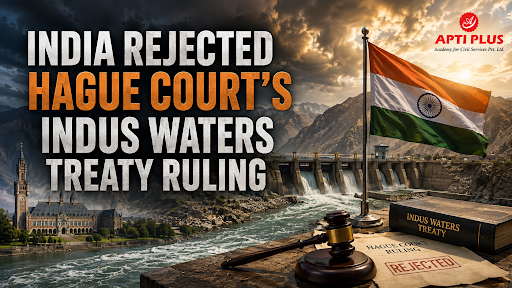
The Ministry of External Affairs declared India does not recognize the Hague Court's order on the Kishanganga and Ratle projects, as parallel arbitration violates the 1960 Treaty's graded dispute mechanism.
What is the Indus Waters Treaty (1960)?
-
Signed in 1960 in Karachi between Indian Prime Minister Jawaharlal Nehru and Pakistani President Mohammad Ayub Khan.
-
Brokered and signed by the World Bank as a third-party signatory and institutional guarantor.
-
Governs the equitable allocation of waters of the Indus River and its five major tributaries originating in the Himalayas and flowing into the Arabian Sea.
-
Establishes a Permanent Indus Commission (PIC) composed of two Commissioners (one each from India and Pakistan) who meet annually to exchange hydrological data and resolve technical questions.
Three-Tier Dispute Resolution Mechanism
|
How Does the Treaty Allocate River Waters?
-
Eastern Rivers (Allocated Exclusively to India):
-
Covers the Ravi, Beas, and Sutlej rivers with an average annual flow of approximately 33 Million Acre-Feet (MAF) or 20% of the total system water.
-
India holds unrestricted rights to utilize all waters of the Eastern Rivers for domestic, agricultural, and industrial use.
-
Western Rivers (Allocated Primarily to Pakistan):
-
Covers the Indus, Jhelum, and Chenab rivers with an average annual flow of approximately 135 MAF (representing over 80% of total basin flow).
-
Allocated to Pakistan for unrestricted use, but subject to specific, legally permissible rights granted to India as the upper riparian state.
India’s Permissible Rights on the Western Rivers
-
Domestic & Non-Consumptive Use: India can draw unlimited water for drinking, municipal supply, washing, and industrial cooling without altering water quality.
-
Agricultural Utilization: India has the right to irrigate specified agricultural land areas (up to 13.4 lakh acres) across Jammu & Kashmir and Ladakh.
-
Hydroelectric Power Generation (Run-of-the-River Projects): India is permitted to construct Run-of-the-River (RoR) hydroelectric plants without constructing large storage reservoirs that divert water permanently away from the river course.
-
Limited Permissible Storage Rights: India can construct up to 3.6 MAF of storage capacity (including 1.25 MAF for general storage, 1.6 MAF for power pondage, and 0.75 MAF for flood control) across the Western Rivers.

What is the Indus Water Dispute?
Contested Projects in Jammu & Kashmir:
-
Kishanganga Hydroelectric Project (330 MW): A run-of-the-river project on the Kishanganga River (a tributary of the Jhelum) in Bandipora district, J&K, which channels water through an underground tunnel into Wullar Lake/Jhelum for power generation before releasing it back.
-
Ratle Hydroelectric Project (850 MW): A run-of-the-river project under construction on the Chenab River in Kishtwar district, J&K.
Pakistan’s Objections: Pakistan claims that the pondage capacity, deep orifice spillways, and freeboard designs of these dams violate Treaty provisions and allow India to manipulate river discharges.
India’s Counter-Position: India maintains that all engineering parameters strictly comply with modern technical criteria stipulated under Annexure D and Annexure E of the 1960 Treaty.
Why Did India Reject the Hague Court’s Ruling?
Dispute Over Jurisdiction & Illegitimate Constitution: India asserts that the Court of Arbitration at the Permanent Court of Arbitration (PCA) was constituted unlawfully because the World Bank violated the Treaty.
Objection to Parallel Proceedings:In October 2022, the World Bank appointed a Neutral Expert and a Court of Arbitration for the same technical issues. India argued the parallel proceedings risk contradictory rulings and compromise treaty integrity.
India’s Non-Participation & Principled Boycott: India has refused to appear before the Hague Court of Arbitration while participating in the legitimate Neutral Expert proceedings.
Formal Notice to Modify the Treaty (Article XII(3)): India issued formal notices to Pakistan in 2023, 2024, and 2026 seeking bilateral consultations to renegotiate the 1960 Treaty, arguing that persistent cross-border terrorism and unilateral litigation have altered the context of bilateral cooperation.
Sovereign Decision Argument: India maintains that sovereign states cannot be subjected to international arbitration without their explicit, procedural consent.
Major Challenges in Transboundary Indus Management?
Persistent Geopolitical Tensions & Cross-Border Terrorism: Bilateral hostility and state-sponsored terror impede technical dialogue between water commissioners.
Accelerated Himalayan Glacial Retreat: Rapid climate warming alters snowmelt patterns, creating unpredictable flash floods in summer and reduced base flows in winter across the Indus basin.
Severe Regional Water Stress: Rapid population growth and expanding agricultural water demand in both countries intensify competition over available river volumes.
Rigid 60-Year-Old Treaty Architecture: The 1960 treaty lacks provisions for modern environmental flows, climate change adaptation, ecological conservation, and digital real-time data sharing.
Way Forward
Pursue Comprehensive Bilateral Treaty Renegotiation: Press Pakistan to enter direct bilateral negotiations to amend the Indus Waters Treaty to incorporate climate change resilience, clean energy targets, and modern glaciological realities.
Accelerate Domestic Hydroelectric & Irrigation Infrastructure: Fast-track the full utilization of India's legitimate rights on the Western Rivers, including completing the Ratle (850 MW), Pakal Dul (1000 MW), Kiru (624 MW), and Ujh multipurpose projects in Jammu & Kashmir.
Maintain Consistent Legal Stance on the Neutral Expert Forum: Continue participating in the World Bank Neutral Expert proceedings while firmly rejecting parallel, unauthorized Court of Arbitration rulings.
Upgrade Hydrological Telemetry in the Indus Catchment: Deploy automated real-time water flow sensors, snow gauges, and satellite data feeds to generate verifiable discharge datasets across Jammu & Kashmir and Ladakh.
Integrate Environmental Flows into Himalayan River Planning: Establish mandatory ecological flow standards to sustain riverine biodiversity and sediment transport during lean winter months.
Conclusion
India’s rejection of the Hague Court ruling reaffirms that transboundary water disputes must strictly follow treaty-mandated dispute sequences and respect sovereign rights amidst evolving climate and energy realities.
Source: THEHINDU
|
PRACTICE QUESTION Q. With reference to the Indus Waters Treaty (1960), consider the following statements: 1. The treaty allocates the waters of the Eastern Rivers (Ravi, Beas, Sutlej) exclusively to India for unrestricted use. 2. India is completely prohibited from generating hydroelectric power on the Western Rivers (Indus, Jhelum, Chenab). 3. The World Bank is a signatory to the Indus Waters Treaty. Which of the statements given above are correct? (a) 1 and 2 only (b) 1 and 3 only (c) 2 and 3 only (d) 1, 2, and 3 Answer: (b) 1 and 3 only Explanation: Statement 1 is correct: Under the Indus Waters Treaty (1960), all the waters of the Eastern Rivers (Ravi, Beas, and Sutlej) are allocated to India for exclusive and unrestricted use. Statement 2 is incorrect: India is not completely prohibited from generating hydroelectric power on the Western Rivers (Indus, Jhelum, and Chenab). The treaty explicitly allows India the right to construct run-of-the-river (RoR) hydroelectric projects on these rivers, subject to specific technical criteria and without altering the essential water flow to Pakistan. Statement 3 is correct: The treaty was brokered by the International Bank for Reconstruction and Development (now the World Bank), which is also a signatory to the treaty for certain specified purposes (such as those under Articles V and X and Annexures F, G, and H). |