Why In News?
India and Uzbekistan agreed to deepen cooperation against terrorism and regional security threats at the 10th meeting of RELATIONS
Bilateral Foundations: Diplomatic ties
began in 1992, followed by the foundational Agreement on Defence Cooperation signed in 2003.
● Bilateral ties progressed from a Strategic Partnership in 2011 to a Comprehensive Strategic Partnership in August 2026.
● Regular bilateral security interactions operate through the Joint Working Group on Defence, which held its 6th session in August 2026.
Joint Operational Counter-Terrorism Mechanism: The Joint Working Group on Counter Terrorism (JWG-CT) held its 10th session in October 2026, co-chaired by senior diplomats from both foreign ministries.
● Both sides reaffirmed zero tolerance toward cross-border terrorism, terror financing, weaponization of emerging technologies, and the crime-terror nexus.
Multilateral Alignment in Eurasian Platforms: Defence and security cooperation coordinates through the United Nations (UN), the Shanghai Cooperation Organisation Regional Anti-Terrorist Structure (SCO-RATS) headquartered in Tashkent, and the Eurasian Group on Combating Money Laundering and Financing of Terrorism (EAG).
● India’s accession to full SCO membership in 2017 aligned regional security matrices with Central Asian republics.
Capacity Building and Military Professionalization: Uzbek military officers undergo specialized strategic instruction at the National Defence College (NDC) and the Indian Military Academy (IMA).
● Under the Indian Technical and Economic Cooperation (ITEC) framework, more than 2,700 Uzbek nationals have completed institutional training in India.
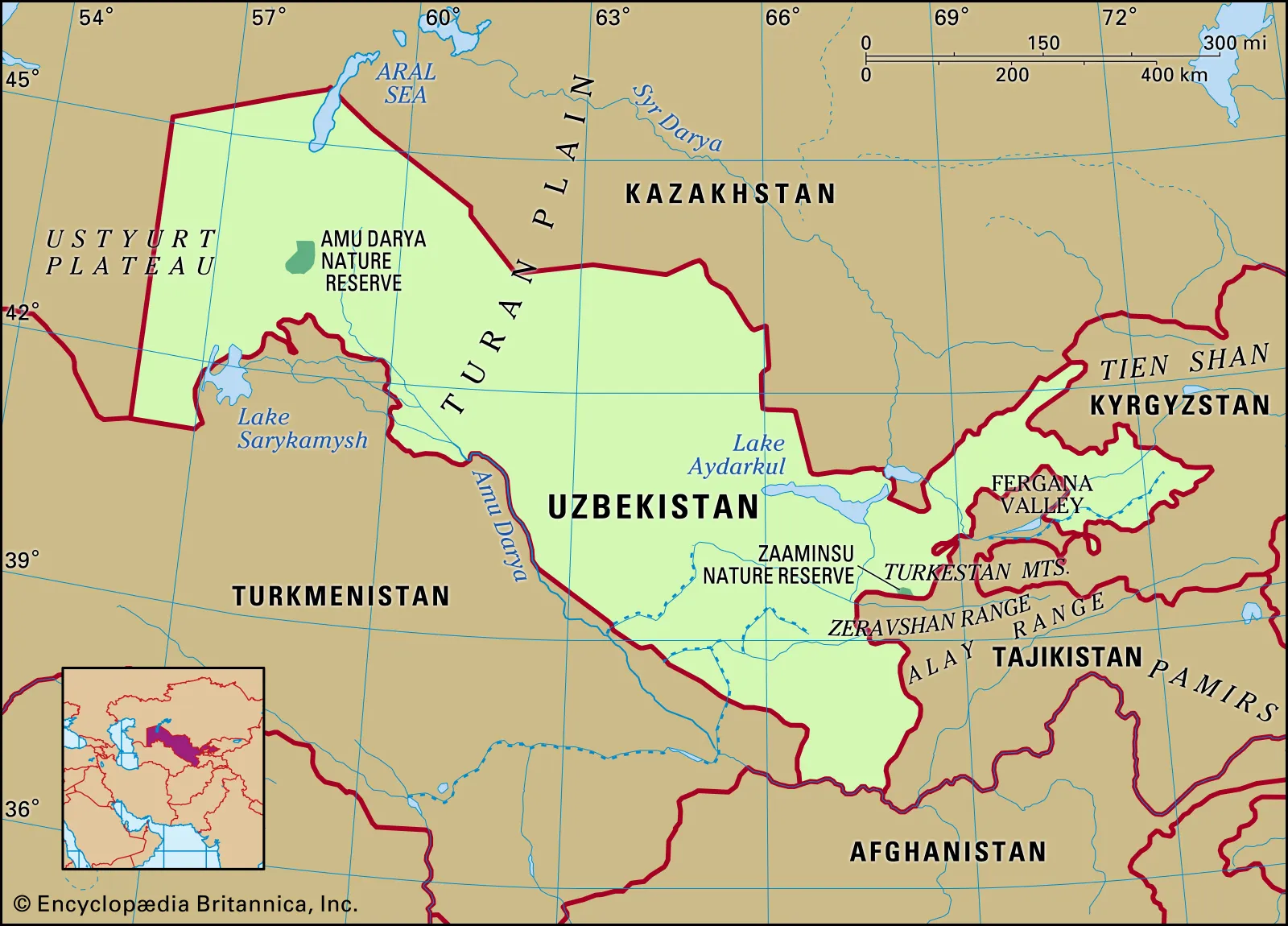
About Uzbekistan● Location: Uzbekistan is a landlocked country in Central Asia, bordered by Kazakhstan to the north and northwest, Kyrgyzstan and Tajikistan to the east and southeast, Afghanistan to the south, and Turkmenistan to the southwest. ● River systems and landforms: The country lies between the Amu Darya and Syr Darya rivers. Its west includes the Kyzylkum Desert, Turan Plain and Ustyurt Plateau, while the Tien Shan and Gissar ranges dominate the east and southeast. ● Climate: Uzbekistan has an arid continental climate, with hot summers, cold winters and low rainfall, making water management and transboundary river cooperation important regional issues. ● Major cities: Tashkent, the capital, alongside Samarkand, Bukhara and Khiva, forms the country's major political, commercial and historic-cultural centres. |
Strategic Significance Of The India-Uzbekistan Comprehensive Strategic Partnership
Geopolitical Anchor In Central Asia: Uzbekistan sits at the physical and demographic core of Central Asia, sharing borders with all four other Central Asian republics and Afghanistan.
● Strengthening ties provides India with a stable diplomatic and security partner to anchor its Connect Central Asia Policy and project influence across Eurasia.
Institutional Framework Elevation: The elevation to a Comprehensive Strategic Partnership (CSP) establishes ministerial-level reviews and structured dialogue across defence, critical minerals, and digital governance. Bilateral ties are legally fortified by the Bilateral Investment Treaty (BIT), which entered into force in May 2025.
Multilateral Alignment In Regional Fora: Cooperation within the Shanghai Cooperation Organisation (SCO) advances India's SECURE template—Security, Economy, Connectivity, Unity, Respect, and Environment.
● Tashkent permanently hosts the Executive Committee of the SCO Regional Anti-Terrorist Structure (RATS), enabling institutional intelligence exchange and counter-extremism coordination.
Counter-Terrorism And Afghanistan Stability: Both nations align closely on preventing transnational terrorism, religious radicalisation, and drug trafficking emanating from unstable borderlands. Bilateral defence cooperation features institutional coordination via the Joint Working Group on Counter-Terrorism and regular joint drills.
Joint Military Interoperability: Armed forces conduct the annual military drill Exercise DUSTLIK, focusing on counter-terrorism and semi-urban warfare operations, with the edition concluded in the Namangan Region, Uzbekistan in April 2026.
Multilateral Global Governance Reforms: Uzbekistan explicitly reaffirms its diplomatic endorsement for India's claim to permanent membership in an expanded United Nations Security Council (UNSC).
How Bilateral Partnerships Evolved?
Trade Expansion: Bilateral trade turnover reached USD 1,317.7 million in 2025, expanding by 33.3 percent year-on-year. Indian exports accounted for USD 1,153.1 million, while imports from Uzbekistan stood at USD 164.6 million.
Pharmaceutical Export Leadership: Pharmaceuticals constitute the anchor of Indian merchandise exports, delivering USD 325.0 million or 37.6 percent of total Indian goods exports in 2024 to feed Uzbekistan's USD 2.14 billion pharmaceutical retail market.
Civil Nuclear Fuel Security: Uzbekistan represents an essential source of nuclear fuel, supplying 100 percent of India's uranium ore concentrate imports in the twelve months to March 2026.
● Under the January 2019 agreement with the Department of Atomic Energy (DAE), Navoi Mining delivers 1,100 tonnes of natural uranium concentrate under International Atomic Energy Agency (IAEA) safeguards.
Critical Minerals And Industrial Geology: Bilateral cooperation covers strategic mineral extraction, value addition, and geological mapping, supported by Tashkent's policy giving preference to Indian firms in prospective mineral blocks.
Digital Public Infrastructure (DPI) And IT Innovation: Bilateral tech collaboration leverages the Tashkent IT Park, established in 2019 with technical support from the Software Technology Parks of India (STPI). Cooperation focuses on digital platforms, Artificial Intelligence (AI), cybersecurity, and the integration of digital payment interfaces.
High Impact Development And Ecological Grant Aid: India provides grant assistance for High Impact Community Development Projects (HICDP), alongside a committed grant of USD 1 million to support environmental restoration in the Aral Sea basin under Uzbekistan's "Yashil Makon" and India's "Ek Ped Maa Ke Naam" initiatives.
Key Challenges in India-Uzbekistan Strategic Ties
Absence Of Direct Overland Transit: Lack of direct territorial contiguity forces cargo to traverse complex sea-land routes, as Pakistan denies overland transit rights to Indian commercial freight.
● Example: Routing cargo via Chinese borders or western European ports adds extensive transit times and high shipping premiums compared to direct routes.
Sanctions Exposure On Maritime Arteries: India's transport corridor strategy relies on Iran's Chabahar Port (Shahid Beheshti Terminal) and the International North-South Transport Corridor (INSTC), both of which face external geopolitical headwinds.
● Example: United States sanctions waiver for Chabahar expired without renewal in April 2026, generating compliance hesitation among international shippers and slowing transport integration.
Persistent Bilateral Trade Asymmetry: Bilateral merchandise flows reflect an acute 7:1 trade imbalance heavily tilted in India's favour, generating persistent trade-deficit concerns in Tashkent.
● Example: Ministry of Investment, Industry and Trade of Uzbekistan Report 2026, Indian exports reached USD 1,153.1 million against imports of USD 164.6 million in 2025, creating an unsustainable bilateral deficit nearing USD 1 billion.
Intense Hegemonic Geopolitical Competition: China dominates Central Asian commercial infrastructure through massive capital injection under the Belt and Road Initiative (BRI) and the China-Pakistan Economic Corridor (CPEC).
Logistical Divergence On Continental Rail Corridors: Tashkent prioritises alternative trans-regional links over southern maritime access routes to hedge its landlocked transit dependencies.
Way Forward To Deepen The Bilateral Strategic Partnership
Operationalising Multimodal Transit Corridors: Fully integrate Chabahar Port into the INSTC multimodal grid and leverage the Ashgabat Agreement and the TIR Convention (Transports Internationaux Routiers) to streamline cross-border customs documentation.
Expediting Rules-Based Trade Integration Via WTO: Finalise Uzbekistan's accession to the World Trade Organization (WTO) to lower non-tariff barriers, enforce predictable tariffs, and operationalise a bilateral Preferential Trade Agreement (PTA).
Financing Strategic Joint Ventures And Credit Lines: Broaden concessionary financing mechanisms using Lines of Credit (LOC) to support local manufacturing hubs in high-potential special economic zones.
Expanding Critical Mineral Supply Chains And Energy Ties: Solidify institutional joint ventures between India's Khanij Bidesh India Limited (KABIL) / DAE and Uzbek state mining conglomerates to secure long-term concessions for uranium, copper, and rare earths.
Institutionalising Local Currency Settlements And FinTech Rail: Establish cross-border bilateral currency clearing mechanisms and link India's Unified Payments Interface (UPI) with Uzbekistan's domestic payment systems to insulate trade flows from third-party currency transaction bottlenecks.
Conclusion
The evolving India–Uzbekistan strategic partnership relies on sustained defense, connectivity, and institutional cooperation to achieve its 2030 trade and regional security goals.
Source: NEWSONAIR
|
PRACTICE QUESTION Q. With reference to the bilateral relations between India and Uzbekistan, consider the following statements:
Which of the statements given above are correct? (a) 1 and 2 only (b) 2 and 3 only (c) 1 and 3 only (d) 1, 2, and 3 Answer: (a) 1 and 2 only Explanation: Statement 1 is correct: Uzbekistan is one of only two doubly landlocked countries in the world (the other being Liechtenstein), meaning it is completely bordered by countries that are themselves landlocked. It is centrally located in Central Asia and shares land borders with all four other Central Asian Republics—Kazakhstan, Kyrgyzstan, Tajikistan, and Turkmenistan—as well as Afghanistan to its south. Statement 2 is correct: In 2025, bilateral trade between India and Uzbekistan surpassed the USD 1 billion milestone, reaching approximately USD 1.3 billion. India maintains a significant trade surplus in this relationship, with Indian exports accounting for roughly USD 1.15 billion of that total turnover compared to around USD 164.6 million in imports from Uzbekistan. Statement 3 is incorrect: Exercise DUSTLIK is an annual joint military (army/air force) drill, not a maritime naval exercise. Given that Uzbekistan is doubly landlocked and has no navy, the exercise focuses on counter-terrorism, multi-domain operations, and joint tactical drills in semi-mountainous and semi-urban terrain. |