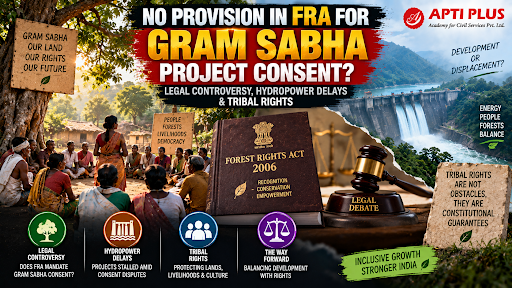
Why In News?
The Ministry of Tribal Affairs clarified that the Forest Rights Act, 2006 contains no statutory provision for obtaining Gram Sabha consent for project clearance.
What is the Forest Rights Act, 2006?
The Act recognizes and restores the land and resource rights of forest-dwelling Scheduled Tribes and other traditional forest dwellers.
-
Correcting Historic Injustices: Enacted as the Scheduled Tribes and Other Traditional Forest Dwellers (Recognition of Forest Rights) Act, 2006 to recognize customary ancestral tenures.
-
Coverage of STs & OTFDs: Recognizes forest rights of Scheduled Tribes and Other Traditional Forest Dwellers residing in forests for at least three generations (75 years).
-
Individual Forest Rights (IFR): Confers secure title rights up to 4 hectares of land occupied for self-cultivation prior to the December 13, 2005 cut-off date.
-
Community Forest Rights (CFR): Vests ownership and access rights to minor forest produce (MFP), grazing grounds, water bodies, and traditional community resources.
-
Community Forest Resource Conservation Rights: Empowers communities under Section 3(1)(i) to protect, regenerate, and manage traditional forest boundaries against destruction.
-
Gram Sabha as the Foundational Authority: Establishes the village assembly as the competent statutory body to initiate, examine, and verify all individual and community claims.
Relevant Constitutional Provisions
|
What is the Role of the Gram Sabha Under the FRA?
Claim Initiation Authority: Serves as the first-tier institution where forest-dwelling families submit Form A and Form B claims for individual and community titles.
Verification via Forest Rights Committees (FRC): Elects democratically a representative Forest Rights Committee to conduct field measurements and physical boundary verifications.
Passage of Statutory Resolutions: Convenes open public assemblies with a mandatory quorum of 50% members (at least one-third women) to approve verified claims.
Protection of Sacred Natural Sites: Enjoys statutory power under Section 5 to stop activities that threaten cultural heritage, biodiversity, and ecologically sensitive catchments.
Evidence-Based Fact Finding: Considers multiple physical and oral evidences, including ancient burial stones, elderly testimony, and historical physical tree marks.
Why is Gram Sabha Participation Important?
|
What is the Difference Between FRA Consent and Forest Clearance?
Vesting of Rights vs Diversion of Land: FRA recognizes pre-existing customary ownership, whereas the Van (Sanrakshan Evam Samvardhan) Adhiniyam, 1980 governs the diversion of forest land.
Stage-I In-Principle Forest Clearance: MoEFCC examines environmental viability and stipulates conditions like Compensatory Afforestation (CA) and Net Present Value (NPV) payments.
Stage-II Final Working Clearance: Permits actual tree felling and physical transfer of forest land to user agencies once all Stage-I compliance conditions are met.
MoEFCC 2009 Executive Circular Linkage: July 2009 guideline mandated that Stage-II clearance required a written Gram Sabha No-Objection Certificate (NOC) certifying completion of the FRA process.
Statutory Text Divergence: The text of the FRA, 2006 does not contain the literal words "Gram Sabha consent for forest clearance", creating an inter-ministerial regulatory debate.
Forest Conservation Rules 2022 Decoupling: New rules shifted the responsibility of obtaining Gram Sabha consent from the Centre to state governments after Stage-II approval.
Role of PESA
|
What are the Major Issues Involved?
Development Imperative vs Tribal Rights: Balancing national clean energy infrastructure (hydropower, grid transmission) with constitutional guarantees given to indigenous forest dwellers.
Inter-Ministerial Jurisdictional Tensions: Divergent operational interpretations between the Ministry of Tribal Affairs (nodal for FRA) and the Ministry of Environment (nodal for forest clearance).
Incomplete Rights Settlement Backlog: Millions of legitimate individual and community forest rights claims remain rejected or pending without written appellate grounds.
-
Till 31st December 2025, a total of 18,90,360 (36.41%) claims have been rejected, comprising 18,36,594 individual and 53,766 community claims. (Source: PIB)
Lack of Formal Inter-Agency Coordination: Absence of a unified digital interface between state tribal welfare departments and forest department clearance portals.
What is the Parliamentary Committee’s Concern?
|
What are the Risks of Diluting Gram Sabha Participation?
Resurgence of Severe Social Conflict: Diluting consent risks igniting civil unrest, public protests, and extremist mobilization in mineral-rich central tribal belts.
Mass Involuntary Displacement Without Relief: Forest communities risk losing ancestral hamlets without formal compensation if title rights remain unrecognized before land diversion.
Permanent Destruction of Sacred Ecosystems: Loss of community-protected sacred groves (Deorais/Sarnas) and ancient cultural shrines that lack formal revenue survey entries.
Erosion of Constitutional Federalism: Bypassing local village democratic institutions weakens the fundamental spirit of democratic decentralization envisioned under the 73rd Amendment.
What are the Arguments for Faster Clearances?
|
Way Forward
Strict Time-Bound FRA Title Settlement: Mandate states to settle all pending IFR and CFR claims within a non-extendable six-month window prior to Stage-I forest appraisal.
Institutionalize Standard Operating Procedures (SOP): Issue a joint binding circular by MoEFCC, MoTA, and MoPR clearly defining the exact evidentiary process for Gram Sabha resolutions.
Digital Video-Recorded Assembly Proceedings: Mandate independent video recording and biometric roll-call of Gram Sabha meetings to eliminate fraudulent, forged consensus certificates.
Independent Tribal Grievance Redressal Body: Establish an autonomous National Forest Rights Tribunal headed by retired judicial officers to adjudicate disputed claim rejections.
Co-Ownership & Equity Sharing in Projects: Grant affected Gram Sabhas permanent perpetual dividend equity or free solar electricity shares in hydro projects operating on diverted lands.
Learn from Successful Model/Case Study
-
Supreme Court Niyamgiri Judgment: In Orissa Mining Corporation vs MoEF (2013), the Supreme Court ruled Dongria Kondh Gram Sabhas hold decisive veto power over bauxite mining in sacred Niyamgiri hills.
-
Mendha Lekha Bamboo CFR Model in Maharashtra: Gram Sabha established sustainable community harvest and commercial sale of bamboo, earning crore-scale village revenues.
-
UN Declaration on the Rights of Indigenous Peoples: Mandates Free, Prior and Informed Consent (FPIC) under Article 19 before approving projects affecting indigenous territories.
-
Canada’s First Nations Equity Model: Provincial governments mandate resource developers to negotiate formal Impact and Benefit Agreements (IBAs) with indigenous councils.
Conclusion
Reconciling national infrastructure needs with tribal rights demands transparent, time-bound settlement of forest titles rather than undermining the constitutional sanctity of the Gram Sabha.
Source: THEHINDU
|
PRACTICE QUESTION Q. Discuss the legal and institutional reforms needed to resolve inter-ministerial discord over the Forest Rights Act and streamline clearance timelines without diluting tribal autonomy. (10 Marks, 150 Words) |