Why In News?
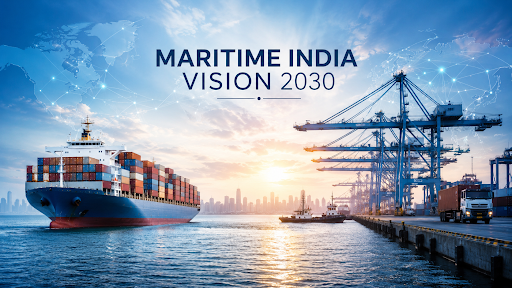
The Ministry of Ports, Shipping and Waterways released the performance achievements of Maritime India Vision (MIV) 2030.
What is Maritime India Vision (MIV) 2030?
The Government of India designs this comprehensive, decade-long blueprint to modernize the maritime sector, enhance port capacity, adopt advanced digital technologies, and promote sustainable port operations.
The initiative sets a strict target to achieve 3,500 Million Metric Tonnes Per Annum (MTPA) of port capacity by 2030.
The vision promotes private sector participation, aiming to handle 85% of major port cargo through Public-Private Partnership (PPP) models by 2030.
The policy heavily prioritizes decarbonization, targeting a 60% share of renewable energy across all Major Ports by 2030.
Objectives of Maritime India Vision 2030
World-Class Port Infrastructure: Builds mega-ports and expands existing facilities to increase the total cargo throughput of Indian ports to 2,200 million metric tonnes by 2030.
Logistics Efficiency: Reduces average vessel turnaround time, successfully lowering this metric from 96 hours in 2014 to 48.8 hours in 2025-26.
Coastal Shipping and Inland Waterways: Shifts cargo from roads to water networks to cut costs, targeting an inland waterways transport throughput of 200 million tonnes by 2030.
Shipbuilding and Ship Repair: Revitalizes domestic shipbuilding with ₹69,725 crore comprehensive package and operates a ₹25,000 crore Maritime Development Fund (MDF) to provide long-term financing for shipyards.
Maritime Digitalisation: Adopt smart technologies like the Digital Twin platform, which creates a real-time virtual replica of port infrastructure to optimize traffic and reduce vessel turnaround time by up to 25%.
Green and Sustainable Ports: Integrates renewable energy and green fuels, pushing ports to operate on solar and wind power while utilizing commercial bio-bitumen to support low-carbon infrastructure.
Blue Economy Strength: Taps into ocean resources responsibly by developing marine biotechnology, sustainable fisheries, and deep-sea exploration.
Cruise Tourism Boost: Upgrades terminals and introduces e-Visas to achieve a target of 1,000 cruise calls by 2030.
Ship Recycling Dominance: Maintains India's 1st rank globally in ship recycling by modernizing yards in Alang, Gujarat to meet Hong Kong Convention standards.
Key Pillars of MIV 2030
Port Infrastructure Modernisation: This pillar focuses on creating deep-water berths, mechanizing cargo handling, and building multi-modal hubs to accommodate larger global ships.
Maritime Logistics Integration: The framework integrates road, rail, coastal shipping, and inland waterways while utilizing the Maritime Single Window and Jal Samriddhi Portal to streamline trade processes.
Shipbuilding and Repair Support: The government deploys the Shipbuilding Financial Assistance Scheme (SBFAS) with a ₹24,736 crore outlay to eliminate cost disadvantages for Indian shipyards.
Coastal Community Development: The program uplifts coastal populations through skill training and tourism, utilizing schemes like the Deen Dayal Upadhyaya Grameen Kaushalya Yojana to train youth for maritime jobs.
Green Maritime Sector: This pillar drives the transition to clean fuels like Liquefied Natural Gas (LNG) and green hydrogen, electrifies port equipment, and enforces strict waste management.
Global Maritime Hubs: The government develops strategic regions, such as Great Nicobar Island, into global maritime hubs through massive transshipment terminals.
Regulatory Reforms: The policy modifies laws to accord "infrastructure status" to Indian-flagged commercial vessels over 10,000 Gross Tonnage.
Major Challenges
High Infrastructure Financing Requirements: Building mega-ports and shipyards demands massive capital, with the upcoming Sagarmala 2.0 requiring an enormous ₹3.6 lakh crore in total investments.
Environmental and Coastal Sustainability Concerns: Port expansion threatens sensitive marine habitats like mangroves and coral reefs, while large projects like the Great Nicobar development face scrutiny for diverting 1.82% of island forest cover.
Global Shipping Market Volatility: Geopolitical conflicts, such as the Red Sea crisis, and fluctuating global shipping tariffs expose Indian maritime trade to severe freight rate volatility.
Skilled Maritime Workforce Deficit: Advanced ports require workers skilled in digital logistics, AI, and modern shipbuilding, but many shipyards currently lack highly trained professionals.
Technological Modernisation Barriers: Transitioning legacy non-major ports to digital and smart port standards remains difficult due to poor existing infrastructure, high costs, and fragmented state-level governance.
Land Acquisition Delays: Expanding port connectivity networks (roads and railways) constantly faces local resistance and delays over land acquisition and environmental clearances.
Trade Deficits: Heavy reliance on imported raw materials like crude oil creates a persistent trade imbalance, challenging the financial stability of shipping operations.
Measures to Accelerate Maritime Growth
Strengthen Port Connectivity: The government must rapidly execute road, rail, and multimodal pipeline projects under the PM Gati Shakti master plan to connect deep hinterlands directly to the coast.
Expand Green Port Initiatives: Ports must strictly implement the Greenhouse Gas Emission Intensity targets and fully transition to renewable energy sources, smart grids, and green hydrogen hubs.
Promote Indigenous Shipbuilding: Strictly implement the fleet acquisition plan for 400+ vessels to provide long-term, visible orders to Indian shipyards and utilize the ₹25,000 crore Maritime Development Fund.
Increase Private Sector Participation: Streamline the bidding process and resolve regulatory bottlenecks to successfully hit the target of handling 85% of cargo via Public-Private Partnerships by 2030.
Enhance Maritime Skill Development: Institutions like the Indian Ship Technology Centre must scale up "On Job Training" models across all coastal states to bridge the acute talent gap in digital shipping.
Integrate Digital Technologies: Implement Digital Twin platforms, AI-based asset tracking, and the Maritime Single Window to mirror the efficiency gains seen at V.O.C Port.
Support Ship Recycling: Market Hong Kong Convention (HKC) compliant yards in Alang to capture the majority of global ship scrapping contracts.
Boost Coastal Shipping: Implement the Coastal Cargo Promotion Scheme aggressively to double the share of coastal shipping in logistics by 2047.
Conclusion
Maritime India Vision 2030 serves as the strategic blueprint to transform India into a dominant, sustainable, and technologically advanced global maritime superpower.
Source: PIB
|
PRACTICE QUESTION Q. Consider the following statements regarding the Maritime India Vision (MIV) 2030: 1. It aims to increase the share of renewable energy across Major Ports to 60% by 2030. 2. It targets handling 100% of major port cargo through Public-Private Partnerships (PPP) by 2030. 3. The vision includes a target of 1,000 cruise calls to boost maritime tourism. Which of the statements given above is/are correct? A) 1 and 2 only B) 1 and 3 only C) 2 and 3 only D) 1, 2, and 3 Answer: B Explanation: Statement 1 is correct: The Ministry of Ports, Shipping and Waterways outlines a key green port target under the Maritime India Vision (MIV) 2030 to increase the share of renewable energy to over 60% across Major Ports from its baseline of less than 10%. Statement 2 is incorrect: MIV 2030 sets a specific target to increase the share of cargo handled by Public-Private Partnerships (PPP) or other private operators at major ports to 85% by 2030, not 100%. Statement 3 is correct: To actively promote ocean and coastal cruise tourism, the blueprint includes a dedicated target to scale up infrastructure and increase the annual frequency to 1,000 cruise calls by 2030. |