Why In News?
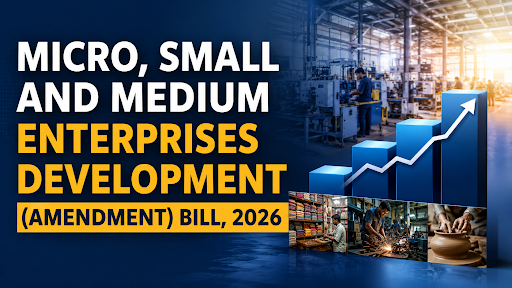
Parliament passed the Micro, Small and Medium Enterprises Development (Amendment) Bill, 2026 to mandate faster payments and dispute resolution for MSMEs.
About MSME Development (Amendment) Bill 2026
The Bill amends the MSME Development Act, 2006, aligning it with technological advancements and the evolving business environment.
-
Existing provisions under the 2006 Act had no fixed timelines for resolving payment disputes, leaving MSME suppliers waiting for months or years to recover dues.
Objective: To modernise the MSME legal framework through digital registration, mandatory TReDS-based settlement, time-bound dispute resolution, and graded enforcement.

Key Features of the Amendment Bill
Revised classification framework: The Bill removes fixed threshold and empowers the Central Government to notify classification criteria — based on investment in plant and machinery/equipment and turnover — through gazette notification, allowing faster, more flexible revisions.
Exclusions from investment calculation: The Bill excludes expenditure on safety, environmental compliance, and innovation-related items from investment calculation, ensuring such spending does not push an enterprise into a higher classification category.
Faster dispute resolution: Amendments to Section 18 expand the MSEFC's jurisdiction, allowing suppliers to file disputes in their own registered jurisdiction, irrespective of the buyer's location.
Mediation timelines: Mediation must be completed within 90 days; if mediation fails, the dispute must go to arbitration within 30 days of mediation's termination (Source: Ministry of MSME/KNN India report on the Bill).
Interim relief for MSMEs: Courts must release at least 50% of the disputed awarded amount to the MSME supplier if an appeal remains pending beyond six months — up from the earlier 75% pre-deposit-only framework.
Decriminalisation of minor defaults: Minor registration or reporting defaults shift from criminal conviction to graded administrative warnings and monetary fines ranging from ₹1,000 to ₹1,00,000.
MSME Sector in India
Micro, Small and Medium Enterprises (MSMEs) are the backbone of the Indian economy, acting as the largest source of non-farm employment and a key driver of manufacturing, exports and inclusive growth.
The Economic Survey 2025–26 identifies MSMEs as central to achieving Viksit Bharat 2047 through innovation, formalisation and global value chain (GVC) integration.
Economic Contribution: Contributes 31.1% of GDP
-
Accounts for 35.4% of manufacturing output.
-
Contributes 48.58% of India's total exports.
Employment Generation: More than 7.47 crore MSMEs operate across manufacturing, trade and services.
-
The sector provides livelihoods to about 32.8 crore people, making it the second-largest employer after agriculture.
Formalisation and Digitalisation: Rapid formalisation has occurred through the Udyam Registration Portal and Udyam Assist Platform, expanding MSMEs' access to institutional credit, public procurement and government incentives.
Credit and Financial Inclusion: Schemes such as the Credit Guarantee Fund Trust for Micro and Small Enterprises (CGTMSE), PMEGP, RAMP Programme and Raising and Accelerating MSME Performance (RAMP) have expanded formal credit and competitiveness.
Source: NEWSONAIR
|
PRACTICE QUESTION Q. Consider the following statements about the Credit Guarantee Fund Trust for Micro and Small Enterprises (CGTMSE):
Which of the statements given above is/are correct? (a) 1 only (b) 2 only (c) Both 1 and 2 (d) Neither 1 nor 2 Answer: (c) Both 1 and 2 Explanation: Statement 1 is correct: The Credit Guarantee Fund Trust for Micro and Small Enterprises (CGTMSE) was officially launched in 2000 as a joint initiative between the Ministry of Micro, Small and Medium Enterprises (MSME), Government of India, and the Small Industries Development Bank of India (SIDBI). SIDBI functions as the Managing Trustee of the fund. Statement 2 is correct: The core objective of the trust is to provide credit guarantee coverage to institutional lenders. This enables them to provide collateral-free and third-party guarantee-free term loans and working capital facilities to new and existing micro and small enterprises (MSEs). |