Why In News?
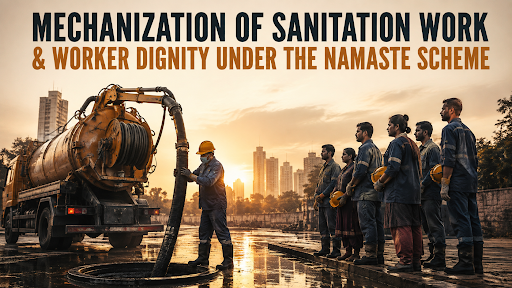
The Ministry of Social Justice and Empowerment (MoSJE) moved a ₹498.73-crore proposal to expand the NAMASTE scheme to rural India.
What is the NAMASTE Scheme?
Launched in 2022–23, the National Action for Mechanised Sanitation Ecosystem (NAMASTE) is a Central Sector Scheme jointly implemented by the Ministry of Social Justice and Empowerment (MoSJE) and the Ministry of Housing and Urban Affairs (MoHUA), executed through the National Safai Karamcharis Finance and Development Corporation (NSKFDC).
Core Mandate & Objectives
-
Zero Fatalities: Eliminates hazardous manual entry into sewers and septic tanks through 100% mechanized cleaning.
-
Formal Identification & Profiling: Digitally profiles over 90,942 Sewer and Septic Tank Workers (SSWs) and 3.78 lakh waste pickers across India. (Source: PIB)
-
Capital Subsidies for Mechanization: Provides up to 50% capital subsidy (capped at ₹5 lakh) for sanitation machinery costing up to ₹15 lakh, transforming manual scavengers into self-employed.
-
Health & Safety Cover: Enrolls 100% profiled sanitation workers under Ayushman Bharat (PM-JAY) with comprehensive health insurance and provides certified PPE kits.
Proposed Rural Expansion (2026–2031): Extends coverage with an outlay of ₹498.73 crore to rural Gram Panchayats, bringing drain cleaners, Sewage Treatment Plant (STP) operators, and Faecal Sludge Treatment Plant (FSTP) workers under its social security net.
Anti-Manual Scavenging Laws in India
The 1993 Act: The Employment of Manual Scavengers and Construction of Dry Latrines (Prohibition) Act, 1993 criminalized manual scavenging of dry latrines, but suffered from weak enforcement and excluded septic tanks.
Self Employment Scheme for Rehabilitation of Manual Scavengers (SRMS, 2007): Provided one-time cash assistance of ₹40,000, monthly stipends of ₹3,000 for skill training, and capital subsidies up to ₹5 lakh to rehabilitate 58,098 identified manual scavengers.
The MS Act, 2013: The Prohibition of Employment as Manual Scavengers and their Rehabilitation Act, 2013 banned manual cleaning of sewers/septic tanks without protective gear, made offences cognizable and non-bailable with up to 5 years imprisonment, and mandated alternative livelihoods.
NAMASTE Scheme (2023–Present): Replaced SRMS, shifting focus from post-facto cash doles to proactive, 100% technological mechanization and institutional enterprise ownership.
Why Hazardous Manual Scavenging Still Persists
Deep-Rooted Caste Hegemony: Manual scavenging remains structurally enforced upon specific Dalit sub-castes (Valmiki, Hela, Dom, Mehtar), reinforcing generational social exclusion and untouchability.
Prevalence of Unsanitary Pits in Semi-Urban & Rural Belts: Millions of single-pit latrines and poorly designed septic tanks lack access for standard suction tankers, forcing manual unblocking.
Informal Subcontracting by Municipalities: Urban Local Bodies (ULBs) evade statutory liability by delegating sewer cleaning to unorganized private contractors who employ migrant workers without safety gear.
High Capital Cost of Robotic Equipment: Advanced manhole-cleaning robots (such as Bandicoot by Genrobotics, deployed in Kerala and Tamil Nadu) remain unaffordable for financially strained Tier-3 municipalities without state subsidies.
Supreme Court Directives
Safai Karamchari Andolan vsUnion of India (2014): The Supreme Court directed all States and UTs to identify manual scavengers and mandated a mandatory compensation of ₹10 lakh to the families of all workers who died in sewers since 1993.
Dr. Balram Singh vs Union of India (October 2023 & Jan 2026 Clarification):
-
Enhanced Compensation: Raised sewer death compensation from ₹10 lakh to ₹30 lakh.
-
Disability Relief: Mandated minimum ₹20 lakh for permanent disability and ₹10 lakh for other occupational injuries.
-
Strict Vicarious Liability: Ruled that municipal bodies and states cannot evade compensation by blaming third-party contractors, ordering strict departmental prosecution for manual entries.
Key Challenges in Eradication
High Bank Loan Rejection Rates: Stringent collateral and credit-score demands by commercial banks block poor sanitation workers from securing Swachhata Udyami loans.
Near-Zero Conviction Rate of Contractors: Police routinely register sewer deaths under Section 304A IPC / Section 106 BNS (death by negligence) rather than the non-bailable MS Act, 2013, allowing contractors to secure quick bail.
Inaccessible Rural Sanitation Pits: Dense rural habitations with narrow alleys cannot accommodate large 3,000-liter suction trucks, perpetuating manual septic cleaning.
Delayed State Compensation Payouts: Bereaved families face bureaucratic delays of 2–4 years to receive the Supreme Court-mandated ₹30 lakh relief from municipal corporations.
Lack of Specialized Technical Training: Low operational training on operating complex robotic machines leads to equipment idling in small municipalities.
Health Hazards for Excluded Waste Pickers: Waste pickers and open-drain cleaners face chronic respiratory and skin infections without formal occupational safety nets.
Way Forward
Universalize Robotic Manhole Technology (Bandicoot Model): Mandate all municipal corporations to deploy robotic scavengers (e.g., Kerala model), replacing manual entry entirely by 2027.
Automate Direct Benefit Transfer for Capital Subsidies: Remove commercial bank intermediaries by disbursing NSKFDC 50% capital subsidies directly through Jan Dhan accounts under Credit Guarantee Schemes.
Enforce Strict Criminal Liability on Municipal Commissioners: Hold principal municipal officers directly liable under BNS and MS Act 2013 for any manual entry permitted within their jurisdiction.
Deploy Compact Mini-Suction Tankers in Rural Areas: Procure customized 500-liter tractor-mounted and e-rickshaw suction units to navigate narrow rural alleys under SBM-Grameen.
Establish an Automated ₹30-Lakh Escrow Compensation Fund: Create a central single-window digital escrow account to disburse ₹30 lakh relief to victims' families within 30 days of an FIR.
Form Worker-Led Sanitation Cooperatives (SHGs): Group profiled SSWs into Self-Help Groups and grant them exclusive long-term municipal mechanized cleaning contracts.
Institutionalize Comprehensive Health Monitoring: Conduct quarterly medical checkups and biometric occupational disease tracking for 100% sanitation workers via Ayushman Arogya Mandirs.
Conclusion
Expanding the NAMASTE scheme to rural India and enforcing the Supreme Court's ₹30 lakh mandate transforms sanitation work from a caste-bound hazard into a mechanized, dignified, and safe public utility enterprise.
Source: THEHINDU
|
PRACTICE QUESTION Q. With reference to the 'NAMASTE' scheme, consider the following statements: 1. It is a Central Sector Scheme jointly implemented by the Ministry of Social Justice and Empowerment and the Ministry of Housing and Urban Affairs. 2. It aims to achieve zero fatalities in sanitation work through 100% mechanization of sewer and septic tank cleaning. 3. The scheme provides capital subsidies to sanitation workers through the National Safai Karamcharis Finance and Development Corporation (NSKFDC). Which of the statements given above are correct? (a) 1 and 2 only (b) 2 and 3 only (c) 1 and 3 only (d) 1, 2, and 3 Answer: (d) 1, 2, and 3 Explanation: Statement 1 is correct: The NAMASTE (National Action for Mechanised Sanitation Ecosystem) scheme is a Central Sector Scheme. It runs as a joint initiative of the Ministry of Social Justice and Empowerment (MoSJE) and the Ministry of Housing and Urban Affairs (MoHUA). Statement 2 is correct: A primary objective of the scheme is to achieve zero fatalities in sanitation work across India. It aims to achieve this by enforcing 100% mechanization of sewer and septic tank cleaning operations. Statement 3 is correct: The scheme promotes "Sanitapreneurship" by providing capital subsidies (up to 5 lakh rupees) to sanitation workers for purchasing specialized cleaning machinery. The financial and training components are channeled through the National Safai Karamcharis Finance and Development Corporation (NSKFDC). |