Why In News?
The Union Minister for New and Renewable Energy announced that deploying agrivoltaic systems across just 10% of India’s suitable agricultural land can generate enough electricity to satisfy the nation’s entire projected power demand up to 2050.
What Is Agrivoltaic Farming?
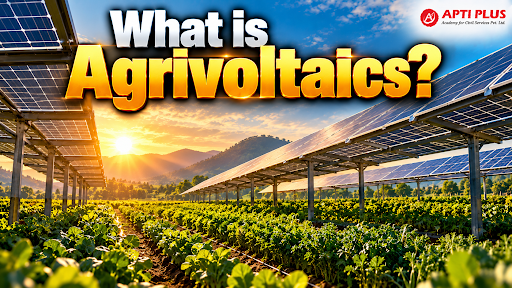
Agrivoltaics (also termed AgriPV, agrophotovoltaics, agrovoltaics, agrisolar, or dual-use solar) is the simultaneous use of the same land parcel for both agricultural production (crop cultivation, livestock grazing, or habitat restoration) and photovoltaic (PV) power generation.
Origin: The concept was first conceptualized in 1981–1982 by German scientists Adolf Goetzberger and Armin Zastrow to eliminate land competition between food and energy production.
Dual-Harvest Model: Instead of converting arable farmland into dedicated solar parks, agrivoltaics elevates solar arrays above crops or places them in wide interspaced rows, enabling "one land, two harvests".

Strategic Importance Of Agrivoltaics For India
Resolving Land Competition: India accommodates 18% of the global human population on just 2.4% of world land mass, while maintaining 160 million hectares of arable cropland. Agrivoltaics eliminates the conflict between agricultural land preservation and solar energy expansion.
Empowering Smallholders ("Annadata to Urjadata"):
-
Over 85% of Indian farmers are small and marginal cultivators holding under 2 hectares.
-
Agrivoltaics transforms farmers into Urjadatas by offering dual revenue streams—harvesting crops while securing predictable, long-term power sale revenues under 15 to 25-year Power Purchase Agreements (PPAs) with state DISCOMs under schemes like PM-KUSUM.
Advancing Net-Zero Climate Goals: Supports India's Panchamrit commitments under the UNFCCC to install 500 GW of non-fossil fuel capacity by 2030 and achieve net-zero carbon emissions by 2070.
Water-Energy-Food Nexus Synergy: Replaces diesel-powered irrigation pumps with clean solar energy, reducing diesel consumption, cutting foreign exchange spent on crude oil imports, and stabilizing farm irrigation.
Decentralized Rural Grid Stability: Generating electricity close to rural consumption centers reduces transmission and distribution (T&D) losses and stabilizes local distribution feeders (11 kV / 33 kV).
What Did the TERI Study Reveal About India’s Agrivoltaic Potential?
Geospatial Land Suitability: Joint geospatial modeling by The Energy and Resources Institute (TERI) and the Energy Transitions Commission (ETC) revealed that 47.5 million hectares (or 30% of India's 160 million hectares of cropland) are technically suitable for agrivoltaics after applying environmental, slope, flood risk, and irradiance filters.
High-Certainty Near-Term Potential: Focusing strictly on 2.8 million hectares of highly compatible crop categories (Categories A, B, and C) reveals an immediate installed capacity of 1,190 GW to 2,130 GW, generating 1,880 TWh to 3,360 TWh of annual clean electricity.
High-Potential Scenario: Under a deployment scenario across 16 million hectares (10% of total cropland), AgriPV yields 8,000 GW of solar panel capacity generating 12,775 TWh of electricity annually.
Exceeding Projected 2050 Power Demand:
-
Electricity generated from cropland alone (12,775 TWh) exceeds India's projected 2050 national power demand of 5,250 TWh to 10,020 TWh.
-
When combined with 10 million hectares of permanent pasture and grazing land, total solar potential reaches 27,290 TWh annually from 17,000 GW of installed solar panels.
State-Wise Geographical Concentration: Six states—Maharashtra, Rajasthan, Andhra Pradesh, Madhya Pradesh, Karnataka, and Uttar Pradesh—concentrate nearly 50% of India's total agrivoltaic potential.
Pilot Crop Insights: Field trials demonstrated that shade-tolerant leafy vegetables and fruits achieve yield increases of 10% to 20% with average water savings of 30%. Slight yield drop in crops like wheat was offset by improved grain quality and higher market prices.
What Are The Challenges In Expanding Agrivoltaics?
High Upfront Capital Expenditures: Stilted mounting structures (elevated to 3.5–5 meters) and solar tracking mechanisms make agrivoltaic plants 25% to 50% (and up to 115%) more expensive to construct than conventional ground-mounted solar arrays.
Credit & Financing Barriers for Smallholders: Over 85% of Indian farmers are small and marginal with limited access to commercial loans, high interest rates, and a lack of collateralized credit or risk guarantee products.
Legal & Land Regulatory Rigidities:
-
Land regulations fall under the State List of the Seventh Schedule of the Constitution of India.
-
State Revenue Codes often mandate formal land reclassification to non-agricultural status for solar arrays, causing farmers to lose statutory agricultural tax exemptions and crop subsidies.
-
Short-term land leasing restrictions in state tenancy laws conflict with the 25-year operational lifespans required for bankable Power Purchase Agreements (PPAs).
Crop Compatibility & Photic Trade-offs: Heavy shade-intolerant cereal staples like rice paddies suffer yield suppression under dense panel arrays unless dynamic trackers or spectral light-splitting systems are used.
Distribution Grid Interconnection Bottlenecks: Rural distribution networks (11 kV / 33 kV) lack sub-station transformer capacity to handle bidirectional voltage flows, risking solar power curtailment by DISCOMs.
Operational Complexity & Maintenance: Simultaneous management of crop operations and elevated solar array cleaning/maintenance increases operational complexity and risks machinery collision.
Way Forward
Uniform Regulatory Recognition & Land Policy Harmonization: The Union Government must formulate a model National Agrivoltaic Policy providing statutory recognition of dual land use under the Right to Fair Compensation and Transparency in Land Acquisition, Rehabilitation and Resettlement Act, 2013 (LARR Act), explicitly waiving land conversion requirements.
-
Example: French National Agrivoltaic Legal Framework, statutory regulations mandate that Agri-PV installations maintain agricultural production as the primary activity, capping crop yield reductions at maximum 10% to retain agricultural tax status and green subsidies.
Tailored Financial Instruments & Subsidies: Expand central capital benchmarks under PM-KUSUM 2.0 to offer 60% capital subsidies specifically for stilted and tracker-enabled Agri-PV arrays erected by Farmer Producer Organisations (FPOs) and cooperatives.
-
Example: Central Arid Zone Research Institute (CAZRI) Jodhpur Model, integrated 100 kW elevated solar arrays with rainwater harvesting systems and drip irrigation, cutting crop water consumption by 30% to 50% while yielding net power sales to state DISCOMs.
Agronomic Innovation & Crop Selection Protocols: Deploy semi-transparent solar panels, curved polymer films blocking near-infrared radiation, and single-axis tracking modules to optimize photosynthetic active radiation.
-
Example: ICAR-IARI Centre of Excellence on Agri-Photovoltaics (Delhi), a 100 kW tracker-integrated agrivoltaic facility tested shade-tolerant high-value crops (strawberries, dragon fruit, medicinal plants, vegetables), reducing irrigation requirements by 1 cycle per year while maintaining peak agricultural output.
Decentralized Farm Electrification & Cold Chain Synergy: Integrate Agri-PV power output with micro-grids, solar water pumps, and local solar-powered cold storage units to minimize post-harvest agricultural losses.
-
Example: BAIF Rural Innovation Centre (Pune, Maharashtra), solar power generated from elevated farm panels directly energized micro-irrigation networks and village cold-chain infrastructure, eliminating reliance on expensive diesel generators costing thousands of rupees per hectare.
Conclusion
Agrivoltaic farming harmonizes national energy security with food production, providing a viable blueprint to transform Indian farmers into resilient Urjadatas for Viksit Bharat 2047.
Source: THEHINDU
|
PRACTICE QUESTION Q. With reference to "Agrivoltaics" (Agri-PV systems), consider the following statements:
Which of the statements given above are correct? (a) 1 and 2 only (b) 2 and 3 only (c) 1 and 3 only (d) 1, 2, and 3 Answer: (d) Explanation: Statement 1 is correct: Agrivoltaics (Agri-PV) describes co-locating solar photovoltaic panels and agricultural production on the exact same piece of land, creating a dual-use system that optimizes land productivity. Statement 2 is correct: High operating temperatures reduce the electrical conversion efficiency of standard photovoltaic modules. The transpiration from crops cultivated underneath lowers ambient surface temperatures, creating a micro-climatic cooling effect that helps keep solar panels cooler and improves their operating efficiency. Statement 3 is correct: According to studies by The Energy and Resources Institute (TERI), around 47.5 million hectares (~30% of India's cropland) is technically suitable for agrivoltaics. Operationalizing just 10% of this suitable land (4.75 million hectares) would generate enough electricity to comfortably surpass India's projected electricity demand for 2050. |