Why In News?
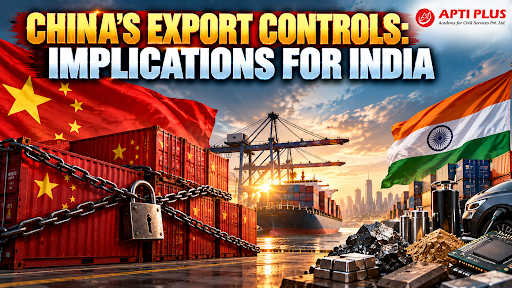
China’s Ministry of Commerce (MOFCOM) announced new export controls on high-end Tunnel Boring Machines (TBMs), super-large-diameter shield equipment, and related components.
Why China Placed Export Controls on Tunnel Boring Machines?
Official Legal Rationale: Beijing cited national security, protection of strategic interests, and international non-proliferation obligations. The controlled hardware is classified as dual-use items possessing both civilian construction utility and military/security applications.
Licensing & End-User Tracking: Exporters must secure individual export licences, declare dual-use control codes in customs documentation, and comply with end-user registration and non-diversion pledges, particularly for exports bound for "sensitive countries and regions" involved in territorial disputes with China.
How China’s Export Control Strategy Evolved?
Statutory Codification (2015–2020): Rooted in the National Security Law (2015) and codified under the Export Control Law (2020), Beijing unified scattered trade regulations under "national security" mandate, expanding statutory authority beyond traditional non-proliferation grounds.
Critical Mineral Supply Chain Controls (2023–2025): China systematically imposed export licensing on gallium and germanium (semiconductors/radar) in July 2023, graphite (EV battery anodes) in October 2023, antimony (munitions/solar) in late 2024, and medium/heavy rare earth elements throughout 2025.
Locking Processing Know-How (2023–2025): Through revisions to the Catalogue of Prohibited and Restricted Technologies, China banned the outward transfer of proprietary technology for rare earth extraction, separation, magnet production, and lithium refining, locking in its midstream processing monopoly.
Institutional Supply Chain Architecture (2024–2026): Enacted State Council Decree 792 (Dual-Use Export Control Regulations) in late 2024, Decree 834 (Industrial and Supply Chain Security), Decree 835 (Countering Improper Extraterritorial Jurisdiction), and Decree 837 (Outbound Investment Regulations) in mid-2026 to discourage global supply chain de-risking.
Pivot to Capital Heavy Equipment (2026): In October 2026, Beijing expanded its playbook from raw material inputs to heavy industrial hardware, targeting full-face TBMs, dredging cutterheads, and high-altitude excavation machinery.
What are the Strategic Objectives Behind the Curbs?
Asymmetric Geopolitical Counterweight: Serves as physical hardware retaliation against Western restrictions on advanced semiconductors, EUV lithography systems, and AI microprocessors.
Preserving Midstream & Manufacturing Chokepoints: Controlling 70% of global TBM production and over 70% of rare-earth refining capacity allows China to prevent competitor nations from establishing parallel supply chains.
Weaponizing the "Geography of Manufacturing": Enforces the reality that possessing Western Intellectual Property (IP) is insufficient if physical assembly occurs inside mainland China.
Grey-Zone Economic Coercion: Leverages administrative trade friction below the threshold of open diplomatic confrontation to slow down strategic military infrastructure development along contested borders.
Denial by Delay and Dissuasion: Discourages the flight of industrial capacity abroad while inflating capital costs and delivery timelines (18–24 months) for foreign alternatives.
What Are the Implications of China's Export Control on India?
Infrastructure and Strategic Tunnelling: India uses large TBMs for projects such as the Mumbai–Ahmedabad High-Speed Rail Corridor and underground metro networks. Export licensing delays could increase project costs and extend completion timelines.
Border Connectivity: Restrictions on walking excavators and wet shotcrete machines could affect tunnelling and road construction in high-altitude Himalayan regions, where infrastructure supports military mobility.
Pharmaceutical Industry: India imports around 70% of its Active Pharmaceutical Ingredients (APIs) from China. Dependence for certain antibiotics and pharmaceutical intermediates may reach 80–90%, creating risks for domestic medicine production.
Renewable Energy and Electronics: India depends heavily on Chinese supplies of solar equipment, electronic components and EV battery materials. Restrictions on graphite, antimony and neodymium-iron-boron (NdFeB) permanent magnets could slow renewable energy deployment and electric mobility.
Defence Preparedness: Gallium is important for advanced radar systems, while antimony has applications in ammunition and other defence-related products. Supply shortages could affect military modernisation and domestic defence manufacturing.
Trade Tensions: India's trade-remedy measures reflect growing commercial tensions. India initiated 18 anti-dumping and anti-subsidy investigations during July–September 2026, with China the largest target.
Artificial Intelligence and Data Security: Dependence on foreign AI infrastructure and services can create technology and security risks. India needs reliable access to computing hardware and greater control over sensitive government and defence data.
What Measures Can India Take to De-Risk Supply Chains?
National Critical Mineral Mission (NCMM): Accelerate domestic exploration, mining and mineral processing to reduce dependence on imported critical materials.
Domestic Heavy Machinery Manufacturing: Promote indigenous design and production of TBMs, specialised excavators and other strategic construction equipment. Targeted Production Linked Incentive (PLI) support could help develop domestic manufacturing capabilities.
Build Mineral Processing Capacity: Expand domestic refining through hydrometallurgical plants, solvent extraction facilities and public-private partnerships. Mining alone cannot ensure supply security if India must send raw materials abroad for processing.
Leverage the China+1 Strategy: Attract global manufacturers seeking alternatives to China. The revised Press Note 3 framework and proposed fast-track approvals for eligible manufacturing joint ventures. India should also encourage technology transfer and foreign investment in critical machinery.
Promote International Partnerships: Work with partners through the Minerals Security Partnership and the Quad, comprising India, the United States, Japan and Australia, to diversify mineral supplies and improve access to technology.
Strengthen Recycling: Implement the Battery Waste Management Rules, 2022, and expand recycling of batteries, electronics and industrial waste. Recovering critical metals through urban mining can reduce import dependence.
Diversify Import Sources: Build alternative supply arrangements with reliable international partners to reduce the risks associated with excessive dependence on a single country.
Support Domestic Research and Development: Encourage collaboration among industry, research institutions and universities to develop indigenous technologies for mineral processing, electronics and advanced industrial machinery.
Conclusion
India must convert China's dual-use export controls into a strategic catalyst for domestic manufacturing self-reliance under Aatmanirbhar Bharat to secure its critical infrastructure and border logistics autonomy.
Source: THEHINDU
|
PRACTICE QUESTION Q. Explain what 'Dual-Use Goods' mean in international trade law. Why do governments enforce export controls on dual-use heavy engineering equipment? (10 Marks, 150 Words) |