Why In News?
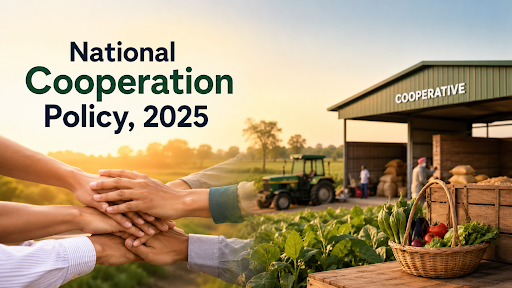
The Union Ministry of Cooperation operationalised the National Cooperation Policy 2025 and convened the first meeting of the National Level Policy Implementation and Monitoring Committee.
What is the National Cooperation Policy, 2025?
It is a comprehensive framework by the Ministry of Cooperation aimed at modernizing the sector, tripling its GDP contribution by 2034, and bringing 50 crore citizens into the movement.
Core Pillars and Objectives
The policy is structured around 16 objectives divided into six strategic pillars: PIB
-
Strengthening Foundation: Legal reforms, better governance, and computerization of Primary Agricultural Credit Societies (PACS).
-
Promoting Vibrancy: Developing business ecosystems and rural clusters.
-
Future-Ready: Tech integration, professional management, and establishing a national "Cooperative Stack".
-
Inclusivity: Ensuring active participation of women, youth, SC/STs, and Adivasis.
-
New & Emerging Sectors: Promoting cooperatives in biogas, waste management, mobile aggregation, and healthcare.
-
Youth-Oriented Capacity Building: Developing courses in higher education and digital employment exchanges.

Why are Cooperatives Important for India?
Inclusive Economic Development: Cooperatives pool local resources, protect the economic interests of weaker sections, prevent monopolies, and distribute wealth evenly among members rather than corporate shareholders.
Rural Economy Backbone: Primary Agricultural Credit Societies (PACS) deliver direct credit to farmers, supporting the 65% of India's population residing in rural areas.
-
Case Study: Amul (GCMMF) proves how landless and marginal dairy farmers can build a multi-billion-dollar market institution through collective cooperative action.
Financial Inclusion: Rural cooperative banks provide cheap, accessible credit to small and marginal farmers who lack access to traditional commercial banks.
Employment and Entrepreneurship: Cooperatives generate local jobs, reduce urban migration, and incubate new start-ups in modern fields like green energy, healthcare, and tourism.
Sustainable Middle Path: The cooperative model balances state-controlled socialism and private capitalism by combining market participation with deep community ownership.
Key Features of the National Cooperation Policy, 2025
Professional Governance: The government establishes the Tribhuvan Sahkari University (TSU) in Anand, Gujarat, as India's first national cooperative university to build skilled manpower and train professional managers.
Digitalisation Drive: The government allocates ₹2,925.39 Crore for the Computerization of PACS to transition 79,630 societies onto a common ERP-based national software.
Transparency and Accountability: The policy mandates regular elections, transparent Management Information Systems (MIS), and independent audits to eliminate corruption and political capture.
Capacity Building: The policy utilizes cluster-based performance monitoring and university training to continuously educate cooperative members on modern business practices.
Women and Youth Empowerment: The framework introduces White Revolution 2.0 to increase milk procurement by 50%, empower rural women, and create career paths for youth.
Multi-State Cooperatives: The government establishes three new national-level apex societies: Bharatiya Beej Sahakari Samiti Limited (BBSSL) for seed production, National Cooperative Organics Limited (NCOL) for organic farming, and National Cooperative Export Limited (NCEL) for global market access.
National Program Integration: The policy links cooperatives with major government schemes, transforming PACS into Common Service Centers (CSCs), PM Bhartiya Jan Aushadhi Kendras, and fuel distribution points.
Model Cooperative Villages: The policy pilots five model cooperative villages in every tehsil, starting in Gujarat under NABARD, to demonstrate holistic rural development.
Expected outcome of the Policy
Improved Farmer Incomes: Initiatives like the "Bharat Beej" brand and organic certification deliver better crop yields and higher market prices for farmers.
Robust Rural Value Chains: The policy provides end-to-end institutional support for aggregation, processing, storage, packaging, and logistics to eliminate exploitative middlemen.
Direct Market Access: Integration with digital commerce platforms like ONDC (Open Network for Digital Commerce) and GeM (Government e-Marketplace) connects small producers directly with national and global buyers.
Financial Sustainability: Scheduled cooperative banks receive the same status as commercial banks, which improves their lending capacity and financial health.
Job Creation: Expanding into new sectors like the Sahkar Taxi scheme ensures direct profit-sharing with drivers and creates thousands of modern jobs.
Inclusive Growth: The policy guarantees the participation of Dalits, Tribals, and weaker sections to distribute economic benefits to the lowest strata of society.
Universal Village Coverage: The policy targets a 30% increase in cooperative societies to ensure at least one active cooperative unit exists in every single panchayat and village.
Major Challenges Faced by the Cooperative Sector
Political Interference: Local politicians frequently capture cooperative management boards to control funds and influence local voting banks.
Deficient Professional Management: Most rural cooperatives lack trained managers and modern corporate leadership, which causes operational inefficiencies.
Limited Digital Adoption: Rural areas suffer from severe digital infrastructure gaps and low digital literacy among farmers, such as the 39% digital illiteracy rate among rural adults, slow technology adoption in rural India.
Financial Stress: Many small cooperatives suffer from limited capital, high Non-Performing Assets (NPAs), and poor credit recovery mechanisms.
Governance Deficits: Weak independent auditing allows financial mismanagement to go unnoticed, eroding member trust.
Low Youth Participation: Young people view cooperatives as outdated institutions and show limited interest due to a lack of awareness and modern career opportunities.
State-Level Policy Divergence: Because "Cooperatives" is a State subject under the Constitution of India, inconsistent state-level laws create uneven growth across regions.

Measures to Strengthen the Cooperative Movement
Democratic Governance: Enforces Part IXB of the Constitution, mandating regular elections every 5 years, limiting board tenures, and requiring independent annual audits.
Digital Expansion: Accelerates the onboarding of all functional PACS onto the national ERP software and fully deploys the National Cooperative Stack.
Professional Training: Utilizes the Tribhuvan Sahkari University to standardize cooperative education and research.
Financial Access: Financial institutions leverage the Sahakar Sarathi IT infrastructure, approved by the RBI, to modernize rural cooperative banking services.
Cooperative Start-ups: Encourages youth to form new cooperatives in emerging fields like technology services, rural logistics, and renewable energy (PM-KUSUM).
Market Linkages and Exports: Utilizes the National Cooperative Export Limited (NCEL) to connect rural artisans and farmers directly with international buyers.
Centre-State Coordination: Establishes strong coordination to align state laws with the national vision, addressing the state-subject status of cooperatives.
Conclusion
The National Cooperation Policy 2025 provides a visionary, tech-driven roadmap to transform cooperative sector into a powerful engine of decentralized, inclusive economic growth by 2047.
Source: PIB
|
PRACTICE QUESTION Q. "Cooperatives are critical instruments for achieving inclusive and sustainable economic development in India." Examine. 150 words |