Why In News?
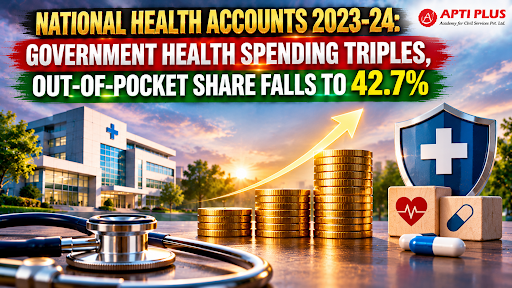
The Ministry of Health and Family Welfare (MoHFW) released the National Health Accounts (NHA) Estimates for India 2023-24.
What Are National Health Accounts (NHA)?
NHA track who pays for healthcare, how much is spent and on which services. Policymakers use them to judge whether public money reaches patients or whether households still carry the cost.
-
Preparing Agency: The National Health Accounts Technical Secretariat (NHATS) at the National Health Systems Resource Centre (NHSRC) prepares the estimates.
-
Edition: This is the eleventh round and uses the System of Health Accounts 2011 (SHA 2011) framework.
-
Global Standard: SHA 2011 is the international framework that makes India's health data comparable with other countries. It classifies spending by financing source, provider and function.
|
Key Terms |
Meaning |
|
Total Health Expenditure (THE) |
Current plus capital health spending from all sources |
|
Current Health Expenditure (CHE) |
Recurring spending only; excludes capital investment |
|
Government Health Expenditure (GHE) |
Spending by the Union, States and local bodies |
|
Out-Of-Pocket Expenditure (OOPE) |
Direct payment by households at the point of care |
|
Social Security Expenditure (SSE) |
Health spending through government-funded insurance and employee health schemes |
What Are The Key Findings Of NHA 2023-24?
-
Absolute Government Spending: GHE rose from ₹1,29,778 crore in 2013–14 to ₹4,14,196 crore in 2023–24. The release calls this a threefold rise, while the raw figures show about 3.2 times.
-
Per Capita GHE: GHE per person rose from ₹1,042 to ₹2,959, about 2.8 times.
-
Government Share In THE: The government's share of THE rose by 14.9 percentage points over the decade.
-
Primary Healthcare Outlay: Government expenditure on primary healthcare was about ₹1.53 lakh crore in 2023–24.
-
Year-On-Year OOPE: The OOPE share was 43.4% in 2022–23, before falling to 42.7% in 2023–24.
-
Social Security Expenditure: SSE rose from 6% of THE in 2013–14 to 11% in 2023–24. It includes schemes such as AB PM-JAY.
-
Private Health Insurance: Its share rose from 3.4% of THE in 2013–14 to 10.2% in 2023–24.
How India's Health Financing Changed Over A Decade?
-
GHE To GDP: Government health expenditure rose from 1.15% of GDP in 2013–14 to 1.43% in 2022–23. Under the revised GDP series with base year 2022–23, the figure is 1.48%.
-
Share Of Government Spending: The government's share in THE rose from 28.6% in 2013–14 to 43.7% in 2022–23.
-
Share Of General Government Spending: Health's share in General Government Expenditure rose from 3.78% to 4.89% over the same period.
-
Pandemic Peak: Government health expenditure reached 1.84% of GDP in 2021–22, when the government made additional investments during COVID-19.
-
Pandemic Low In OOPE: OOPE as a share of THE fell to 39.4% in 2021–22, a figure driven by one-time additional government spending.
-
Total Spending Base: India's total health expenditure in 2021–22 was about ₹9.04 trillion, or around 3.8% of GDP and ₹6,602 per capita.
Initiatives Taken By Government For Reducing Out-Of-Pocket Health Expenditure
AB PM-JAY Cover: The Ayushman Bharat Pradhan Mantri Jan Arogya Yojana (AB-PMJAY) provides health insurance of ₹5 lakh per family per year to families from the poorest 40% of society and all senior citizens aged 70 and above.
-
Largest Scheme Of Its Kind: Ayushman Bharat PM-JAY is described as the largest publicly funded health assurance scheme in the world.
-
Hospital Admissions: As of 28 February 2026, a total of 11.69 crore hospital admissions had been approved under AB-PMJAY.
-
Portability Across States: Under AB PM-JAY, 29.05 lakh inter-state portability hospital admissions, worth more than ₹8,383.97 crore, were authorised as on 30 June 2026.
Ayushman Arogya Mandirs (AAM): As on 30 November 2025, 1,81,873 AAMs had been set up, and over 6.54 crore yoga and wellness sessions had been held.
Pradhan Mantri Bhartiya Janaushadhi Pariyojana (PMBJP): Jan Aushadhi Kendras grew to over 18,646 by February 2026. They sell medicines at 50–80% below branded prices, with 2,000+ medicines and 300 surgical devices.
National Health Mission (NHM): It funds the Free Drugs Service Initiative, the Free Diagnostics Service Initiative and the Pradhan Mantri National Dialysis Programme. Together they cut household spending at public facilities.
Ayushman Bharat Digital Mission (ABDM): It creates Ayushman Bharat Health Account (ABHA) IDs and digital health records. These reduce repeat tests and support portable care.
What Are The Key Challenges In Reducing Out-Of-Pocket Health Expenditure?
Households Still Carry The Largest Load
Household Share Of Current Spending: Households funded 56.44% of CHE in 2022–23, and OOPE alone accounted for 49.90% of CHE. Nearly half of all recurring health spending still comes directly from households.
Rising Per Capita Burden: Nationally, OOPE rose from ₹3,56,254 crore in 2021–22 to ₹3,82,629 crore in 2022–23, an increase of ₹26,375 crore within a year. Per capita OOPE rose from ₹2,600 to ₹2,767 over the same period. The falling share therefore hides a rising absolute burden.
Medicines And Outpatient Care Drive Spending
Medicine Expenditure: India spent over ₹1.6 lakh crore on medicines in 2022–23. This makes drugs the single largest pressure point on household budgets.
Pharmacy Share Rising: The share of pharmacies in CHE rose from 19.35% in 2021–22 to 21.19% in 2022–23, an increase of 1.84 percentage points. Spending at chemists is growing faster than spending in government hospitals.
Coverage Gap For Outpatient Care: AB-PMJAY covers secondary and tertiary hospital care. Most household payments for consultations, diagnostic tests and medicines fall outside its scope, so households keep paying for care before and after hospital stays.
Missed Public Spending Targets
National Health Policy Target Unmet: The National Health Policy (NHP) 2017 committed to raising public health expenditure from 1.15% of GDP to 2.5% by 2025. Combined public spending was only about 1.8% of GDP in 2021–22, so the target remains unmet.
Union Share Shrinking: Union government health expenditure declined from 0.37% of GDP in 2020–21 to 0.29% in 2025–26. The Centre is moving away from the NHP 2017 expectation that it finance about 40% of public health spending.
Government Spending Fell In 2022–23: Even as OOPE rose, total government health spending fell by more than ₹48,000 crore between 2021–22 and 2022–23. Public funding dropped at the same time that households were paying more.
Pandemic Spike Distorts The Trend: Government health expenditure reached 1.84% of GDP in 2021–22, driven by emergency COVID-19 spending. This temporary peak makes the decade-long trend look stronger than the underlying baseline.
Uneven State Effort
Slow Growth In State Spending: State health expenditure rose from 0.67% of GDP in 2017–18 to 1.1% in 2025–26. States now fund most of the public effort, so their fiscal capacity determines the pace of OOPE reduction. (Source: RBI)
Few States Meet The Budget Norm: The NHP 2017 asked States to allocate at least 8% of their budgets to health by 2020. As of 2025–26, only three States had met this norm. (Source: PRS)
Dependence On Private Hospitals And Insurance
Private Hospitals Absorb Most Admissions: Of the 11.69 crore PM-JAY admissions by 28 February 2026, 6.74 crore were in private hospitals. Public hospital capacity is not yet absorbing most authorised care, which leaves patients exposed to private pricing.
Private Insurance Growth Needs Regulation: Private health insurance rose from 3.4% of THE in 2013–14 to 9.2% in 2022–23. Rapid premium-based growth can shift costs back onto households if premiums and claim rules are not regulated.
What Is The Way Forward For Reducing Out-Of-Pocket Health Expenditure In India?
Raise Public Spending
Time-Bound Spending Path: Set a dated road map to the NHP 2017 target of 2.5% of GDP for public health spending, and report progress in every Union Budget. A fixed timeline makes the target enforceable rather than aspirational.
Restore The Union's Share: The NHP 2017 envisaged that the Centre would fund about 40% of total public health spending. With the Union's share falling to 0.29% of GDP, the Centre must rebuild its allocation to meet this benchmark.
Cover Outpatient Care And Medicines
Expand Outpatient Coverage: Add outpatient and diagnostic benefits to the public insurance design. The pharmacy share of CHE rose to 21.19% in 2022–23, which shows that outpatient and medicine costs are where households are most exposed.
Scale Generic Medicines Access: Expand Jan Aushadhi outlets beyond the existing 18,646 Kendras, especially in districts with few outlets. The 50–80% price advantage over branded medicines shows the saving potential for households.
Strengthen Primary Care
Use Primary Care As The First Point Of Contact: Build on the 1,81,873 Ayushman Arogya Mandirs so that patients can get basic care before turning to costly hospital or private clinic visits. Fill staff vacancies so the centres can deliver the full set of services.
Shift Care And Regulate Prices
Strengthen Public Hospital Capacity: Increase public hospital capacity and set standard rates for empanelled private hospitals, since most PM-JAY admissions go to private hospitals. This reduces the scope for unregulated private charges.
Regulate Insurance Premiums: Monitor the growth of private insurance premiums, whose share of THE rose from 3.4% to 9.2% between 2013–14 and 2022–23. Regulation keeps insurance cover from becoming a new cost burden on households.
Conclusion
NHA 2023-24 shows a steady shift from household payments to public and pooled financing. Yet OOPE is still 42.7% of THE, and households still carry the largest share of current spending. Reaching the NHP 2017 target and covering outpatient care are the next steps.
Source: ANINEWS
|
PRACTICE QUESTION Practice Question Q. With reference to National Health Accounts (NHA) in India, consider the following statements: 1. NHA estimates are prepared by the National Health Systems Resource Centre through its Technical Secretariat. 2. Out-of-Pocket Expenditure as a share of Total Health Expenditure rose between 2013-14 and 2023-24. 3. Public health and sanitation is a subject in the State List of the Seventh Schedule. Which of the statements given above is/are correct? (a) 1 only (b) 1 and 3 only (c) 2 and 3 only (d) 1, 2 and 3 Answer: (b) Explanation: Statement 1 is correct. The National Health Systems Resource Centre (NHSRC), designated as the National Health Accounts Technical Secretariat (NHATS) in August 2014 by the Ministry of Health and Family Welfare, prepares the annual National Health Accounts estimates using the internationally accepted System of Health Accounts (SHA 2011) framework. Statement 2 is incorrect. According to the National Health Accounts Estimates for India 2023–24, Out-of-Pocket Expenditure (OOPE) as a share of Total Health Expenditure declined sharply by 21.5 percentage points, falling from 64.2% in 2013–14 to 42.7% in 2023–24. During the same period, Government Health Expenditure more than tripled from ₹1.30 lakh crore to ₹4.14 lakh crore. Statement 3 is correct. Under the Seventh Schedule of the Constitution of India, Public health and sanitation; hospitals and dispensaries falls under Entry 6 of List II (State List), giving state governments primary constitutional responsibility for healthcare delivery. |