Why In News?
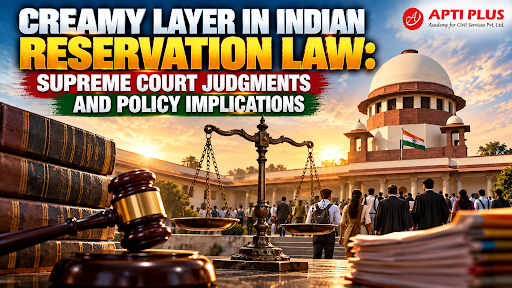
The Supreme Court reserved its judgment on an application moved by the Union Government concerning the nationwide identification and exclusion criteria for the Other Backward Classes (OBC) Creamy Layer.
What Is The OBC Creamy Layer?
Meaning: The creamy layer comprises the relatively advanced and affluent section of the Other Backward Classes (OBCs) who have attained substantial socio-economic elevation and are therefore excluded from reservation quotas.
Exclusion from OBC Reservation: While the central government provides 27% reservation for OBCs in civil posts and educational institutions, individuals falling under the creamy layer are ineligible for affirmative action quotas and must compete in the general (unreserved) category.
Income and Status Criteria: Under the DoPT Office Memorandum of September 8, 1993, creamy layer status is determined via two distinct tests:
-
Status-Based Test (Category II): Children of parents holding constitutional posts or entering Group A / Class I services directly, or both parents entering Group B / Class II services before age 40, are automatically categorized as creamy layer regardless of their wealth.
-
Income/Wealth Test (Category VI): For persons not covered under status criteria, parents having a gross annual income of ₹8 lakh or more (or owning wealth above statutory ceilings) for three consecutive years fall in the creamy layer.
Difference Between OBC and Non-Creamy Layer (NCL): All citizens belonging to backward castes notified in the Central OBC List constitute the broad OBC category, but only those whose parental status or income falls below the prescribed threshold receive the OBC-NCL Certificate necessary for reservation benefits.
Purpose of the Creamy Layer Principle: The doctrine prevents elite monopolization within backward classes, ensuring that affirmative action benefits percolate to the truly underprivileged and disadvantaged individuals at the grassroots level.
What Did The Supreme Court Rule In March 2026?
Parental Income Alone Cannot Be Sole Criterion: The Supreme Court ruled that total household receipts cannot be mechanically aggregated to deny backward class certification without assessing socio-occupational status.
Treatment of Salary Income: The bench held that as per the 1993 DoPT OM, income derived purely from salaries is explicitly excluded from the calculation of the ₹8 lakh income ceiling under Category VI.
Treatment of Agricultural Income: Income generated from agricultural landholdings is also excluded from the income computation, preventing rural farming families from being disqualified due to seasonal crop valuations.
Status of Parents in Public Employment: The court held that children of employees working in PSUs, nationalized banks, universities, and defense undertakings cannot be pushed into the creamy layer merely because their salary exceeds ₹8 lakh.
Impact on OBC Reservation: The ruling protects thousands of candidates from arbitrary disqualification, ensuring that children of mid-level public sector employees are not treated unequally compared to children of state civil servants.
Need for Revised Administrative Rules: The judiciary underscored that persistent administrative failure by executive bodies to establish statutory job equivalence over three decades cannot penalize legitimate reservation claimants.
Why Centre Sought A Two-Year Implementation Window?
Administrative Complexity: Mapping hundreds of disparate pay-scales, designations, and promotional hierarchies across central and state public enterprises to central government ranks presents an enormous bureaucratic task.
Identification of Equivalent Posts: Establishing exact horizontal parity between managerial positions in public sector banks (Scale I to IV) and Central Civil Services (Group A/B) requires inter-departmental evaluation.
Revision of Existing Rules: Comprehensive redrafting of the 1993 DoPT OM, associated circulars, and state-level certification rules demands structured inter-ministerial coordination.
Consultation with Stakeholders: The Centre must engage in wide-ranging consultations with state governments, the National Commission for Backward Classes (NCBC), public sector unions, and legal experts
Uniform Implementation Mechanism: Formulating standardized software portals and pan-India administrative instructions is vital to eliminate conflicting interpretations by local revenue authorities issuing caste certificates.
Concern Over Existing Appointments and Admissions: A retrospective enforcement would destabilize thousands of past civil service selections, public sector recruitments, and university degrees awarded over past recruitment cycles, leading to cascading litigation.
Constitutional Provisions Governing OBC Reservations
Article 14 (Right to Equality): Enshrines the doctrine of equality before the law and equal protection of laws, mandating that unequals cannot be treated equally and that classification must be founded on an intelligible differentia.
Article 15(4) (Special Provisions for Advancement): Empowered by the 1st Constitutional Amendment Act, 1951, this enables the State to make special provisions for the educational advancement of Socially and Educationally Backward Classes (SEBCs).
Article 16(4) (Equality of Opportunity in Public Employment): Empowers the State to make reservations in appointments or posts in favor of any backward class of citizens that is not adequately represented in the services under the State.
Article 46 (Directive Principles of State Policy): Directs the State to promote with special care the educational and economic interests of the weaker sections of the people and protect them from social injustice and all forms of exploitation.
Substantive Equality vs Formal Equality: The Constitution mandates substantive equality (equalizing starting conditions through positive discrimination) rather than formalistic equality, justifying affirmative action as a tool to dismantle historical caste disadvantages.
Reservation for Socially and Educationally Backward Classes: The constitutional matrix dictates that backwardness must be primarily social and educational, clarifying that economic destitution alone does not qualify a group as an OBC.
Major Supreme Court Judgments On The Creamy Layer
Indra Sawhney vs Union of India (1992)
-
A 9-judge Constitution Bench upheld the 27% reservation for OBCs recommended by the Mandal Commission.
-
Formulated the Creamy Layer doctrine, directing the government to identify and exclude socially advanced members of backward classes to preserve the constitutional validity of affirmative action.
-
Ruled that total reservations must not exceed the 50% ceiling, except in extraordinary circumstances.
M. Nagaraj vs Union of India (2006)
-
Upheld constitutional amendments enabling reservations in promotions for SCs and STs subject to quantifiable data showing backwardness and inadequate representation.
-
Affirmed that the creamy layer principle is an essential facet of the Basic Structure doctrine under Article 14, necessary to prevent reverse discrimination.
Jarnail Singh vs Lachhmi Narain Gupta (2018)
-
A 5-judge bench extended the application of the creamy layer principle to Scheduled Castes (SCs) and Scheduled Tribes (STs) in promotional quotas.
-
Clarified that excluding the affluent stratum within a reserved group is essential to give full effect to substantive constitutional equality.
Source: THEHINDU
|
PRACTICE QUESTION Q. Analyze the administrative and legal challenges in applying income-versus-status equivalence for public sector employees under OBC reservation norms. (10 Marks, 150 Words) |