Why In News?
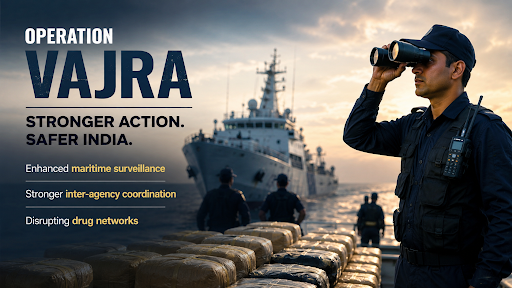
The Central Bureau of Narcotics (CBN) intercepts illegal export of 12 crore Tramadol Hydrochloride tablets weighing 30 metric tons worth over ₹1,000 crore in Delhi under Operation Vajra.
What is Operation Vajra?
The Central Bureau of Narcotics (CBN), operating under the Department of Revenue, Ministry of Finance, leads this high-intensity anti-drug crusade.
Objectives of Operation Vajra
Disrupting Organized Networks: The operation dismantles complex interstate drug syndicates operating across Madhya Pradesh, Maharashtra, Rajasthan, and international borders.
Preventing Chemical Diversion: It stops the illegal diversion of dual-use pharmaceutical formulations, preventing smugglers from trafficking Tramadol (known as the "fighter drug") to active conflict zones like Libya.
Intelligence-Led Enforcement: The agency deploys advanced intelligence gathering and risk-based profiling to expose syndicates hiding illicit shipments behind falsified export documentation.
Inter-Agency Collaboration: The CBN actively coordinates with domestic agencies like the Directorate of Revenue Intelligence (DRI) and global bodies such as the International Narcotics Control Board (INCB).
Safeguarding Public Health: The mission directly advances the national goal of Nasha Mukt Bharat (Drug-Free India) by seizing highly addictive synthetic drugs like Mephedrone (popularly called "Meow Meow").

Challenges India Faces in Combating Narcotics
Complex Multi-State Networks: Kingpins orchestrate operations across multiple states—such as managing shell companies in Bengaluru, coordinating from Kerala, and exporting from Delhi—to evade localized law enforcement.
Dark Web and Encryption: Traffickers leverage the dark web and encrypted communication channels to anonymize transactions, making it difficult for agencies to trace buyers and sellers.
Unregulated Synthetic Production: Illicit labs easily synthesize drugs like Mephedrone using common industrial precursor chemicals, complicating efforts to track chemical diversion.
Porous International Borders: India shares extensive, poorly monitored land and maritime borders with major global drug-producing regions, facilitating easy smuggling.
Sophisticated Money Laundering: Cartels utilize registered Limited Liability Partnerships (LLPs) to launder drug proceeds and present illicit funds as legitimate business revenue.
Falsified Documentation: Criminals generate highly sophisticated fake destination and cargo papers to bypass customs inspections at major exit ports.
Framework Supporting Anti-Narcotics Enforcement
NDPS Act, 1985: The Narcotic Drugs and Psychotropic Substances (NDPS) Act, 1985 serves as India's primary legislative tool, banning illicit substances and granting extensive powers for arrests and asset seizures.
Central Bureau of Narcotics (CBN): The CBN regulates the legal manufacture of synthetic drugs and prevents the diversion of precursor chemicals into illicit channels.
Narcotics Control Bureau (NCB): The NCB acts as the apex national coordinating and intelligence agency dedicated solely to drug law enforcement.
Directorate of Revenue Intelligence (DRI): The DRI serves as the premier anti-smuggling agency, collaborating with the CBN to intercept massive drug shipments across Bengaluru, Delhi, and Kochi.
UN Single Convention on Narcotic Drugs, 1961: This international treaty binds India to global standards, mandate-driven cooperation, and strict control over narcotic substances.
PIT NDPS Act: The Prevention of Illicit Traffic in Narcotic Drugs and Psychotropic Substances (PIT NDPS) Act empowers law enforcement to use preventive detention against habitual drug offenders.
Measures to Strengthen India's Anti-Narcotics Strategy
Expanding Intelligence Operations: Agencies must deploy advanced risk-based profiling to identify and flag suspicious cargo before it exits domestic ports.
Boosting Global Cooperation: India must establish real-time intelligence-sharing channels with international bodies like the International Narcotics Control Board (INCB) to apprehend overseas kingpins.
Securing Borders and Hotspots: Law enforcement must conduct regular, targeted cordon-and-search operations in high-risk zones to disrupt local distribution networks.
Deepening Financial Investigations: Investigators must trace the ultimate beneficial ownership of shell companies, targeting directors of entities like the Bengaluru-based LLP to freeze illicit assets.
Reducing Demand and Raising Awareness: Public campaigns, such as "Say No to Drugs, Bro – Ride a Cycle, Bro", must actively engage the youth to curb drug abuse.
Leveraging Technology in Factories: The government must install digital monitoring systems in chemical manufacturing units to prevent the diversion of dual-use raw materials.
Empowering Communities: States should implement secure, anonymous reporting mechanisms, such as toll-free helplines, to encourage citizen participation in reporting drug peddling.
Source: PIB
|
PRACTICE QUESTION Q. "Drug trafficking is no longer merely a law-and-order issue but a multidimensional national security challenge." Discuss. 150 words |