Why In News?
The Ministry of Petroleum and Natural Gas (MoPNG) operationalized guidelines for the GOBARdhan Central Sector Scheme (National Circular Bioenergy Scheme), backed by a total financial outlay of ₹23,731 crore for a 10-year period from FY 2026–27 to FY 2035–36.
What Are The New Operational Guidelines?
The MoPNG Operational Guidelines provide a comprehensive execution roadmap designed to address long-standing market failures in India’s bioenergy sector:
-
Unifying Demand, Capital, and Infrastructure: Unlike earlier fragmented initiatives, the guidelines bring together six synchronized growth engines—offtake assurance, pricing, capital grants, pipeline development, credit guarantees, and challenge funds.
-
Commercial De-risking for Investors: By establishing 100% assured offtake and 10-year price certainty, the framework eliminates counterparty and demand risk for private developers and institutional lenders.
-
Scale Target: The framework aims to drive a nearly 10-fold increase in domestic Compressed Biogas (CBG) output over the next decade.
What Is The Gobardhan Scheme?
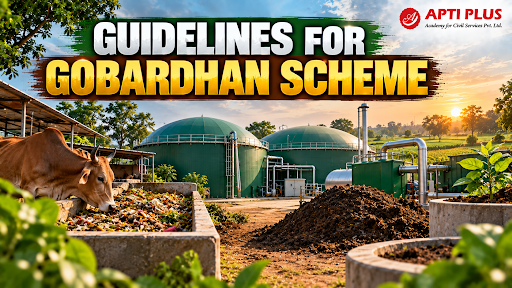
Originally launched under the Swachh Bharat Mission (Grameen) in 2018, the Galvanizing Organic Bio-Agro Resources Dhan (GOBARdhan) initiative has been restructured into a unified Central Sector Scheme under the MoPNG, officially subsuming the earlier Sustainable Alternative Towards Affordable Transportation (SATAT) program from September 1, 2026
Core Objective: Establishes framework to transform agricultural residue, cattle dung, press mud, poultry waste, and municipal solid waste into Compressed Biogas (CBG) and organic manure, targeting a 10-fold increase in domestic CBG output over the next decade.
Decarbonization & Foreign Exchange Targets: By substituting fossil fuels, the policy aims to replace 10 million metric tonnes (MMT) of conventional fuels, save over ₹40,000 crore in energy import bills, generate 150,000 direct jobs, contribute ₹75,000 crore to GDP, and abate 40 million tonnes (MT) of CO2 emissions.

Key Features Of The Gobardhan Framework
CBG Offtake Assurance: Producers receive an option for up to 100% assured offtake of saleable CBG mapped directly to City Gas Distribution (CGD) networks or trunk pipelines.
-
Long-term supply is governed by binding tripartite agreements signed between the producer, the CGD entity, and GAIL (India) Limited as the designated synchro operator.
CBG Blending Obligation: To create sustained structural demand, the policy mandates a phased CBG Blending Obligation for CGD operators in the CNG (Transport) and PNG (Domestic) segments:
-
FY 2026–27: 3%
-
FY 2027–28: 4%
-
FY 2028–29 onwards: 5%
Administered CBG Pricing & Consumer Protection
-
10-Year Price Lock: Government-backed procurement price is fixed at ₹2,110 per MMBTU (equivalent to ₹105/kg or ₹98/kg at 95% methane content) locked until March 31, 2036.
-
Affordability Support: To prevent retail price inflation, the Centre provides direct Affordability Support of ₹10 per kg (₹215 per MMBTU) to GAIL, reducing net procurement cost to ₹1,895 per MMBTU. Spreading this cost across a domestic gas base 2.5 to 3 times larger than before renders consumer price impacts negligible.
Capital Assistance Architecture: The policy provides capital grants up to ₹30 crore per CBG project across structured components:
-
Greenfield Projects: ₹1.25 crore per TPD of installed capacity (subject to a headline ceiling of up to ₹2 crore per TPD).
-
Brownfield Expansions: 50% of the greenfield rate for additional capacity.
-
Biogas Upgradation Units: ₹0.60 crore per TPD (capped at ₹5 crore).
-
Disbursement: Linked strictly to physical progress, commercial sales, and SCADA-monitored plant performance.
Feedstock Aggregation Machinery (BAM): To solve seasonal raw material bottlenecks, the scheme offers 50% financial assistance (capped at ₹0.75 crore per TPD or ₹90 lakh / ₹9 million) for machinery purchasing in plants processing >50% biomass or >3,000 MT annually.
Development of Pipeline Infrastructure (DPI)
-
Under 50 km: Standard financial assistance covers 50% of construction cost up to ₹0.5 crore per km for steel/MDPE pipelines (restricted to ₹0.075 crore per km for MDPE-only lines).
-
50 km to 75 km: Additional funding provided at ₹0.15 crore per km, with a total project ceiling of ₹28.75 crore. Plants must have nameplate capacity of ≥2 TPD (preference for >5 TPD) and execute a 50% take-or-pay / supply-or-pay agreement.
Institutional Credit Guarantee Mechanism
-
Risk Sharing: Offers up to 85% credit guarantee coverage on institutional bank loans for eligible MSME developers, lowering collateral requirements and unlocking commercial debt (Source: MoPNG Guidelines, 2026).
CBG Ecosystem Challenge Fund
-
Local Value Addition: Allocates district-level grants to incentivize localized biomass mapping, technological innovation, and organic manure commercialization (Source: MoPNG Guidelines, 2026).
Economic And Environmental Significance
Rural Income & Job Creation: Generates new income streams for farmers through biomass sales and creates over 150,000 direct jobs in rural logistics and plant management.
Clean Energy & Import Substitution: Replaces 10 million metric tonnes (MMT) of fossil fuels and saves over ₹40,000 crore in foreign exchange import bills.
Soil Restoration & Waste Management: Targets production of 250 million metric tonnes (MMT) of organic fertilizer to restore soil organic carbon and reduce chemical urea dependency.
Macroeconomic Contribution & Decarbonization: Adds ₹75,000 crore to domestic GDP while preventing 40 million tonnes (MT) of CO2 emissions annually.
Challenges
Feedstock Supply Chain Seasonality: Seasonal availability, high transportation costs, and logistical decay of agricultural residues induce significant plant downtime.
-
Example: Stubble Burning in Punjab and Haryana, seasonal paddy straw harvesting windows lasting only 20–25 days annually cause severe supply shortages, raw material price surges, and unviable capital expenditure for decentralized storage yards.
Infrastructure and Grid Connectivity Delays: High capital costs for last-mile pipeline laydown and regulatory friction in securing pipeline hook-ups force producers to rely on inefficient cascades.
-
Example: City Gas Distribution Network Interconnection Delays, private CBG units in rural clusters experience multi-month delays in receiving Petroleum and Natural Gas Regulatory Board (PNGRB) pipeline connectivity approvals, resulting in localized gas flaring and revenue losses
Financing Constraints for Private MSMEs: Commercial banks remain hesitant to offer non-recourse debt without established track records and clear anti-duplication subsidy verification across state-central policies.
Multi-Agency Coordination: Successful execution requires seamless alignment between MoPNG, Department of Fertilizers, Ministry of Jal Shakti, MNRE, and state nodal agencies.
Government Initiatives Driving The Sector
SATAT Transition: The earlier Sustainable Alternative Towards Affordable Transportation (SATAT) initiative has been subsumed into GOBARdhan from September 1, 2026, honoring legacy liabilities while integrating retail outlets into the national grid.
Unified GOBARdhan Portal: A single digital portal managed by the Department of Drinking Water and Sanitation for plant registration, subsidy processing, BAM machinery applications, and MDA certification tracking.
Waste-to-Wealth Mission: Overarching national mandate targeting complete resource recovery from urban and rural organic waste.
Way Forward
Long-Term Policy Stability: Enforce the 10-year administered price and strictly monitor the 5% blending obligation across all CGD entities.
De-risking Feedstock Aggregation: Scale rural biomass centers utilizing Biomass Aggregation Machinery (BAM) grants to secure year-round raw material supply banks.
Institutional Credit Expansion: Fully leverage the 85% MSME credit guarantee scheme to unlock commercial bank lending for first-time project developers.
Accelerated Pipeline Interconnection: Standardize Petroleum and Natural Gas Regulatory Board (PNGRB) open-access tariffs and streamline DPI pipeline grants to minimize gas flaring.
Bio-Slurry Integration into Rural Co-operatives: Monetize bio-fertilizers by linking CBG plant FOM production directly to Primary Agricultural Credit Societies (PACS) and established fertilizer distribution channels.
Conclusion
The GOBARdhan Scheme 2026 creates a comprehensive ecosystem spanning demand, pricing, capital, and infrastructure, converting agricultural and organic waste into circular bioeconomy, rural prosperity, and energy independence.
Source: ECONOMICTIMES
|
PRACTICE QUESTION Q. Examine how the GOBARdhan Scheme can support India's energy security, rural economy and circular economy. 150 words |