Why In News?
On September 1, 2026, India Post Payments Bank celebrated its 9th Foundation Day, reporting over 13.25 crore customers and ₹29,104 crore in deposits.
What is India Post Payments Bank (IPPB)?
It is a public sector bank under the Department of Posts and the Ministry of Communications, wholly owned by the Government of India.
-
Differentiated Banking Model: Operates under RBI’s specialized payments bank framework to promote low-cost savings accounts and remittance services.
-
Nachiket Mor Committee Origin: Conceived following the 2014 RBI panel's call for niche financial institutions to serve migrant labor and rural households.
-
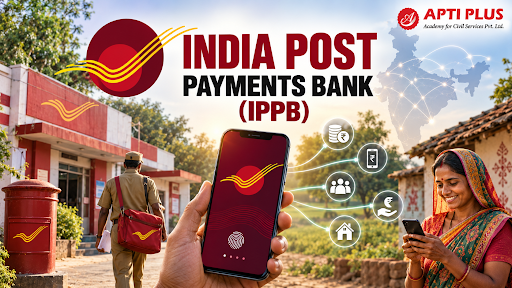
Last-Mile Phygital Delivery: Fuses India Post's legacy physical network with biometric smartphones to deliver branchless doorstep banking services.
Regulatory Framework & Payments Bank Norms
Statutory Licensing: Regulated under Section 22 of the Banking Regulation Act, 1949 as a scheduled payments banking entity.
Statutory Deposit Ceiling: Accepts demand deposits up to ₹2,00,000 per individual customer, following RBI’s enhanced 2021 threshold.
Absolute Credit Prohibition: Barred from extending direct retail loans or issuing credit cards to insulate depositors from credit default risks.
Prudential Investment Mandate: Mandated to invest at least 75% of demand deposits in government securities (SLR) to ensure 100% liquidity.
Capital Adequacy Ratio (CAR): Subject to a minimum capital adequacy ratio of 15% of risk-weighted assets under RBI prudential norms.
Key Operational Pillars & Services Offered
Doorstep Banking via Micro-ATMs: Over 3 lakh Gramin Dak Sevaks carry biometric handheld devices to conduct cash deposits and withdrawals at doorsteps.
Aadhaar Enabled Payment System (AePS): Enables customers of any domestic bank to withdraw cash locally using Aadhaar biometric authentication.
Direct Benefit Transfer (DBT) Payouts: Disburses PM-KISAN subsidies, MGNREGA wages, and social pensions directly at rural doorsteps, plugging leakages.
Digital Life Certificates (Jeevan Pramaan): Generates face-authentication and biometric life certificates at home for over 1.6 crore central and state pensioners.
Rural Merchant Solutions (DakPay Soundbox): Deploys voice-alert payment soundboxes to empower unorganized village merchants with instant UPI confirmation.
Third-Party Financial Distribution: Acts as a corporate broker distributing micro-insurance, health covers, and mutual funds for partner commercial banks.
IPPB Significance for Financial Inclusion
Deepening Rural Banking Penetration: Over 77% of IPPB’s 13.25 crore accounts belong to rural and semi-urban citizens across underserved geographies. (Source: PIB)
Financial Empowerment of Women: Women constitute 49% of all active account holders, receiving direct welfare transfers into their own bank accounts. (Source: PIB)
Eliminating Geographical Distance Barriers: Resolves the rural banking desert challenge by placing a certified banking touchpoint within 5 kilometers of every hamlet.
Catalyzing Rural Financial Literacy: Postmen act as trusted village advisors teaching digital literacy, safe PIN practices, and fraud deterrence.
Key Structural & Operational Challenges
Absence of Net Interest Margins (NIM): Lack of lending operations deprives IPPB of lucrative loan interest spreads, squeezing operational profits.
Heavy Last-Mile Cash Handling Costs: Transporting physical currency to remote forested and hilly post offices entails severe logistical expenses.
Intermittent Rural Telecom Connectivity: Cellular network dead zones and biometric mismatch errors trigger failed AePS transaction attempts.
High Customer Account Inactivity: Many rural accounts remain dormant once annual DBT welfare payments are withdrawn in cash.
Mounting Cybersecurity & AePS Frauds: Silicone fingerprint cloning and phishing threats target vulnerable rural account holders.
Intense FinTech Competition: Competing against private UPI apps and zero-fee digital wallets limits fee-based transaction revenues.
Way Forward
Transition to Small Finance Bank (SFB): Apply for an Small Finance Bank (SFB) license under RBI on-tap rules to unlock micro-lending for rural smallholders and MSMEs.
Scale Credit Co-Lending Alliances: Expand partnerships with NABARD and commercial banks to disburse micro-loans while originating credit on commission.
Upgrade Rural Telecom Under 4G Saturation Project: Integrate BharatNet optical fiber connections across all 1.55 lakh post offices to eliminate payment downtime.
Deploy Biometric Liveness Detection: Integrate dual-modal Aadhaar face-authentication and iris scanning to eradicate cloned fingerprint frauds.
Expand Merchant Soundbox Ecosystem: Scale the DakPay Soundbox deployment to onboard 1 crore rural mom-and-pop grocery stores onto digital rails.
Learn from Successful Models
-
Kenya’s Postbank & M-Pesa Synergy: Partnered with mobile network operators to convert postal branches into digital agency banking hubs.
-
Brazil's Banco Postal: Leveraged 6,000 postal branches as bank correspondents for private lenders, extending credit to 10 million unbanked citizens.
Conclusion
Upgrading India Post Payments Bank into a full-service rural financial engine bridges the last-mile digital divide and powers inclusive economic growth toward Viksit Bharat@2047.
Source: PIB
|
PRACTICE QUESTION Q. Which committee originally recommended the creation of differentiated banks, including Payments Banks and Small Finance Banks, in India? (a) Bimal Jalan Committee (b) Nachiket Mor Committee (c) Urjit Patel Committee (d) Y.H. Malegam Committee Answer: (b) Explanation: The Committee on Comprehensive Financial Services for Small Businesses and Low Income Households, chaired by Dr. Nachiket Mor (2014), recommended establishing Payments Banks. |