Why In News?
The Union Cabinet approved the Pradhan Mantri Surya Sarovar Yojana (PM-SSY) to scale 5,000 MW of floating solar with 10,000 MWh battery storage across national reservoirs to drive land-neutral clean energy.
About Pradhan Mantri Surya Sarovar Yojana (PM-SSY)
It is a Central Sector Scheme with a dedicated budget of ₹5,070 crore managed by the Ministry of New and Renewable Energy (MNRE).
5,000 MW Floating Solar Target: Mandates the development of 5,000 MW (5 GW) of utility-scale floating solar capacity sanctioned between FY 2026–27 and FY 2030–31.
Mandatory Energy Storage Systems (ESS): Requires every sanctioned FSPV project to integrate co-located Battery Energy Storage Systems (BESS) with a minimum duration of two hours.
10,000 MWh Cumulative Storage Capacity: Ensures 10,000 MWh of storage to supply dispatchable clean electricity during evening peak demand periods (6 PM–10 PM).
Central Financial Assistance (CFA): Provides ₹1 crore per MW as capital subsidy upon successful commissioning, significantly de-risking private and public investments.
Project Feasibility Grants: Extends financial assistance of up to ₹50 lakh per project for preparatory bathymetric surveys, hydrographic mapping, and environmental assessments.
Reservoir & Industrial Pond Deployment: Covers major irrigation reservoirs, hydro dam catchments, water treatment facilities, and thermal power plant ash/cooling ponds across all States and Union Territories.
What is Floating Solar Photovoltaic (FSPV)?
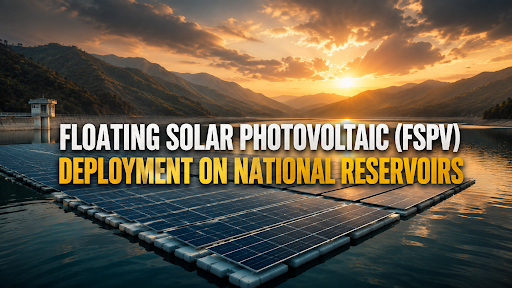
It is a solar power deployment technology where photovoltaic module arrays are mounted on buoyant floating platforms placed on water bodies instead of terrestrial land.
-
Solar Panels on Water Bodies: Photovoltaic panels are fixed onto modular floating structures secured by specialized underwater mooring and anchoring systems.
-
Reservoir-Based Solar Generation: Co-locates solar arrays on the water surface of hydroelectric dams, thermal power plant cooling reservoirs, municipal lakes, and irrigation tanks.
-
Floating Platforms (Pontoons): Constructed using food-grade, UV-stabilized High-Density Polyethylene (HDPE) designed to withstand corrosion, waves, and weathering over a 25-year operational lifespan.
-
Grid-Connected Floating Solar: Electricity generated is channeled via specialized waterproof marine cables to floating central inverters and stepped up to the regional grid through nearby substations.
-
Operational Benchmarks in India: Exemplified by the 600 MW Omkareshwar Floating Solar Project in Madhya Pradesh (world's largest underway) and NTPC's operational plants at Ramagundam (100 MW, Telangana) and Kayamkulam (92 MW, Kerala).
What are the Benefits of Floating Solar?
Zero Land Requirement & Conflict Avoidance: Eliminates the need to acquire 4 to 5 acres of land per MW required for ground-mounted solar, avoiding agricultural land displacement and tribal land disputes.
Reduces Water Evaporation: Solar panel shading blocks direct solar radiation and wind across the water surface, reducing evaporation losses by 60% to 70% under covered areas.
Improves Solar Panel Efficiency via Water-Cooling: Natural convective cooling from underlying water lowers panel operating temperatures, boosting electricity generation efficiency by 5% to 15% compared to ground arrays.
Hydro-Solar Hybrid Synergy: Co-locating FSPV on hydroelectric reservoirs utilizes existing transmission towers, switchyards, and evacuation infrastructure, allowing hydro dams to act as giant water batteries.
Suppresses Toxic Algal Blooms: Reduced sunlight penetration in covered water zones suppresses excessive algal growth, lowering water filtration costs for municipal reservoirs.
Supports Grid-Integrated Energy Storage: Co-located BESS transforms intermittent daytime solar into firm, round-the-clock (RTC) power for peak load management.
Steps taken by Government to Support Solar Energy Sector
|
Policy / Scheme |
Mechanism of Action |
Intended Impact & Targets |
|
PM Surya Ghar: Muft Bijli Yojana |
Provides direct subsidies up to ₹78,000 for 3 kW residential rooftop installations. |
Solarising 1 crore households while providing 300 units of free monthly power. |
|
Pradhan Mantri Surya Sarovar Yojana (PM-SSY) |
₹5,070 crore outlay to deploy floating solar panels paired with battery storage systems on reservoirs. |
Scaling 5,000 MW floating solar and 10,000 MWh storage without requiring land. |
|
PM-KUSUM Scheme |
Subsidizes solar pumps and feeder-level solar setups for farmers. |
Target of 34,800 MW solar capacity to replace diesel-run agricultural pumps. |
|
Ultra-Mega Solar Parks Scheme |
Provides developers with plug-and-play generation parks with pre-acquired land and grid access. |
Sanctioned 55 solar parks across 13 states with a cumulative capacity of 40,000 MW. |
|
Green Energy Corridor (GEC) |
Sets up thousands of circuit kilometres of high-voltage transmission lines and dedicated sub-stations. |
Safely integrates highly volatile and shifting regional solar loads into the national grid. |
|
Production-Linked Incentive (PLI) |
Allocates over ₹14,000 crore to incentivize domestic manufacturing of high-efficiency solar components. |
Decouples the supply chain from imports by building local lines for wafers, cells, and modules. |
|
Approved List of Models & Manufacturers (ALMM) |
Mandates a government registry of approved domestic solar equipment for public projects. |
Ensures high-quality component standards and shields local industries from cheap imports. |
|
100% FDI (Automatic Route) |
Allows foreign companies to invest up to 100% equity in renewable projects without prior approval. |
Attracts massive international capital and global project developers to the Indian market. |
|
ISTS Charge Waiver |
Waives interstate transmission fees for solar projects commissioned by June 2025. |
Lowers distribution costs across state borders (waiver tapers off by 25% annually until 2028). |
|
Green Energy Open Access Rules |
Permits medium-to-large private commercial industries to buy cheap solar energy directly from green generators. |
Accelerates private net-zero corporate transitions using open national electrical networks. |
What are the Major Challenges of Floating Solar?
Higher Initial Capital Expenditure (CAPEX): FSPV systems cost roughly 25% to 30% more per MW due to specialized HDPE floaters, marine anchoring, and waterproof cabling.
Severe Water-Level Fluctuations: Indian monsoon-fed reservoirs experience seasonal water depth variations of 10 to 20 metres, demanding complex elastic mooring lines and anchoring systems.
Anchor & Mooring Failures: Reservoir bed topography (silt, rocky strata) requires precision underwater engineering to prevent panels from drifting during floods.
Operation & Maintenance (O&M) Complexities: Servicing electrical systems on water requires specialized safety boats, diving crews, and robotic cleaning mechanisms to manage bio-fouling and bird droppings.
Extreme Storm and Wind Vulnerability: High monsoon wind speeds, surface turbulence, and cyclonic waves exert heavy mechanical stress on pontoon hinges and anchoring lines.
Reservoir-Use & Fisherfolk Conflicts: Large-scale surface coverage can disrupt local artisanal inland fisheries, navigation channels, and recreational water tourism.

Way Forward
Mandate Scientific Bathymetric & Hydrographic Surveys: Utilize drone LiDAR and sonar mapping to analyze reservoir bed geology and water level shifts prior to mooring design.
Cap Maximum Reservoir Surface Coverage: Enforce strict Central Electricity Authority (CEA) guidelines restricting floating solar coverage to 20%–30% of total reservoir surface area to preserve aquatic oxygenation and light penetration.
Develop Indigenous High-Grade HDPE Floater Manufacturing: Support domestic polymer manufacturers under the Production Linked Incentive (PLI) scheme to produce UV-resistant, recyclable, food-grade floaters.
Standardize Co-Located Battery Storage (BESS) Protocols: Deploy modular lithium-iron-phosphate (LFP) and sodium-ion battery storage systems designed for high-humidity lakeside environments.
Strengthen Real-Time Water Quality & Ecological Monitoring: Install automated IoT sensors to continuously track Dissolved Oxygen (DO), pH, turbidity, and water temperature around floating solar islands.
Promote Floating Solar-Aquaculture Co-Existence: Involve local fisherfolk cooperatives through designated fishing corridors and support cage aquaculture beneath peripheral zones.
Conclusion
The Pradhan Mantri Surya Sarovar Yojana transforms India’s vast reservoir network into clean energy hubs, overcoming land scarcity to power a climate-resilient, water-secure energy transition.
Source: INDIANEXPRESS
|
PRACTICE QUESTION Q. With reference to Floating Solar Photovoltaic (FSPV) systems and the 'Pradhan Mantri Surya Sarovar Yojana (PM-SSY)', consider the following statements: 1. Floating solar panels exhibit higher generation efficiency than ground-mounted panels due to the natural cooling effect of water. 2. Under the PM-SSY scheme, every sanctioned project must mandatorily include co-located battery storage with a minimum of two hours' duration. 3. The National Institute of Solar Energy (NISE) estimated India's floating solar potential to be less than 10 GWp. Which of the statements given above are correct? (a) 1 and 2 only (b) 2 and 3 only (c) 1 and 3 only (d) 1, 2, and 3 Answer: (a) 1 and 2 only Explanation: Statement 1 is correct: Floating Solar Photovoltaic (FSPV) systems generally operate at a higher generation efficiency (typically around 5% to 15% higher) compared to conventional ground-mounted panels. This is due to the natural cooling effect provided by the underlying water bodies and lower ambient temperatures over water surfaces, which reduces thermal degradation of solar cells. Statement 2 is correct: Under the newly approved Pradhan Mantri Surya Sarovar Yojana (PM-SSY), sanctioned projects are mandatorily required to integrate co-located Energy Storage Systems (ESS) with a minimum storage duration of two hours. Across the total targeted capacity of 5,000 MW, the scheme mandates a cumulative storage capacity of 10,000 MWh to help supply power during peak demand hours. Statement 3 is incorrect: A comprehensive national assessment report published by the National Institute of Solar Energy (NISE) estimated India's floating solar potential to be over 102 GWp (specifically around 102.18 GWp, assuming a conservative utilization of up to 20% of suitable reservoir surfaces), not less than 10 GWp. |