Why In News?
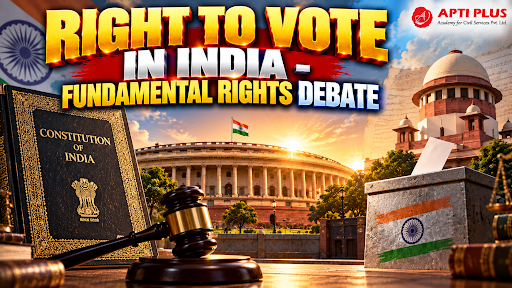
Voter roll purges, procedural disenfranchisement, and internal Election Commission of India (ECI) tensions have renewed arguments to elevate the right to vote to a Fundamental Right under Part III.
What Is The Right To Vote In India?
The right to vote enables citizens to exercise democratic agency, hold the executive accountable, and legitimize the state.
Article 326: Establishes that elections to the Lok Sabha and State Legislative Assemblies must be conducted on the basis of Universal Adult Suffrage, declaring that every citizen aged 18 or above—not disqualified by law—is entitled to register as an elector.
Statutory Operationalization under RPA, 1950 and 1951:
-
Representation of the People Act (RPA), 1950: Governs the preparation, revision, and maintenance of electoral rolls, defining conditions of registration such as "ordinary residence".
-
Representation of the People Act (RPA), 1951: Governs the actual conduct of polls, qualifications, and disqualifications; Section 62 confers and circumscribes the statutory "right to vote" on polling day.
Electoral Roll Enrolment as a Prerequisite: A citizen cannot cast a ballot merely by virtue of citizenship; registration on the official constituency electoral roll is mandatory under the statutory scheme.
How Did The Constituent Assembly View The Right To Vote?
The Ambedkar-Shah Proposal: In the initial draft stages, Dr. B.R. Ambedkar and Prof. K.T. Shah advocated placing the right to vote directly within Part III (Fundamental Rights) to shield universal suffrage from legislative tampering.
Objections of the Advisory Committee: The Advisory Committee on Fundamental Rights, chaired by Sardar Vallabhbhai Patel, rejected its inclusion in Part III, expressing concern that making it an enforceable fundamental right would invite constant litigation over procedural qualifications and voter roll management.
Compromise in Part XV: The framers chose to house the franchise under Article 326 in Part XV (Elections), establishing adult suffrage as a bedrock constitutional commitment while leaving administrative disqualifications and regulatory modalities to parliamentary legislation.
What Is Universal Adult Suffrage And Its Evolution?A Bold Democratic Leap: In 1950, despite widespread illiteracy and acute socio-economic poverty, India extended unconditional voting rights to all adult citizens, dismantling colonial-era property, tax, and educational qualifications. The 61st Constitutional Amendment Act, 1988: Lowered the voting age from 21 years to 18 years by amending Article 326, institutionalizing youth participation as a vital component of the democratic polity. Principle of Non-Discrimination: Guarantees equal electoral value—one person, one vote, one value—ensuring political equality as an unalterable facet of constitutional democracy. |
Is The Right To Vote A Fundamental, Constitutional, Or Statutory Right?
Statutory View (Kuldip Nayar Doctrine): In Kuldip Nayar vs Union of India (2006), a five-judge Constitution Bench held that the "right to elect" is neither a fundamental right nor a common law right, but purely a statutory right governed by Section 62 of the RPA, 1951.
Constitutional View (Article 326): In Rajbala vs State of Haryana (2015) and in Anoop Baranwal vs Union of India (2023), the Supreme Court recognized that voting is an inherent constitutional right rooted directly in Article 326, which cannot be abrogated arbitrarily by ordinary legislation.
Nexus with Freedom of Expression under Article 19(1)(a): In PUCL vs Union of India (2013 - NOTA Judgment), the Court ruled that a voter’s decision to cast a ballot or express dissent via None of the Above (NOTA) is a protected facet of freedom of speech and expression under Article 19(1)(a), creating a jurisprudential overlap with Part III.
The Distinction in Judicial Remedies:
-
Statutory Right: Can be amended, restricted, or withdrawn by ordinary parliamentary enactment without attracting the strict proportionality scrutiny reserved for fundamental rights.
-
Fundamental Right: Directly enforceable via Article 32 before the Supreme Court, invulnerable to executive overreach, and alterable only within the boundaries of reasonable restrictions.
What Are The Arguments For Elevating Voting To A Fundamental Right?
Insulation from Legislative Caprice: Prevents ruling regimes from enacting indirect exclusionary criteria (such as educational qualifications, toilet construction requirements, or two-child norms in local bodies) that disproportionately disenfranchise the poor.
Heightened Scrutiny for Electoral Roll Deletions: Subjecting administrative purges to fundamental rights scrutiny ensures that bureaucratic software glitches or mass deletions violate Part III, reversing the burden of proof onto the State.
Alignment with the Basic Structure: Because "democracy" and "free and fair elections" are unalterable pillars of the Basic Structure (Indira Nehru Gandhi vs Raj Narain, 1975), the citizen’s franchise should receive structural parity with fundamental liberties.
Protecting Marginalized Communities: Elevating the vote to a fundamental right ensures that unhoused urban populations, nomadic communities, and internally displaced persons are not excluded due to stringent "ordinary residence" proof.
What Are The Arguments Against Fundamental Right Status?
Preserving Regulatory and Administrative Flexibility: Conducting nationwide elections across 97 crore voters requires operational rules regarding roll verification, filing deadlines, and polling hours that could be crippled by endless Article 32 litigation.
Risk of Over-Judicialization: Elevating voting to Part III could compromise the mandate of Article 329(b), drawing constitutional courts into adjudicating routine polling disputes and delaying election timelines.
Adequacy of Existing Constitutional Safeguards: Article 326 already creates an affirmative constitutional mandate that prohibits arbitrary executive disenfranchisement, enforceable under Article 226 before High Courts.
Way Forward
Revisit the Kuldip Nayar Precedent via a Larger Bench: The Supreme Court should constitute a seven-judge Constitution Bench to clarify the constitutional hierarchy of the right to vote, evaluating whether it flows inherently from Article 326 read with Article 19(1)(a).
Statutorily Mandate Due Process for Voter Deletions: Amend the Registration of Electors Rules, 1960 to require mandatory written notice, documented field verification, and a 30-day appeal window before any voter's name is removed from the roll.
Operationalize Migrant and Remote Voting Frameworks: Introduce postal balloting or secure electronic voting centers for domestic migrant workers, armed forces, and essential workers to eliminate economic disenfranchisement.
-
Example: Service Voter and Electronically Transmitted Postal Ballot System (ETPBS), successfully scaled for defense personnel and capable of adaptation for internal economic migrants.
Conclusion
In a constitutional republic, the right to vote must be safeguarded as a fundamental entitlement rather than a fragile legislative gift, ensuring the survival of Indian democracy.
Source: THEHINDU
|
PRACTICE QUESTION Q. With reference to the constitutional framework governing elections in India, consider the following statements: 1. Under Article 325, there shall be one general electoral roll for every territorial constituency, and no person is ineligible for inclusion on grounds only of religion, race, caste, or sex. 2. The voting age in India was reduced from 21 years to 18 years by the 61st Constitutional Amendment Act, 1988, which amended Article 326. 3. In Kuldip Nayar v. Union of India (2006), the Supreme Court held that the right to vote is an explicit Fundamental Right guaranteed under Article 19(1)(a). Which of the statements given above are correct? (a) 1 and 2 only (b) 2 and 3 only (c) 1 and 3 only (d) 1, 2 and 3 Answer: (a) Explanation Statement 1 is correct: Article 325 of the Indian Constitution provides that there shall be one general electoral roll for every territorial constituency. It explicitly states that no person can be excluded from this roll, or claim a special roll, solely on grounds of religion, race, caste, or sex. Statement 2 is correct: The voting age in India was reduced from 21 to 18 years by the 61st Constitutional Amendment Act, 1988, which amended Article 326 (the provision governing adult suffrage). Statement 3 is incorrect: In Kuldip Nayar v. Union of India (2006), and reiterated in recent judgments, the Supreme Court of India clarified that the right to vote is a constitutional or statutory right, not a Fundamental Right. While the freedom of voting (expressing a choice or opting for NOTA) is an facet of free expression under Article 19(1)(a), the right to vote itself is not explicitly guaranteed as a Fundamental Right under Part III of the Constitution. |