Why In News?
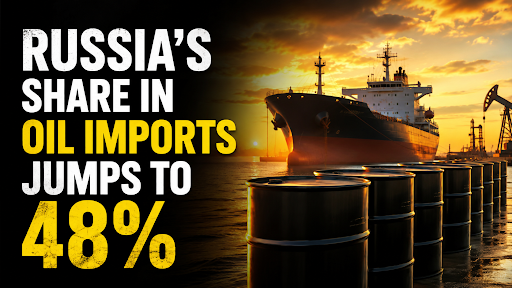
Russia's share of India's crude oil imports climbed to a record range of 46-52.5% in June 2026, driven by Gulf supply disruptions during the West Asia conflict.
India's Crude Oil Import Dependence
India's domestic crude oil production fell from 29.7 MMT to 28.0 MMT over the last five years, even as refining and consumption kept growing.
Crude oil consumption continues rising with economic growth, keeping India as the world's third-largest crude oil importer.
Import dependence touched a record 88.7% in FY 2025-26 (provisional), meaning less than 12% of India's crude needs are met domestically.

What Caused the Rise in Russian Oil Imports?
West Asian supply disruptions: the US-Iran war since February 2026 disrupted regional shipping and production, sharply cutting Gulf exports to India.
Strait of Hormuz risks: blockage risk through this critical chokepoint — which carries roughly a fifth of global oil shipments — pushed Indian refiners toward non-Gulf sources.
Reduced Gulf supplies: Saudi Arabia's share of India's crude imports collapsed to just 4.2% in June 2026, down from nearly 21% in February; Kuwait, Qatar, and Iraq — which together supplied over 30% in January — effectively dropped to zero in June.
Availability of Russian crude: with a US sanctions waiver on Russian oil purchases granted to India after the Strait of Hormuz crisis, Indian refiners resume large-scale Russian purchases without the earlier 25% additional US tariff penalty.
Commercial interests of Indian refiners: both public and private refiners have clear margin incentives to maximise discounted-crude intake whenever sanctions exposure allows it.
Venezuela's re-emergence: after US sanctions on Venezuelan oil eased, Venezuela recaptured a 4.6% share of India's crude imports in June 2026, adding a second non-Gulf, non-Russian alternative source
Geopolitical Implications
India-Russia strategic partnership: continued large-volume crude purchases reinforce a decades-old bilateral relationship, with Russia positioning itself as a reliable energy partner "in times of need".
India-US relations: Russian oil purchases became a direct flashpoint in India-US trade relations, with the additional 25% tariff explicitly justified by Washington as a response to India's "indirect importation of Russian oil".
European sanctions: despite an EU ban on oil products refined from Russian crude, eight shipments from India-based refineries using Russian crude still reached EU ports in June 2026, illustrating the practical limits of downstream sanctions enforcement.
Global oil market: China and India together buying the majority of Russia's seaborne crude exports has effectively created a parallel, discounted oil market running alongside the sanctioned Western-aligned market.
Strategic autonomy: India's continued purchases, despite US pressure, reflect its long-standing foreign-policy position of buying energy based on national economic interest rather than aligning fully with any single bloc's sanctions regime.
What Are the Risks?
Excessive dependence on one supplier: Russia's share crossing 46-52% of India's total crude basket represents a historic concentration risk — before February 2022, Russian crude was less than 1% of India's oil imports.
Western sanctions: the US imposed an additional 25% tariff on Indian goods in August 2025 specifically over India's Russian oil purchases.
Secondary sanctions risk: US lawmakers and NATO officials have repeatedly warned that India, alongside China and Brazil, could face secondary sanctions for continued large-scale Russian oil purchases.
Geopolitical uncertainty: the US sanctions waiver that allowed India's June 2026 import surge was time-limited and expired mid-June 2026, creating uncertainty over future purchase volumes.
Shipping and insurance risks: in June 2026, 54% of Russia's seaborne oil moved via "shadow" tankers operating under sanctions, with 45 vessels found operating under false flags — raising insurance, safety, and compliance risk for buyers.
Strategic vulnerability: heavy reliance on a single geopolitically contested supplier leaves India exposed if sanctions enforcement tightens or Russian export capacity itself gets disrupted.
Way Forward
Diversify crude suppliers, rebuilding Gulf and other alternative sourcing relationships even while continuing to purchase discounted Russian crude, to avoid replacing one concentration risk with another.
Expand domestic exploration to reduce the 88.7% import dependence that makes supplier concentration a recurring vulnerability.
Strengthen strategic reserves toward the IEA-recommended 90-day benchmark, well above India's current roughly 74-day combined national cover.
Develop renewable energy capacity to structurally lower the growth rate of crude oil demand over the medium term.
Increase biofuel use, building on the advanced 20% ethanol-blending target already achieved for Ethanol Supply Year 2025-26.
Promote electric mobility to reduce transport-sector oil demand growth over the coming decade.
Maintain strategic autonomy by keeping energy-purchase decisions grounded in commercial and supply-security logic rather than full alignment with any single geopolitical bloc's sanctions framework.
Conclusion
Russia's near-50% share of India's crude imports has delivered short-term cost and supply benefits amid the West Asia crisis, but it has replaced one concentration risk with another, making faster diversification and reserve-building essential for durable energy security.
Source: THEHINDU
|
PRACTICE QUESTION Q. "India's rising dependence on Russian crude oil shows how energy security decisions are shaped as much by geopolitics as by economics." Critically analyse. 250 words |