Why In News?
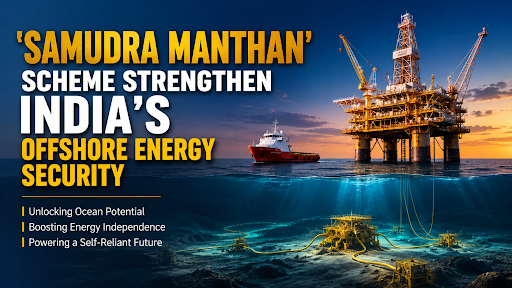
The Union Cabinet approved the Samudra Manthan National Offshore Exploration Scheme, to reduce India's crude oil import dependency.
What is the Samudra Manthan Scheme?
Central Sector Scheme: Ministry of Petroleum & Natural Gas (MoPNG) initiative to accelerate offshore hydrocarbon exploration and strengthen India's long-term energy security under the National Offshore Exploration Scheme.
Risk-Sharing Model: Government reimburses up to 50% of deepwater and ultra-deepwater exploratory drilling costs, reducing exploration risks and encouraging private and global investment.
Implementation Timeline: The first phase will be implemented during FY 2026–27 to FY 2030–31.
Financial Outlay: Approved outlay of ₹84,084 crore for offshore exploration, infrastructure and technology development.
Strategic Significance: Supports Atmanirbhar Bharat, Energy Security, Make in India and the Blue Economy by unlocking India's offshore hydrocarbon potential.
What are the Key Objectives?
Expand Offshore Exploration: Open over 1 million sq. km of India's Exclusive Economic Zone (EEZ) by removing about 99% of previous "No-Go" restrictions, increasing exploration acreage.
Enhance Domestic Hydrocarbon Production: Increase production from 62 MMTOE to 80 MMTOE annually and expand the hydrocarbon resource base from 1.6 billion TOE to 2.2 billion TOE.
Reduce Import Dependence: Lower India's annual USD 144 billion energy import bill and potentially reduce crude oil imports by nearly ₹1 lakh crore per year through domestic discoveries.
Attract Investment: Improve India's exploration attractiveness by de-risking high-cost offshore drilling and encouraging domestic and foreign investment.
Strengthen Energy Security: Diversify domestic energy sources and reduce vulnerability to global geopolitical disruptions and oil price volatility.
Boost Employment & Manufacturing: Promote offshore engineering, shipbuilding, subsea services and indigenous manufacturing under Make in India.
What are the Major Components?
Large-Scale Seismic Surveys: ₹28,534 crore allocated for advanced 2D and 3D seismic surveys to improve identification of hydrocarbon reserves.
Exploratory Drilling: ₹43,200 crore allocated for drilling 60 deepwater and ultra-deepwater wells, with support up to ₹675 crore per well in frontier basins such as Andaman and Krishna-Godavari.
Shared Offshore Infrastructure: ₹10,000 crore for common offshore production facilities, evacuation pipelines and logistics infrastructure to reduce development costs.
Advanced Exploration Technologies: ₹2,000 crore allocated for Oil & Gas Manufacturing and Services Zones, digital exploration technologies and localisation of deepwater equipment under Make in India.
Technology & Digital Innovation: Promotes AI-enabled seismic interpretation, advanced geophysical imaging, digital reservoir modelling and modern offshore exploration technologies for efficient resource discovery.
Capacity Building: Strengthens technical expertise, domestic service providers and research capabilities for deepwater exploration, supporting long-term offshore energy development.

What are the Possible Challenges?
High Capital Costs: A single deep-water exploratory well may cost USD 125–150 million, making projects highly capital-intensive.
Technological Complexity: Ultra-deepwater drilling (>1,500 m) requires advanced rigs, subsea robotics and specialised technologies, much of which is imported.
Environmental Risks: Offshore drilling and seismic surveys may affect marine biodiversity, fisheries and coastal ecosystems, necessitating stringent Environmental Impact Assessment (EIA) norms.
Long Gestation Period: Commercial production generally takes 5–10 years from exploration to production, delaying returns on investment.
Global Price Volatility: Falling international crude prices can reduce the commercial viability of expensive offshore projects.
Regulatory Delays: Multiple environmental and statutory approvals can delay exploration and field development.
Infrastructure Constraints: Limited offshore logistics, ports, pipelines and evacuation infrastructure increase project costs.
Import Dependence on Technology: Dependence on foreign equipment and expertise raises costs and exposes projects to supply-chain disruptions.
Climate Commitments: Expanding fossil fuel production must be balanced with India's Net Zero by 2070 target and clean energy transition.
What Measures Can Maximise the Scheme's Success?
Accelerate Geological Data Acquisition: Expand high-quality seismic surveys and strengthen the National Data Repository (NDR) to reduce exploration risks.
Strengthen Environmental Safeguards: Adopt rigorous EIAs, real-time marine monitoring and international offshore safety standards.
Promote Indigenous Technology: Invest in Make in India R&D for deep-water rigs, subsea systems, underwater robotics and offshore engineering.
Integrate with Energy Transition: Develop offshore infrastructure that also supports offshore wind, green hydrogen and carbon capture projects.
Time-bound Clearances: Establish a single-window mechanism with fixed timelines for statutory approvals.
Forge Global Partnerships: Collaborate with offshore leaders such as Norway, Brazil and the United States for technology transfer and best practices.
Strengthen Skill Development: Train specialised offshore engineers, geoscientists and marine technicians through industry-academia partnerships.
Expand Strategic Petroleum Reserves: Complement higher domestic production with stronger strategic reserves to enhance long-term energy security.
Conclusion
The Samudra Manthan Scheme serves as a transformative mission that balances financial risk-sharing with advanced technology to secure India's energy independence and power its rapid economic growth.
Source: PIB
|
PRACTICE QUESTION Q. Consider the following statements regarding the 'Samudra Manthan' Scheme: 1. It is a Central Sector Scheme aimed exclusively at exploring onshore sedimentary basins. 2. The scheme operates under the administrative control of the Ministry of Earth Sciences. 3. It offers financial support of up to 50% for drilling deepwater exploration wells to de-risk private investment. Which of the statements given above is/are correct? (a) 1 and 2 only (b) 3 only (c) 2 and 3 only (d) 1, 2 and 3 Answer: (b) Explanation: Statement 1 is incorrect. While it is a Central Sector Scheme, it is not exclusively aimed at exploring offshore sedimentary basins. The scheme encompasses a comprehensive set of interventions across the entire offshore exploration and production value chain, including the development of common offshore production and evacuation infrastructure and the establishment of Oil & Gas Manufacturing and Services Zones, in addition to exploration activities like seismic surveys and drilling. Statement 2 is incorrect. The scheme operates under the administrative control of the Ministry of Petroleum and Natural Gas, not the Ministry of Earth Sciences. The Ministry of Earth Sciences oversees the "Deep Ocean Mission" (Samudrayaan), which is a separate initiative. Statement 3 is correct. The scheme provides financial support of up to 50% of the cost for drilling deepwater and ultra-deepwater exploration wells (capped at specific amounts, e.g., ₹650–₹675 crore per well) to de-risk private investment and encourage exploration in high-risk areas. |