Why In News?
The Commission for Air Quality Management (CAQM) reviewed crop residue management strategies, emphasizing decentralized farm-level processing models to reduce logistical transportation costs and eliminate seasonal farm fires.
What is Stubble Burning?
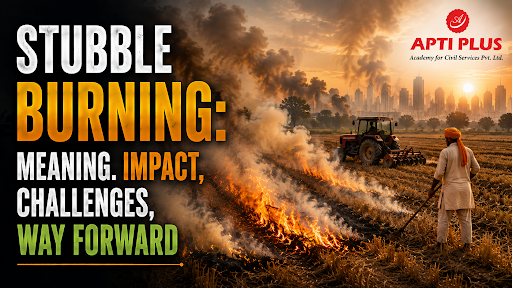
Stubble burning (Parali) refers to the intentional setting on fire of agricultural crop residue (straw and stalks) left in the field after harvesting grains like paddy and wheat.
It is a seasonal practice that occurs between September and November in the Indo-Gangetic plains, specifically across Punjab, Haryana, and Western Uttar Pradesh, to rapidly clear fields for the subsequent Rabi (winter) crop sowing cycle.

Why Do Farmers Burn Stubble?
Severe Time Crunch: Farmers have only 10 to 15 days between harvesting Kharif paddy (late October) and sowing Rabi wheat (early November); delay in wheat sowing reduces grain yields by 1 to 1.5 quintals per acre for every week lost.
Impact of Groundwater Conservation Laws: The Punjab Preservation of Subsoil Water Act, 2009 prohibits paddy transplantation before mid-June to prevent aquifer depletion, pushing the harvest deep into late October and leaving no time for natural straw decomposition.
Acute Rural Labour Shortages & High Wages: Manual harvesting and straw clearance require intensive manual labor, costing over ₹4,000 to ₹5,000 per acre, which small and marginal farmers cannot afford.
Prohibitive Operating Costs of Farm Machinery: Operating specialized machinery like the Happy Seeder or Super Seeder requires high-horsepower tractors (50+ HP) consuming 6 to 8 litres of diesel per acre, eroding small farmers' thin profit margins.
Lack of a Lucrative Farm-Gate Market: Farmers lack local off-take mechanisms that pay cash for raw straw; transporting bulky, low-density straw over long distances costs more than the straw's commercial value.
Residue of Mechanical Combine Harvesters: Combine harvesters cut only the upper grain-bearing earheads of rice plants, leaving behind tough, rooted stalks measuring 1 to 2 feet in height that cannot be ploughed directly without specialized implements.
High Silica Content Obstacle: Non-basmati paddy straw has high silica content and low digestibility, making it unsuitable for direct cattle feed, unlike wheat straw (bhusa).
What are the Impacts of Stubble Burning?
Air Pollution & Toxic Winter Smog: Emits hazardous plumes of fine particulate matter (PM2.5 and PM10), carbon monoxide (CO), nitrogen oxides (NOx), methane, and polycyclic aromatic hydrocarbons, transforming Delhi-NCR and the Indo-Gangetic Plains into a public health emergency.
Destruction of Essential Soil Nutrients: Burning one tonne of paddy straw vaporizes approximately 5.5 kg of Nitrogen, 2.3 kg of Phosphorus, 25 kg of Potassium, and 1.2 kg of Sulphur, permanently degrading agricultural topsoil fertility. (Source: ICAR)
Death of Soil Microbial Ecology: Intense surface heat exceeding 300°C sterilizes the top 3 inches of soil, killing beneficial mycorrhizal fungi, nitrogen-fixing bacteria, and earthworms, necessitating higher doses of chemical fertilizers.
Respiratory & Cardiovascular Illnesses: Epidemiological studies reveal that winter stubble smoke spikes acute asthma attacks, chronic obstructive pulmonary disease (COPD), bronchitis, and lung function decline among children and the elderly across North India.
Acceleration of Regional Climate Warming: Releases black carbon (soot) aerosols that deposit on Himalayan glaciers, accelerating seasonal snowmelt and altering regional monsoon precipitation patterns.
What are the Alternatives to Stubble Burning?
In-Situ Management (On-Farm)
-
Happy Seeder & Super Seeder: Tractor-mounted machines that simultaneously cut paddy straw, sow wheat seeds into the unploughed soil, and deposit the cut straw as a protective organic mulch layer.
-
Pusa Bio-Decomposer: A microbial fungal consortium developed by ICAR-IARI that accelerates natural cellulose and lignin breakdown when sprayed on watered fields.
-
Zero-Till Drills & Rotary Mulchers: Chops crop stalks into fine pieces and mixes them into the soil to boost organic carbon.
Ex-Situ Management (Off-Farm)
-
Thermal Power Plant Co-Firing: Mixing 5% to 7% biomass pellets with coal in thermal power stations to displace fossil fuels.
-
Compressed Bio-Gas (CBG) Plants: Anaerobic digestion of straw to produce methane fuel and organic slurry fertilizer under the SATAT Scheme.
-
Second-Generation (2G) Bio-Ethanol Refineries: Converting non-food agricultural lignocellulosic biomass into ethanol (e.g., IOCL’s 2G ethanol plant in Panipat, Haryana).
Decentralized Farm-Level Solutions (The "Village Chakki" Model)
-
Local Pyrolysis & Biochar Kilns: Converting straw into carbon-stable biochar in village-level units; returning biochar to fields enhances soil moisture retention and locks carbon for centuries.
-
Micro-Briquetting Units: Compressing loose straw into solid fuel briquettes within a 5 km radius to supply local brick kilns and rural agro-industries without heavy freight charges.
Crop Diversification & Short-Duration Varieties: Shifting from water-guzzling paddy to maize, pulses, millets, and oilseeds, or planting short-duration rice cultivars like PR-126 (maturing in 120 days compared to 155 days for Pusa-44).
Initiatives Taken To Address Stubble Burning
Commission for Air Quality Management (CAQM) Act, 2021: Established an overarching statutory commission with sweeping powers to coordinate anti-stubble action across Punjab, Haryana, Rajasthan, UP, and Delhi.
Crop Residue Management (CRM) Scheme: Centrally funded scheme allocating over ₹3,000 crore to subsidize in-situ and ex-situ farm machinery—providing 50% capital subsidy to individual farmers and 80% to Custom Hiring Centres (CHCs).
Mandatory Biomass Co-Firing Policy (SAMARTH Mission): The Ministry of Power mandated thermal power plants across NCR to blend 5% to 7% biomass pellets with coal, creating an assured industrial procurement market for parali.
SATAT (Sustainable Alternative Towards Affordable Transportation): Incentivizes entrepreneurs to establish commercial Compressed Bio-Gas (CBG) plants using agricultural residue, with guaranteed off-take by public sector oil marketing companies.
Judicial Directives & Environmental Compensation: In M.C. Mehta vs Union of India and subsequent rulings, the Supreme Court directed state governments to track farm fires via ISRO satellites, impose environmental compensation fines, and hold district magistrates personally accountable.
What are the Challenges In Ending Stubble Burning?
Severe 10–15 Day Agronomic Bottleneck: The rigid window between harvesting late-maturing paddy and sowing wheat makes slow biological solutions unviable unless farmers have immediate, high-speed clearing machinery.
High Capital Costs for Small and Marginal Landholders: Over 85% of Indian operational landholdings are small and marginal (<2 hectares); small farmers cannot afford ₹2.5 lakh to ₹3 lakh Super Seeders or heavy tractors, making machinery subsidies disproportionately benefit affluent landlords.
High Logistics and Transportation Costs of Raw Straw: Raw paddy straw has an extremely low bulk density (approx. 50 kg/m³); baling, storing, and trucking it beyond 25 km costs more than the market price offered by power plants, making centralized ex-situ logistics unviable.
Slow Decomposition Rate of Biological Sprays: Fungal bio-decomposers require 20 to 25 days of constant soil moisture and warm temperatures to break down dense rice residue, failing to match the urgent 10-day wheat planting deadline.
Under-Utilized Custom Hiring Centres (CHCs) & Machinery Idleness: CRM machines are utilized for only 15 to 20 days during October-November and remain completely idle for the remaining 10 months, imposing heavy capital depreciation costs on village panchayats and cooperatives.
Farmer Distress & Coercive Enforcement Backlash: Registering criminal police FIRs, blacklisting land records (red entries), and imposing penalties create intense friction with agrarian communities without addressing the underlying lack of affordable harvesting alternatives.
Open-Ended MSP Procurement Disincentivizes Diversification: The open-ended Minimum Support Price (MSP) public procurement for paddy by the Food Corporation of India (FCI) guarantees safe cash returns, making farmers reluctant to switch to pulses, maize, or oilseeds.
Way Forward To Address Stubble Burning
Establish Village-Level Decentralized "Biomass Chakkis": Establishing micro-pelletizing, briquetting, and pyrolysis units within 5 km of farm clusters, allowing farmers to deliver loose straw locally just like wheat to a flour mill.
Promote Farm-Level Biochar Production: Encourage local Farmer Producer Organizations (FPOs) and Self-Help Groups (SHGs) to operate mobile pyrolysis kilns; returning biochar to agricultural fields improves soil water retention by 15% and cuts chemical fertilizer needs by 20%. (Source: ICAR)
Provide Direct Operational Cash Compensation: Provide small and marginal farmers with a direct DBT cash incentive of ₹2,500 per acre to cover the fuel and rental expenses of operating in-situ machinery, eliminating the economic incentive to burn. (Source: NITI Aayog)
Mandate Short-Duration Paddy Varieties: State governments must phase out long-duration varieties like Pusa-44 and supply certified seeds of short-duration cultivars (PR-126, Pusa Basmati 1509), creating a 25-day buffer period for straw management.
Deploy "Uberized" Mobile Apps for Custom Hiring Centres (CHCs): Develop GPS-enabled mobile applications allowing small farmers to book nearby Super Seeders and balers on demand with transparent hourly tariff caps, preventing equipment hoarding by large landholders.
Guarantee Long-Term Biomass Off-Take Prices for Thermal Plants: Enforce mandatory long-term biomass fuel supply agreements between power utilities and village FPOs with indexed minimum support prices to guarantee financial returns for rural straw balers.
Expand Crop Diversification Incentives (Haryana’s Model): Scale up financial incentives under schemes like Haryana’s Mera Pani Meri Virasat, providing ₹7,000 per acre to farmers who replace paddy with water-efficient pulses, maize, and millets.
Institutionalize Carbon Credits for Non-Burning Farmers: Create a verified agricultural carbon offset protocol allowing village panchayats and FPOs to aggregate non-burning farm plots and sell carbon credits to polluting corporate entities under the Indian Carbon Market.
What India Can Learn from Successful Domestic & International Models
Case Study 1: In Punjab's Kallar Majra village, the entire farming community adopted Happy Seeders and zero-till machines collectively via a local cooperative, eliminating stubble burning entirely for seven consecutive years while improving wheat yields by 10%.
Case Study 2: Haryana introduced a multi-pronged approach combining a ₹1,000 per acre non-burning incentive, subsidized straw balers, and supply linkages to 2G ethanol and paper mills, achieving over 40% reduction in farm fires compared to neighboring states.
Case Study 3: China passed national regulations mandating over 85% comprehensive utilization of crop straw by subsidizing industrial bio-coal power plants, straw-based construction boards, and biological fertilizers, dramatically curbing air pollution across the Yangtze River Delta.
Case Study 4: Under the EU's Good Agricultural and Environmental Condition (GAEC) cross-compliance standards, farmers who burn stubble face automatic reductions or total cancellations of their direct farm income subsidies, enforcing compliance through satellite monitoring.
Conclusion
Transforming agricultural crop residue from a polluting seasonal waste into a localized economic asset through decentralized village-level processing and direct farmer incentives is the sustainable path to smoke-free winter skies.
Source: indianexpress
|
PRACTICE QUESTION Q. Coercive legal penalties and police enforcement have repeatedly failed to halt seasonal stubble burning in the Indo-Gangetic Plains. A lasting solution requires treating parali as an economic resource rather than an environmental liability. Critically Analyze. (15 Marks, 250 Words) |