Why In News?
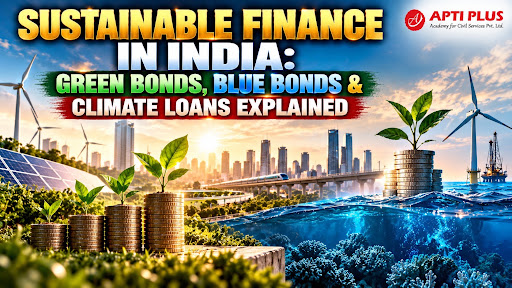
Sagarmala Finance Corporation, a state-owned maritime-focused lender, to launch India's maiden Blue Bond to raise up to ₹600 crore to fund sustainable maritime and port infrastructure
What are Blue Bonds?
A Blue Bond is a debt instrument designed specifically to raise capital for sustainable, water- and ocean-related projects, marine conservation, and sustainable coastal economic growth.
Scope: Unlike conventional fixed-income bonds, blue bonds ring-fence funds exclusively for marine biotechnology, water stewardship, pollution abatement, and coastal resilience.
Environmental Impact: Projects funded by blue bonds contribute to ocean ecosystem restoration, reduction of marine plastic waste, sustainable aquaculture, and blue carbon sequestration (e.g., mangroves and seagrasses).
Investor Returns & Structure: Blue bonds operate as fixed-income instruments offering structured coupon payments to institutional investors seeking verifiable ESG (Environmental, Social, and Governance) impacts.
Impact Reporting: Issuers must track capital utilization and issue post-issuance impact reports measuring key metrics, such as wastewater treated, carbon sequestered, or marine habitats protected.
How are Blue Bonds Different from Green Bonds?
|
Feature |
Green Bonds |
Blue Bonds |
|
Primary Scope |
Broad environmental projects including land-based renewable energy, clean transportation, and energy efficiency. |
Specifically focused on ocean, marine, riverine, and coastal water ecosystems. |
|
Target Infrastructure |
Solar power plants, mass transit, electric vehicles, and green buildings. |
Sustainable ports, green shipping, offshore wind, marine conservation, and aquaculture. |
|
Ecosystem Focus |
Terrestrial climate mitigation, afforestation, and urban waste management. |
Marine biodiversity, mangrove restoration, coastal erosion control, and sustainable fisheries. |
|
SEBI Regulatory Context |
Governed under Regulation 2(1)(q) of SEBI NCS Regulations, 2021. |
Sub-category under SEBI's broader ESG Debt Securities framework (Regulation 2(1)(oa)). |
Why is India Exploring Blue Bonds?
Vast Maritime Geography: India features an 11,098 km coastline (including island territories), 14,500 km of navigable inland waterways, and an Exclusive Economic Zone (EEZ) spanning 2.4 million sq. km.
Economic Contribution & Livelihoods: India's blue economy accounts for 4.1% of national GDP and directly supports over 4 million livelihoods across coastal fishing communities.
Port Infrastructure Demands: Expanding maritime trade requires massive infrastructure modernization across 12 major ports and over 200 non-major ports.
Coastal Livelihoods & Fisheries: Sustainable fisheries and aquaculture support over 14 million coastal community members, requiring modern cold chains, landing facilities, and sustainable gear.
Navigational & Shipbuilding Upgrades: Developing inland water transport and domestic green shipbuilding reduces national logistics costs and lowers emissions.
Global Experience
|
What Projects Can Blue Bonds Finance?
Port Modernization & Decarbonization: Installation of shore power facilities, energy-efficient berth operations, and transition to green port infrastructure under the Harit Sagar Guidelines.
Clean Maritime Logistics: Development of coastal shipping routes, Ro-Ro terminals, and inland water transport corridors to shift freight from road to waterways.
Fisheries & Coastal Infrastructure: Construction of modernized, eco-friendly fishing harbors, cage aquaculture facilities, and solar-powered cold storage units under Pradhan Mantri Matsya Sampada Yojana (PMMSY).
Marine Conservation & Blue Carbon: Ecosystem restoration including mangrove afforestation, seagrass bed preservation, and coastal erosion protection systems.
Wastewater & Marine Pollution Abatement: Tertiary wastewater treatment plants and plastic waste interception projects in coastal urban centers.
Significance
Diversification of Capital Sources: Reduces dependence on traditional bank credit and government budgets by tapping global ESG capital markets.
Expansion of Coastal Employment: Drives economic growth in coastal belts, generating skilled jobs in marine biotech, eco-tourism, and sustainable aquaculture.
Alignment with SDG 14: Fulfills international climate commitments under UN SDG 14 (Life Below Water) and the BBNJ (Biodiversity Beyond National Jurisdiction) Agreement.
Maritime Infrastructure Resilience: Accelerates green shipping and port digitization, aligning with Maritime India Vision 2030.
Socio-Economic Inclusion: Protects traditional coastal fishers and tribal communities while expanding women-led marine enterprises (e.g., seaweed farming SHGs).
Net-Zero Transition: Complements India's national mandate to achieve Net-Zero carbon emissions by 2070 through marine clean tech and blue carbon sinks.
Source: THEHINDU
|
PRACTICE QUESTION Q. Which of the following best describes a 'Blue Bond'? (a) A government security issued by the Ministry of Water Resources to fund inter-linking of rivers. (b) A debt instrument designed specifically to raise capital for ocean conservation, sustainable fisheries, and coastal infrastructure projects. (c) An equity-linked security issued by the International Monetary Fund to compensate developing countries for marine oil spills. (d) A specialized corporate bond issued under the Companies Act, 2013 to finance deep-sea oil drilling operations. Answer: (b) Explanation: Blue Bonds are specialized debt instruments earmarked specifically for water stewardship, marine ecosystem restoration, sustainable fisheries, and coastal infrastructure. |