Why In News?
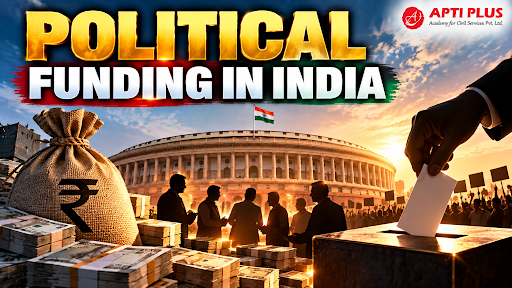
Thousands of Registered Unrecognised Political Parties exploit tax exemptions and collect corporate donations without contesting elections, creating transparency challenges in Indian political funding.
What Is Political Funding?
Meaning: Political funding refers to the methods, financial contributions, and capital mobilized by political parties and candidates to sustain organizational operations, run public campaigns, and contest democratic elections.
Core Components:
-
Individual Contributions: Direct monetary donations made by citizens to political entities.
-
Corporate Contributions: Institutional donations made by commercial companies, conglomerates, and business enterprises under statutory ceilings.
-
Electoral Trusts: Non-profit corporate vehicles established under the Electoral Trusts Scheme, 2013 to pool corporate donations and route them transparently to registered parties.
-
Internal Party Mobilization: Revenue accrued through mandatory membership fees, sale of party literature, levies on elected representatives, and grassroots crowdfunding.
Democratic legitimacy dictates that sources of political finance must remain transparent to electors to prevent illicit corporate capture of state policy.
What Are The Constitutional Dimensions Of Political Finance?
Voter's Right to Know under Article 19(1)(a): In Association for Democratic Reforms vs Union of India (2024), the Supreme Court held that the voter's right to information regarding who finances political parties is an integral part of freedom of speech and expression.
Plenary Powers under Article 324: Vests the Election Commission with superintendence, direction, and control over elections, requiring it to enforce conditions that guarantee a level playing field.
Electoral Equality under Article 14: Unregulated, asymmetric money power violates equality of opportunity in political participation, skewing electoral outcomes in favor of deep-pocketed lobbies.
Freedom of Political Association under Article 19(1)(c): Political parties operate as vital instruments of collective democratic expression, requiring statutory protection from arbitrary financial asphyxiation by executive agencies.
Free and Fair Elections as Basic Structure: Reaffirmed in Indira Nehru Gandhi vs Raj Narain (1975), pure and uncorrupted elections form an unalterable pillar of constitutional democracy.
What Are The Major Sources Of Political Funding In India?
Individual Donations: Direct financial transfers by citizens via banking instruments, Unified Payments Interface (UPI), or restricted cash transactions.
Corporate Donations under Companies Act, 2013:
-
Permitted under Section 182, requiring board resolutions and disclosure in profit-and-loss statements.
-
The Supreme Court declared the 2017 amendments to Section 182 of the Companies Act, 2013 unconstitutional.
-
These amendments had removed the 7.5% corporate net profit cap and deleted the requirement to disclose specific recipient party names on corporate balance sheets.
-
The 5-judge Constitution Bench ruled that allowing unlimited and anonymous corporate political funding violates Article 19(1)(a) (Right to Information) and undermines the principle of free and fair elections by enabling corporate capture of public policy.
Electoral Trusts Scheme, 2013: Approved corporate entities registered under Section 8 of the Companies Act; mandated to distribute at least 95% of total contributions received in a fiscal year to eligible political parties via banking channels.
Grassroots Crowdfunding and Digital Drives: Decentralized public micro-donations collected through verified online payment gateways, fostering broader citizen participation.
State Subsidies in Kind: Indirect public support, including free airtime on state-owned broadcast networks (Doordarshan and All India Radio), subsidized party offices, and free copies of electoral rolls.
What Are The Major Concerns In Political Financing?
Donor Anonymity and the ₹20,000 Cash Exemption Loophole: Under Section 29C of the Representation of the People Act, 1951, political parties are only required to report donations exceeding ₹20,000, enabling parties to aggregate vast black money reserves as small cash donations.
Corporate State Capture and Quid Pro Quo: Unchecked corporate funding leads to crony capitalism, where large campaign donations are traded for regulatory favors, tax concessions, environmental clearances, and government procurement contracts.
Asymmetry in Expenditure Caps: While individual candidates face statutory campaign expenditure ceilings under Rule 90 of the Conduct of Elections Rules, 1961, political parties face no legal ceiling on overall campaign spending under Section 77 of the RPA, 1951.
Misuse of Registered Unrecognised Political Parties (RUPPs): Over 2,800 RUPPs exist in India, the vast majority of which never field candidates in general or state elections, functioning primarily as tax shelters and money laundering conduits.
-
The Association for Democratic Reforms (ADR) report found a 223% rise in the declared income of RUPPs in FY2022-23. Out of the 2,764 RUPPs, only 739 had submitted their financial records for the year to the Election Commission of India (ECI).
What Is The Regulatory Role Of The Election Commission Of India?
Mandatory Contribution Reports (Section 29C, RPA 1951): Political parties must submit an annual Contribution Report to the ECI detailing all donations received above ₹20,000 from individuals and companies.
Annual Audited Accounts: Parties are required to submit audited annual financial balance sheets and income-expenditure statements certified by chartered accountants.
Election Expenditure Monitoring (EEM): Deploys Expenditure Observers, static surveillance teams, and flying squads to track candidate spending, illicit liquor, cash distribution, and freebies during active model code enforcement.
Lack of Deregistration Powers: Under Section 29A of the RPA, 1951, the ECI has the statutory power to register political parties, but lacks the corresponding legal authority to deregister non-compliant or fraudulent political parties .
What Are The Structural Bottlenecks In Political Finance?
Proliferation of Dormant RUPPs for Money Laundering: Unscrupulous entities establish paper political parties to exploit Section 13A tax exemptions, laundering unaccounted cash through fake donations and claiming 100% deductions under Section 80GGB/GGC.
-
Example: ECI Clean-Up Drive (2022–2024) identified over 800 registered unrecognized parties that had not contested a single election in a decade and were operating as hawala fronts from single-room commercial offices.
The ₹2,000 Cash Truncation Loophole: While the Finance Act, 2017 lowered the cash donation threshold from ₹20,000 to ₹2,000 for tax exemption, political parties continue to deposit crores of unaccounted cash by fabricating millions of donor slips under ₹2,000.
-
Example: ADR Analysis of Party Audit Reports, revealing that 60-70% shares of national and regional party revenues are declared as "unnamed small donations under ₹2,000".
Commercialization of Digital and Social Media Campaigns: Surreptitious funding of third-party proxy political action committees (PACs), shadow advertising networks, and influencer campaigns evades official expenditure registers.
-
Example: Meta and Google Political Ad Transparency Repositories, where millions are spent by unverified proxy pages that circumvent direct party attribution.
Way Forward
Empower the ECI to Deregister Inactive Political Parties: Amend Section 29A of the Representation of the People Act, 1951 to vest the Election Commission with explicit statutory authority to strike off and deregister parties that fail to contest elections for five consecutive years.
-
Example: ECI Formal Proposals to the Law Ministry, petitioning for express statutory power to delist dormant and fraudulent political entities.
Establish a Centralized Real-Time Digital Disclosure Portal: Mandate that all political parties disclose every donation—irrespective of amount—on a public online portal managed by the ECI within 48 hours of receipt.
-
Example: Federal Election Commission (FEC) Framework (USA), requiring itemized digital reporting of all campaign donations and expenditures on an accessible, searchable public database.
Introduce Statutory Ceilings on Political Party Campaign Spending: Enact legislative amendments capping the total aggregate expenditure that political parties can incur during election campaigns to restore competitive parity.
-
Example: Law Commission 255th Report on Electoral Reforms (2015), recommending a legal ceiling on political party spending to prevent plutocratic dominance.
Independent Audits via CAG-Empanelled Chartered Accountants: Strip political parties of the liberty to choose their own private auditors; mandate annual financial audits conducted strictly by independent auditors appointed by the Comptroller and Auditor General (CAG).
-
Example: Second Administrative Reforms Commission (Ethics in Governance), advocating for external, state-supervised audits of party finances.
Explore Partial State Funding of Elections: Implement public funding in kind—providing fuel, communication facilities, and campaign materials—to insulate elections from corporate reliance.
-
Example: Indrajit Gupta Committee on State Funding of Elections (1998), recommending state funding in kind exclusively to recognized political parties to create a clean, level playing field.
Conclusion
True electoral democracy demands that political parties be held to the highest standards of financial transparency, ensuring that elected governance reflects the sovereign will of voters rather than the financial muscle of covert donors.
Source: THEHINDU
|
PRACTICE QUESTION Q. Examine the relationship between transparency in political funding and free and fair elections in India. 150 words |