Why In News?
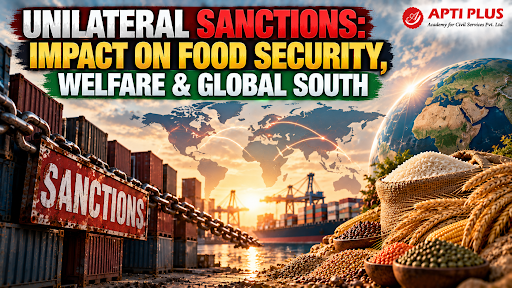
At the 18th BRICS Summit in New Delhi, Iranian President Masoud Pezeshkian flagged how unilateral economic sanctions severely compromise food security and human welfare.
What are Unilateral Sanctions?
Unilateral sanctions are economic, financial, trade, or diplomatic penalties imposed by an individual sovereign state or a regional bloc (such as the US or EU) without explicit authorization from the United Nations Security Council (UNSC).
How They Work
-
Targeting: They focus on a specific nation's government, key industries, or individual leaders.
-
Goals: The imposing country tries to force a change in policy, behavior, or leadership.
-
Actions: Measures include trade embargoes, tariffs, travel bans, and blocking financial transactions.
Common Examples
-
Trade Embargoes: Halting imports or exports of vital goods like oil.
-
Financial Restrictions: Freezing national or individual bank assets.
-
Travel Bans: Restricting entry for targeted political figures.
Controversies and Legal Status
-
International Law: Many countries and groups (such as the BRICS nations) view unilateral measures as unlawful when not backed by the United Nations because they bypass collective security frameworks.
-
Human Rights: Critics and the UN Human Rights Office (OHCHR) note that these penalties often hurt regular citizens, disrupting access to food, medicine, and basic public welfare rather than just targeting leadership.
How Can Sanctions Affect Food Security?
Disruption of Agricultural Inputs: Unilateral restrictions on major commodity producers impede the global flow of vital agricultural inputs—such as nitrogen, phosphate, and potash fertilizers—driving down crop yields worldwide.
Financial and Payment Messaging Freezes: Disconnecting banks from the SWIFT international payment network and freezing foreign exchange reserves prevents targeted nations from settling payments for imported grains, pulses, and edible oils.
Effect of Bank Over-Compliance: Fearing punitive secondary sanctions from Western regulators, global shipping conglomerates, maritime insurers, and international trade banks refuse to process even legally exempted agricultural shipments.
Domestic Food Inflation: Supply shortages, currency devaluations, and circuitous import routes cause domestic staple food prices to surge, eroding food affordability for low-income households.
Long-Term Impairment of Domestic Farming: Restrictions on importing modern tractors, irrigation hardware, seed genetics, and crop protection chemicals cause steady deterioration of domestic agrarian output.

How Do Sanctions Affect People’s Welfare?
Macroeconomic Contraction and Real Income Erosion: Comprehensive sanctions contract national output, triggering factory closures, rising unemployment, and runaway inflation that destroys domestic household purchasing power.
Severe Healthcare System Impairment: Even with official medical exemptions, banking barriers prevent the procurement of essential cancer therapies, insulin, specialized diagnostic reagents, and spare parts for MRI and dialysis machines.
Disproportionate Burden on Marginalised Demographics: Lower-income families, daily-wage laborers, women, children, and elderly citizens bear the brunt of rising living costs, lack of public welfare subsidies, and nutritional deprivation.
Degradation of Civic Infrastructure and Utilities: Water treatment facilities, municipal electrical grids, and public transport systems deteriorate because municipalities cannot import replacement filters, turbines, and maintenance parts.
Growth of Illicit and Shadow Economies: Sanctions encourage smuggling, black-market trading, and financial corruption, weakening formal state institutions and consumer protections.
What are the Arguments in Favour of Sanctions?
Non-Kinetic Deterrence: Provides a vital non-military tool to respond to cross-border aggression, state-sponsored terrorism, and treaty violations without triggering open warfare.
Enforcing Global Norms and Accountability: Imposes economic and political costs on regimes and individuals engaged in severe human rights abuses, democratic rollbacks, or war crimes.
Containing Nuclear and WMD Proliferation: Slows down the development of weapons of mass destruction (WMD) by denying rogue states the dual-use technologies, centrifuges, and financing required for weapons testing.
Alternative to Destructive Armed Interventions: Offers an intermediate diplomatic instrument between verbal condemnations and destructive military intervention that preserves human life.
Protecting the Multilateral Rules-Based Order: Demonstrates international commitment to upholding territorial sovereignty and international treaties by penalizing aggressive violations.
What are the Major Concerns?
Collective Punishment of Civilian Populations: Broad sectoral sanctions act as a blunt weapon, punishing everyday citizens while political and military elites often maintain access to black markets and state resources.
Fragmentation of the Global Trading Architecture: Unilateral economic penalties accelerate geoeconomic fragmentation, eroding World Trade Organization (WTO) rules and encouraging economic bloc rivalries.
Collateral Damage to Vulnerable Third Countries: Developing and least developed countries in Africa, Asia, and Latin America suffer from food and energy shocks created by supply disruptions in sanctioned producer states.
Erosion of the United Nations Charter Authority: Growing use of unilateral sanctions by powerful coalitions circumvents the UN Security Council, undermining multilateral dispute resolution mechanisms.
Incentivising Parallel Financial Infrastructure: Promotes the rapid development of non-Western clearing mechanisms, unregulated crypto-exchanges, and barter systems, weakening international anti-money laundering (AML) controls.
Way Forward
Enforcing Mandatory and Legally Binding Humanitarian Carve-Outs: Ensure that food, fertilizer, agricultural equipment, and medical supplies are exempt from financial and secondary sanctions, backed by legal indemnities for commercial banks.
-
Example: UN Security Council Resolution 2664 (2022) establishing a cross-cutting humanitarian carve-out across all UN sanctions regimes to safeguard aid delivery.
Transitioning to Targeted 'Smart Sanctions': Restrict punitive measures to designated political figures, military entities, and illicit financial conduits through asset freezes and travel bans, avoiding blanket trade embargos.
-
Example: FATF Targeted Financial Sanctions Framework focuses asset-freezing actions strictly on identified terror financiers rather than entire economic sectors.
Establishing Safe Humanitarian Payment Channels: Set up specialized escrow mechanisms and bilateral currency swap windows to facilitate food and medical purchases free from secondary sanctions.
-
Example: Swiss Humanitarian Trade Arrangement (SHTA), a verified payment mechanism ensuring humanitarian goods reach vulnerable populations without sanction violations.
Expanding Local-Currency Trade and Multilateral Clearing: Utilize non-dollar settlement arrangements, central bank currency swaps, and development financing via institutions like the New Development Bank (NDB) to settle essential South-South trade.
-
Example: India-UAE Local Currency Settlement System (LCSS) enabling direct bilateral trade settlement in Indian Rupee and UAE Dirham.
Protecting Agricultural Supply Corridors Under International Law: Adopt international treaties that designate agricultural trade corridors and fertilizer exports as protected global public goods immune from geopolitical retaliation.
-
Example: Black Sea Grain Initiative (2022), which temporarily restored maritime grain transport from conflict zones to mitigate global food supply shocks.
Conclusion
De-politicizing food and healthcare trade through binding humanitarian exemptions and multilateral frameworks is vital to prevent economic statecraft from inflicting collective punishment on vulnerable civilian populations.
Source: INDIANEXPRESS
|
PRACTICE QUESTION Q. With reference to economic sanctions in international relations, consider the following statements: 1. Multilateral sanctions authorized under Chapter VII of the United Nations Charter are legally binding on all UN member states. 2. Unilateral Coercive Measures (UCMs) require mandatory ratification by the World Trade Organization (WTO) to take legal effect. 3. 'Secondary sanctions' refer to penalties imposed on third-party companies or individuals who conduct business with a sanctioned entity. 4. UN Security Council Resolution 2664 introduced a baseline humanitarian carve-out for humanitarian assistance across sanctions regimes. Which of the statements given above are correct? A) 1, 3, and 4 only B) 1 and 2 only C) 2, 3, and 4 only D) 1, 2, 3, and 4 Answer: A Explanation: Statement 1 is correct: Multilateral sanctions authorized by the UN Security Council under Chapter VII of the UN Charter (specifically Article 41) are legally binding on all United Nations member states under Article 25. Statement 2 is incorrect: Unilateral Coercive Measures (UCMs)—economic or financial measures imposed by individual states outside the UN framework—do not require or have any mechanism for mandatory ratification by the World Trade Organization (WTO) to take legal effect. Statement 3 is correct: 'Secondary sanctions' target and penalize third-party foreign individuals or companies that continue commercial or financial interactions with a primary-sanctioned country or entity. Statement 4 is correct: UN Security Council Resolution 2664 established a standing humanitarian carve-out (exemption) relating to asset freezes across UN sanctions frameworks to facilitate the delivery of basic life-saving aid. |