Why In News?
The full operationalization of the 1,506-km Western Dedicated Freight Corridor (WDFC) connecting Dadri to Jawaharlal Nehru Port (JNPT) completes India’s 2,843-km freight rail backbone.
What Are Dedicated Freight Corridors?
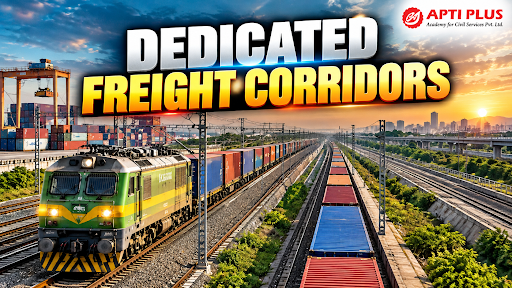
Dedicated Freight Corridors (DFCs) are high-capacity, high-speed rail networks built exclusively for freight transportation across major economic and industrial corridors.
-
Exclusive Tracks: Only freight and cargo trains run on these lines, stopping at goods terminals instead of passenger stations.
-
No Delays: Goods trains do not have to wait for passenger trains to pass, which makes travel much faster.
-
Lower Costs: Moving goods by these dedicated lines reduces overall logistics and transport costs.
Major Dedicated Freight Corridors
-
Eastern Dedicated Freight Corridor: Spans 1,337 km and connects Ludhiana in Punjab to Sonnagar in Bihar, strengthening the country’s mineral-industrial axis.
-
Western Dedicated Freight Corridor: Spans 1,506 km connecting Dadri in Uttar Pradesh to Jawaharlal Nehru Port (JNPT) in Navi Mumbai, Maharashtra.
-
Eastern Dedicated Freight Corridor Route: Originates at Ludhiana (Punjab), traverses the northern industrial plains, and terminates at Sonnagar (Bihar).
-
Western Dedicated Freight Corridor Route: Originates at Dadri (Uttar Pradesh), traverses Haryana, Rajasthan, and Gujarat, and terminates at JNPT (Navi Mumbai, Maharashtra).
Proposed New Freight Corridors: Detailed Project Reports (DPR) are under examination for three new routes:
-
East Coast Corridor (Kharagpur to Vijayawada)
-
East-West Corridor (Palghar-Bhusawal-Nagpur-Kharagpur-Dankuni and Rajkharsawan-Kalipahari-Andal)
-
North-South Corridor (Vijayawada-Nagpur-Itarsi)

Significance of DFCs for the Indian Economy
Complementary Economic Roles: The EDFC strengthens India's mineral-industrial axis, whereas the WDFC powers the manufacturing-export axis.
Logistics Cost Reduction: Moving long-haul cargo to rail yields major unit transport savings, as rail freight averages ₹1.96 per tonne-km compared to ₹11.03 per tonne-km for road transport—directly tackling national logistics costs estimated at 7.97% of GDP (₹24.01 lakh crore in 2023-24).
Enhanced Productivity & Supply Chain Efficiency: Supports longer, heavier, and double-stack container trains, cutting transit time between Dadri and JNPT from about 66 hours to 58 hours.
-
This results in lower working-capital needs, better inventory-to-sales ratios, reduced road congestion, lower emissions, higher factory utilization, and enhanced export reliability.
De-congesting Conventional Rail Tracks: Daily traffic on DFCs expanded from 247 trains a day in 2023-24 to 443 in August 2026. Diverting goods traffic releases capacity on conventional lines for passenger trains and additional freight services.
Sectoral Competitiveness: Directly benefits engineering, automobiles, auto components, textiles, apparel, chemicals, and petrochemicals across key manufacturing hubs in Haryana, Rajasthan, Gujarat, and Maharashtra.
Synergy with PM GatiShakti & Sagarmala: Boosts PM GatiShakti’s unified spatial master plan (22,000 data layers across 58 Central Ministries and 36 States/UTs) and integrates with Sagarmala’s 294 rail/road port connectivity projects and 14 industrial projects.
Key Challenges in DFC Implementation
Last-Mile & Terminal Linkage Bottlenecks: Weak links remain in last-mile connectivity, port evacuation, terminal capacity, warehousing, road interfaces, and customs processing.
Statutory & Financial Constraints during Network Expansion: Expanding new corridors requires navigating complex land acquisition, environmental clearances, capital financing structures, maintenance, and technological interoperability standards.
Transition from Trunk to Terminal Integration: Moving beyond basic trunk rail connections requires coordinated investments in port-rail integration, multimodal logistics parks, and industrial clusters.
Way Forward to Strengthen DFC Network
Eliminate Last-Mile Weak Links: Modernize warehousing, customs processing, road interfaces, and port evacuation infrastructure to match high-speed rail corridor performance.
Deepen Port-Rail Integration: Build dedicated links connecting the DFC network directly to major maritime gateways including Mundra, Kandla, Pipavav, Hazira, and upcoming projects like Vadhavan.
Develop Multimodal Logistics Parks & Feeder Routes: Leverage Bharatmala’s expressways and feeder corridors to seamlessly connect factories, warehouses, and ports with DFC terminals.
Accelerate Next-Phase Freight Corridors: Complete Detailed Project Report (DPR) examinations for the East Coast Corridor, East-West Corridor, and North-South Corridor, while prioritizing the 2,052-km Dankuni-Surat DFC to establish a second east-west freight spine.
Adopt Global Multimodal Best Practices: Draw lessons from global models like the EU TEN-T Rhine-Alpine Corridor, U.S. National Multimodal Freight Network, China's 2030 intermodal freight hub programme, and Singapore/Netherlands digital-twin and GIS spatial-planning systems.
Source: THEHINDU
|
PRACTICE QUESTION Q. Consider the following Statements:
Which of the assertions given above is/are correct? (a) 1 only (b) 2 only (c) Both 1 and 2 (d) Neither 1 nor 2 Answer: (a) Explanation: Statement 1 is correct: PM GatiShakti is a transformative, digital GIS-based National Master Plan (Geographic Information System) that integrates data layers across various Central Ministries and States/UTs to facilitate seamless, data-driven planning and implementation of multimodal connectivity infrastructure. Statement 2 is incorrect: The Sagarmala project focuses on port-led development across India's extensive coastline. It is not exclusive to inland waterways (which are primarily covered under the National Waterways projects and Jal Marg Vikas Project). Sagarmala explicitly includes rail port-connectivity infrastructure under its "Port Connectivity Enhancement" pillar to optimize the movement of cargo to and from hinterlands. |